If it was not seen during one visit, what else could explain that absence?
Food caches, shelter, timing, and the limits of a short observation.
LUNARA PROJECTS · WINTER WILDLIFE SCIENCE
Follow the evidence with Winter Survival Detectives
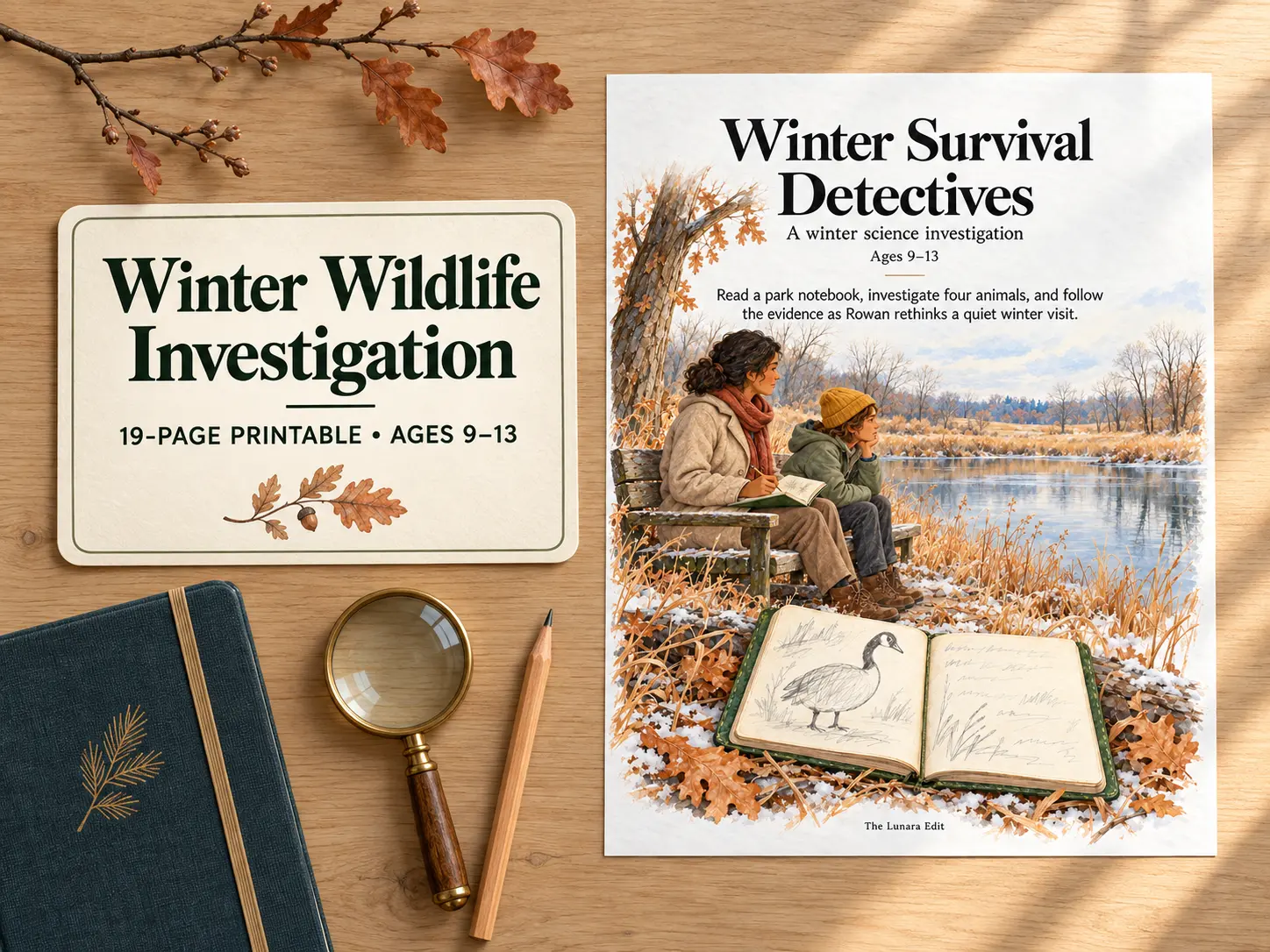
A story-led printable investigation for ages 9–13, built around one deceptively simple question: if an animal was not seen during a short winter visit, what can we actually conclude?
THE QUESTION UNDER THE SNOW
Winter makes absence feel like an answer. The pond is quiet, the branches look still, and a child can reasonably decide that the animals must have left, gone to sleep, or disappeared somewhere warmer. Those are useful first ideas. They are not all the same, and a brief visit cannot sort them out by itself.
Winter Survival Detectives begins in that uncertain space. Instead of asking learners to memorize one tidy list of animals that hibernate, migrate, or stay active, it asks them to notice what the park notebook establishes, compare it with species information, and revise an explanation when a second entry changes the evidence.
A NOTEBOOK STORY IN FIVE PARTS
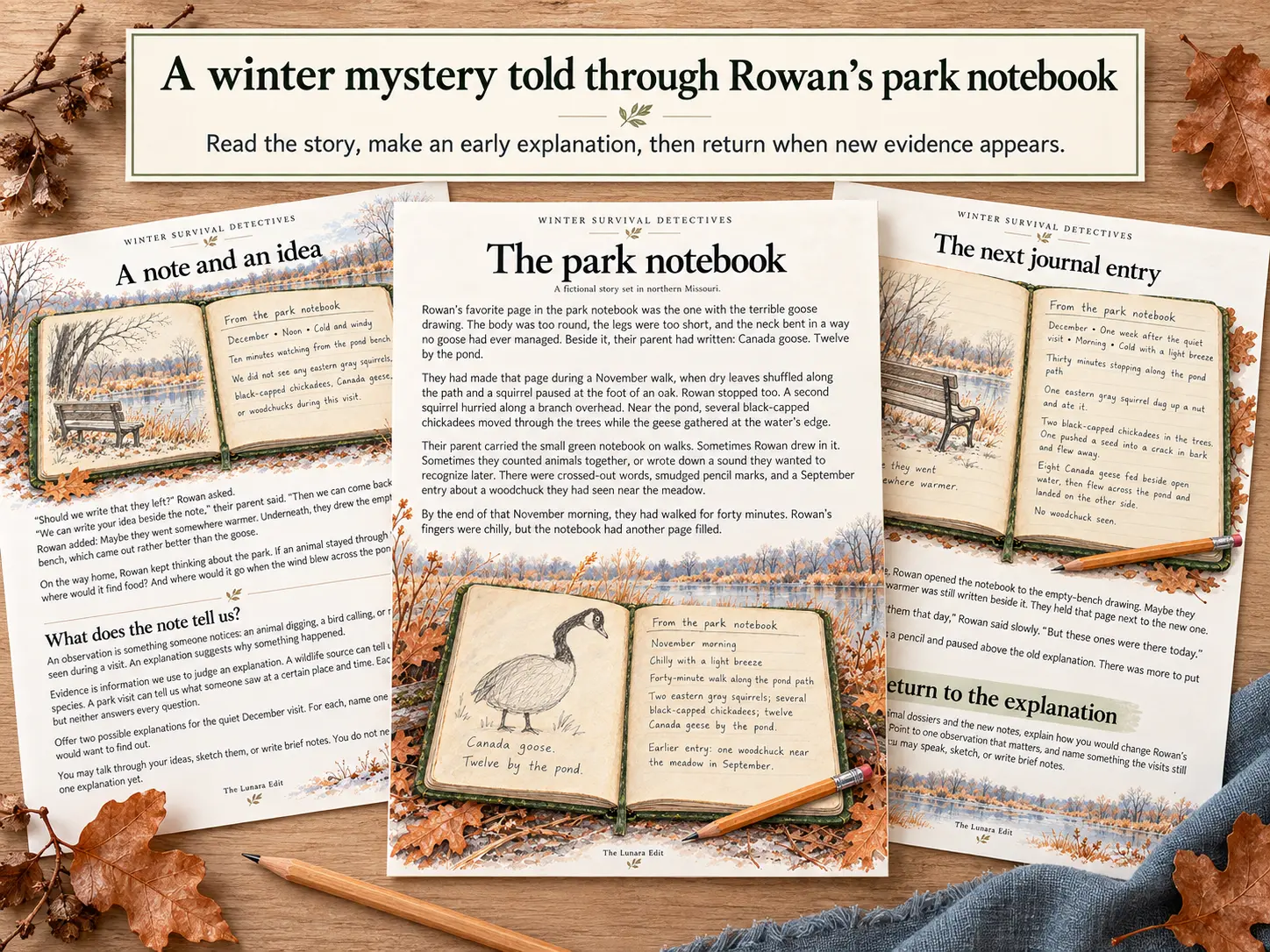
The investigation opens with a small shared notebook. Rowan and their parent have used it on earlier walks: sometimes Rowan draws, sometimes the parent writes a label, and sometimes they record a sound they want to recognize later. The pages already have crossed-out words, smudged pencil marks, and an older woodchuck note tucked among the newer sightings.
On a cold December visit they do not see any squirrels, chickadees, geese, or woodchucks. Rowan writes an explanation beside the empty-bench drawing. Later, a second visit adds a squirrel, two chickadees, and eight geese. The learner returns to the first explanation with more to work with—and with some questions still genuinely open.
The park, family, and notebook entries are fictional. Their purpose is to give the science a little life: the learner is helping a character rethink a real reasoning problem, not filling in disconnected boxes about winter animals.
FOUR CASES · FOUR DIFFERENT STRATEGIES
Food caches, shelter, timing, and the limits of a short observation.
A real hibernator whose winter behavior still cannot be confirmed from one glance.
Winter food, short movements, and the difference between seeing an action and explaining it.
Local movement, population differences, and the danger of making a large claim from a small moment.
SPECIES INFORMATION, USED CAREFULLY
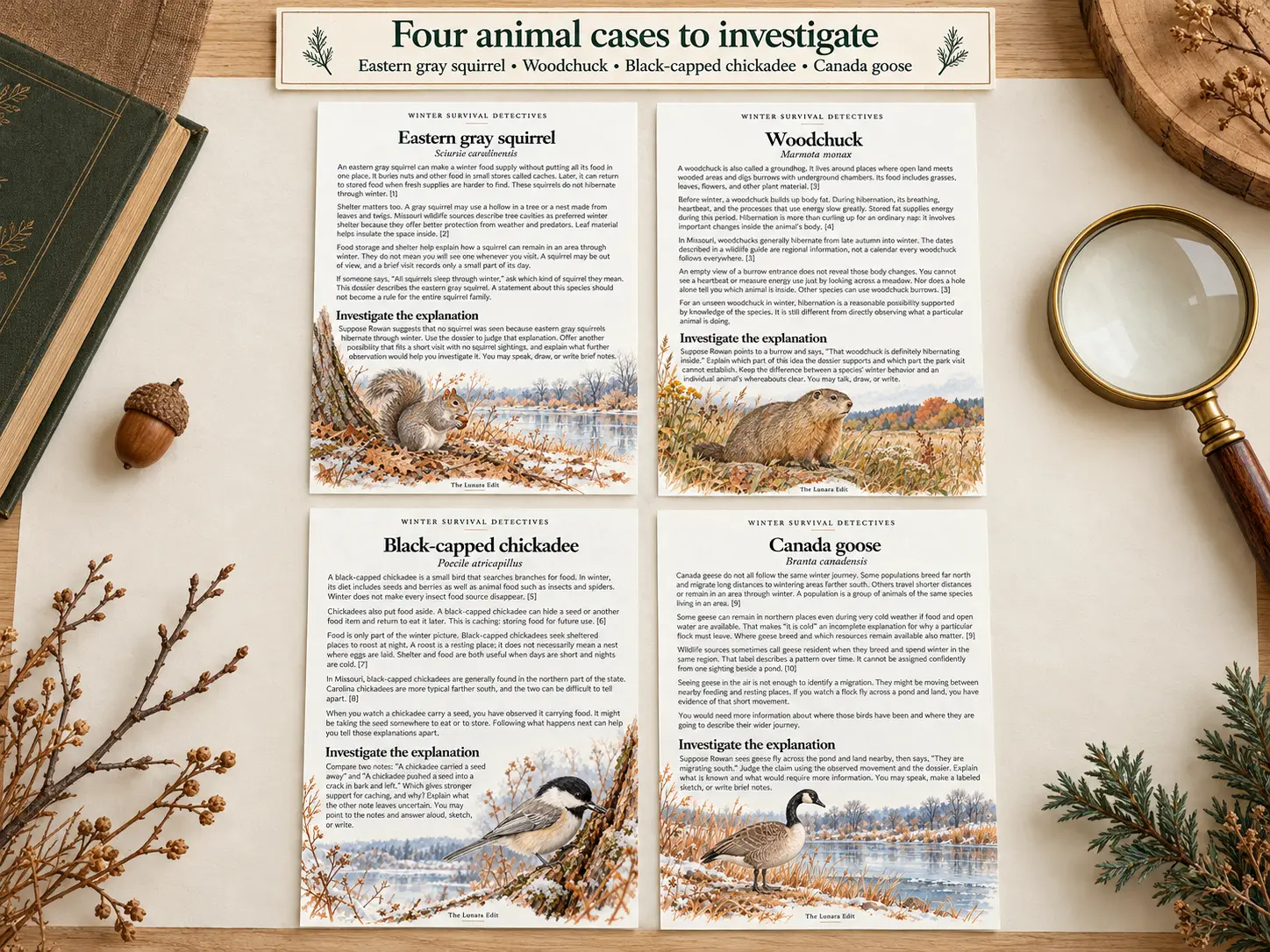
An eastern gray squirrel can rely on stored food and remain active through winter. A woodchuck is a true hibernator, but an unoccupied-looking burrow entrance does not prove what is happening inside. A black-capped chickadee stays busy finding winter food, while a Canada goose might belong to a population that migrates or one that spends the winter nearby.
The point is not to replace one oversimplified rule with four new ones. Each dossier keeps asking the learner to separate information about a species from evidence about one individual animal at one time and place. That distinction is small enough to miss and important enough to practice.
The wildlife content was checked against government and university sources, including the National Park Service, the Missouri Department of Conservation, the Cornell Lab of Ornithology, and Environment and Climate Change Canada. The final two pages of the PDF list all ten references.
FROM OBSERVATION TO EXPLANATION
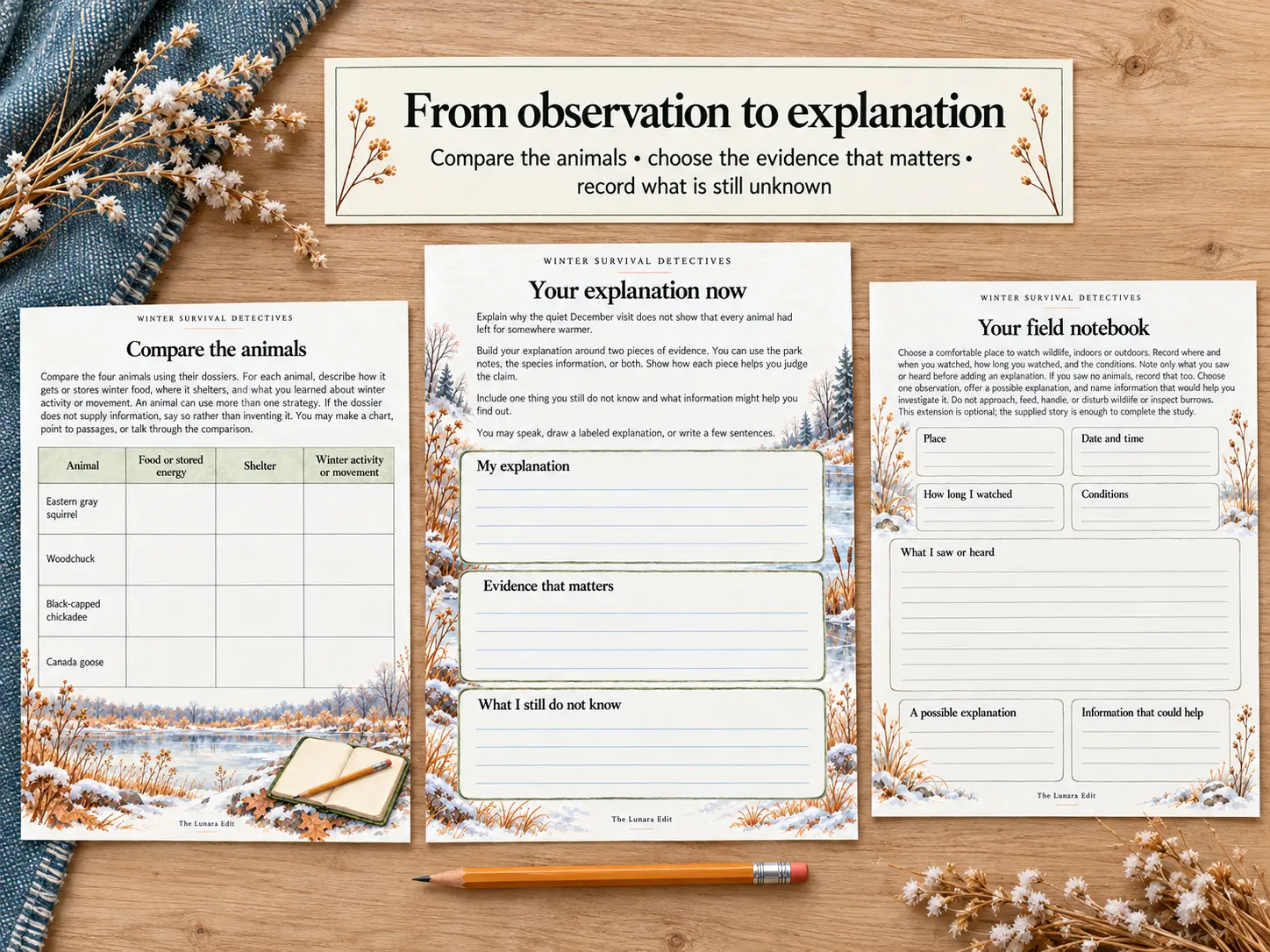
After the four cases, learners compare how each animal gets or stores food, finds shelter, and behaves or moves in winter. They use that comparison beside the two park entries, then explain why the quiet December visit does not show that every animal left for somewhere warmer.
A strong explanation here is not the longest one. It connects at least two relevant pieces of information to the claim and acknowledges a limit. The response can be spoken, drawn as a labeled explanation, or written in a few sentences. The science lives in the connection between claim and evidence, not in how much handwriting a child can produce that day.
An optional field-notebook page carries the same habit into a real observation. It asks what was actually seen or heard, what might explain it, and what information could help next. No park trip is required to complete the core investigation.
FOR THE ADULT NEARBY
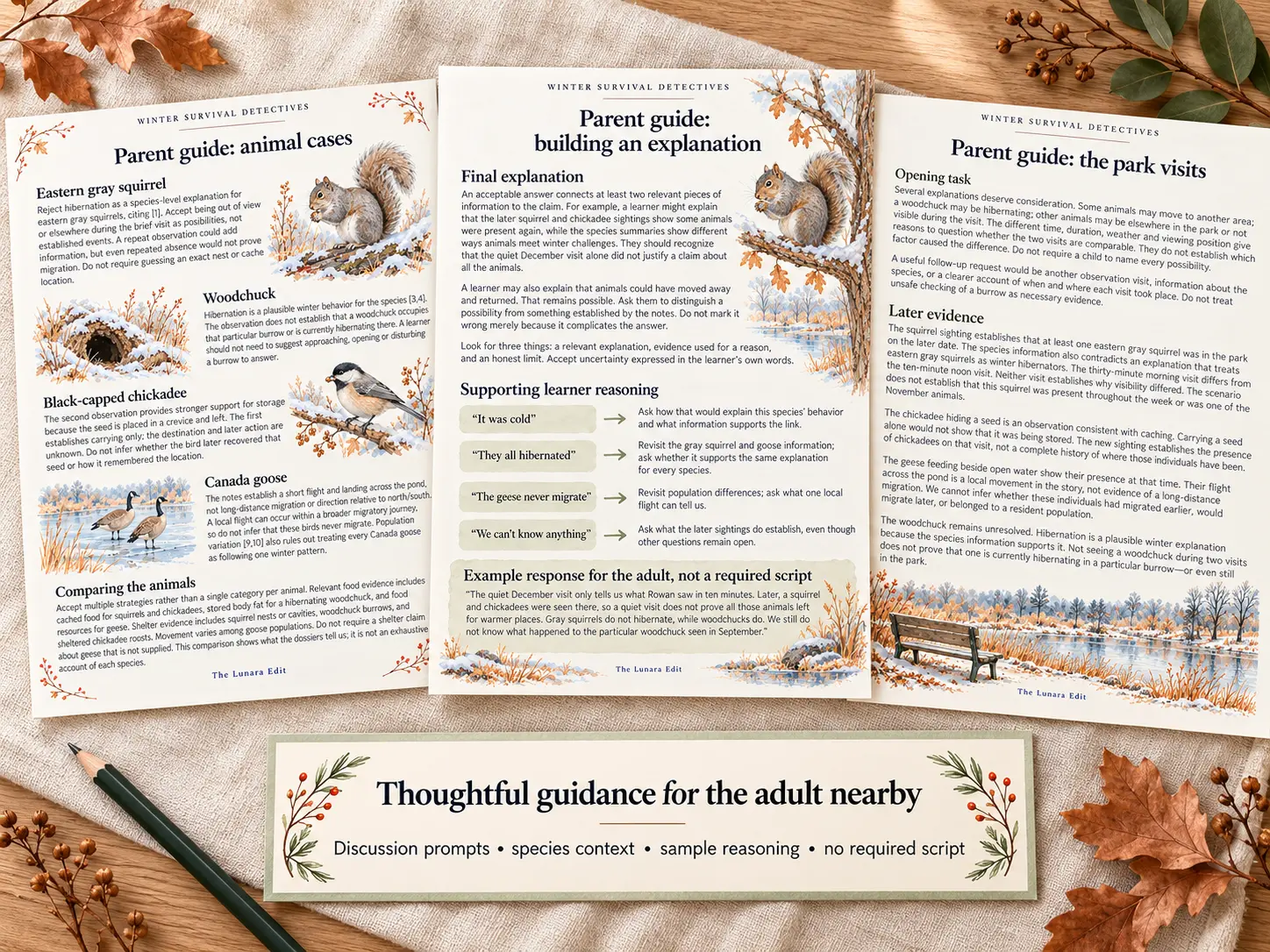
The parent guide explains what each observation does and does not establish, offers questions for common first answers, and includes an example response for the adult—not a required script for the child. If a learner says, “They all hibernated,” you can ask which species information supports that idea and where it stops fitting.
You can use the investigation in one longer sitting or across several short sessions: read the first notebook entry, pause after an early explanation, investigate one or two animals at a time, and return for the later evidence. The story remembers where you were.
WHAT’S IN THE DOWNLOAD
The purchase license covers one household or one homeschool co-op, learning pod, or group serving up to 30 children. The digital file itself may not be shared. Schools, multiple groups, and groups over 30 need an extended license.
WINTER SCIENCE · EVIDENCE · A SMALL FAMILY STORY
Winter Survival Detectives is available as an instant-download PDF on Etsy. Print the whole investigation or begin with the notebook story and see where the evidence takes you.
Get Winter Survival Detectives on Etsy (opens in a new tab)