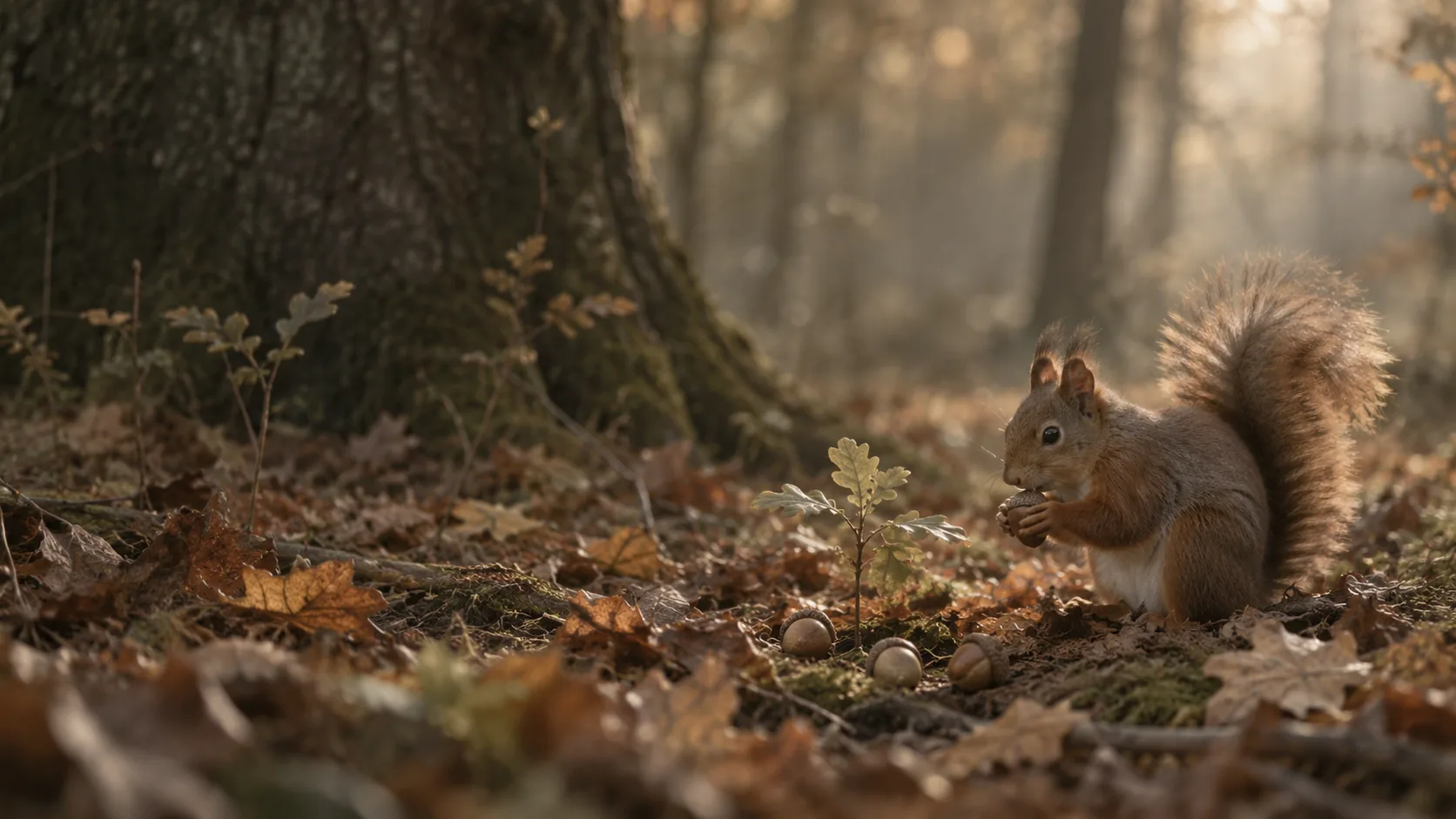
Watch a squirrel bury an acorn and it looks like a very small act of theft: nut acquired, hole dug, evidence concealed. But from the tree's point of view, something useful has just happened. Its seed has been picked up, carried away, and tucked into the ground.
Sometimes the squirrel comes back. Sometimes another animal finds the cache first. Sometimes the acorn is moved again. And sometimes it stays exactly where it was buried long enough to become an oak.
A pantry with hundreds of addresses
Some squirrels store food one hiding place at a time.
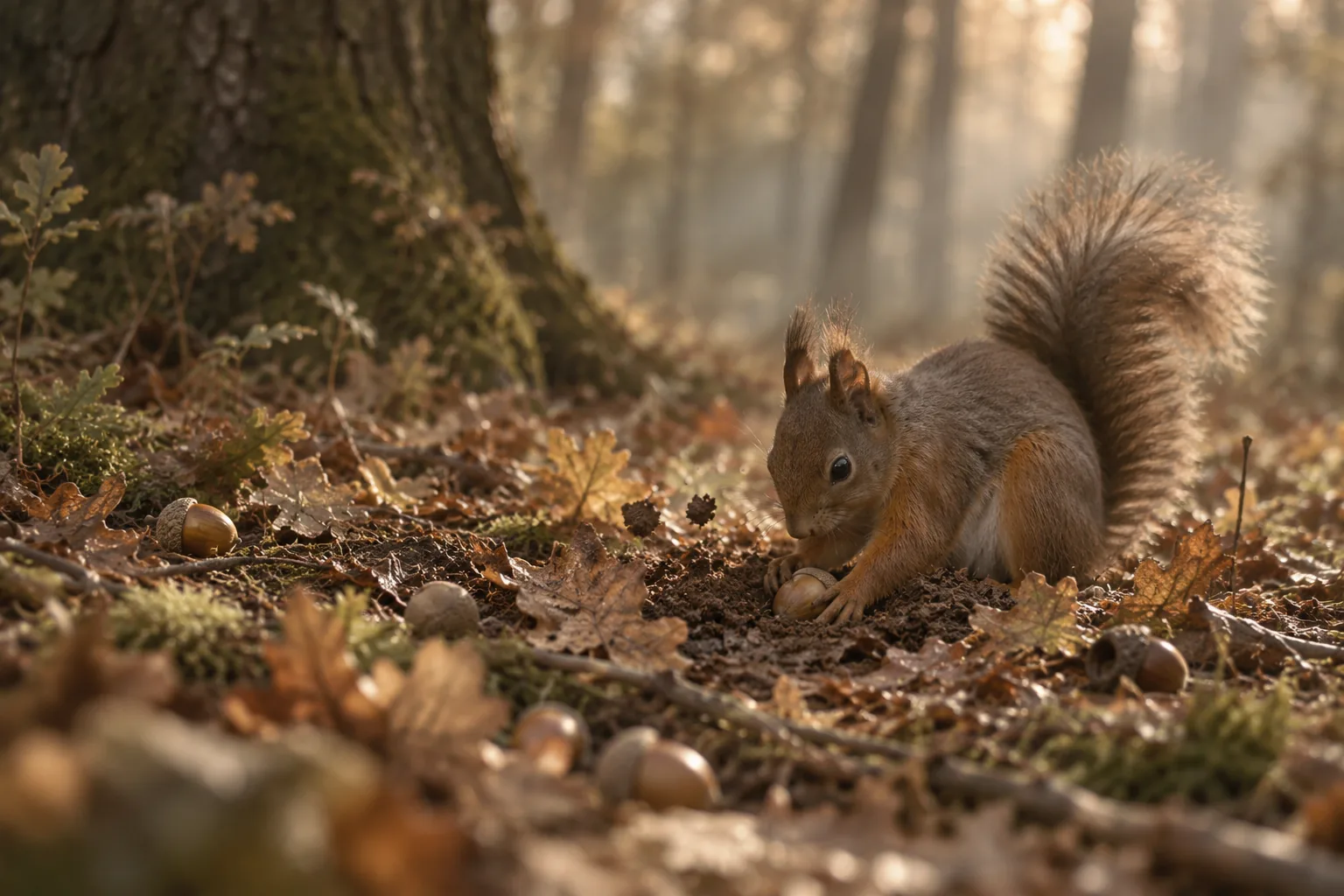
Gray squirrels and fox squirrels are classic scatter-hoarders. Instead of putting the whole autumn harvest in one nest or burrow, they spread individual nuts among many small caches. One acorn here. Another near a log. Another under leaves twenty steps away.
There is a practical reason for all that separation: a single discovered pantry can be emptied, but widely scattered caches are harder for a competitor to steal all at once. Eastern gray squirrels even change how they cache when another squirrel is watching. In field observations, they spaced caches farther apart and were more likely to bury food with their backs turned toward the audience.
So the squirrel carrying an acorn across the yard is not simply wandering. It is solving a storage problem in a landscape full of hungry neighbors.
The map is mostly in the squirrel
They remember more than the joke gives them credit for.
In a field experiment with gray squirrels, animals relocating buried food returned to within five centimeters of the target in 62.5 percent of attempts after a twenty-day delay. Researchers could still detect some memory after forty-three and sixty-two days.
Other work with fox squirrels suggests that the organization can be surprisingly sophisticated. When squirrels collected several kinds of nuts from one location, they tended to place different nut species in different parts of their caching area — a pattern researchers described as a kind of spatial "chunking."
Memory matters because a scatter-hoarder needs to solve two competing problems: hide food well enough that somebody else cannot find it, while still leaving itself enough clues to find the food later.
From winter food to seed dispersal
The acorns that stay buried are the interesting part.
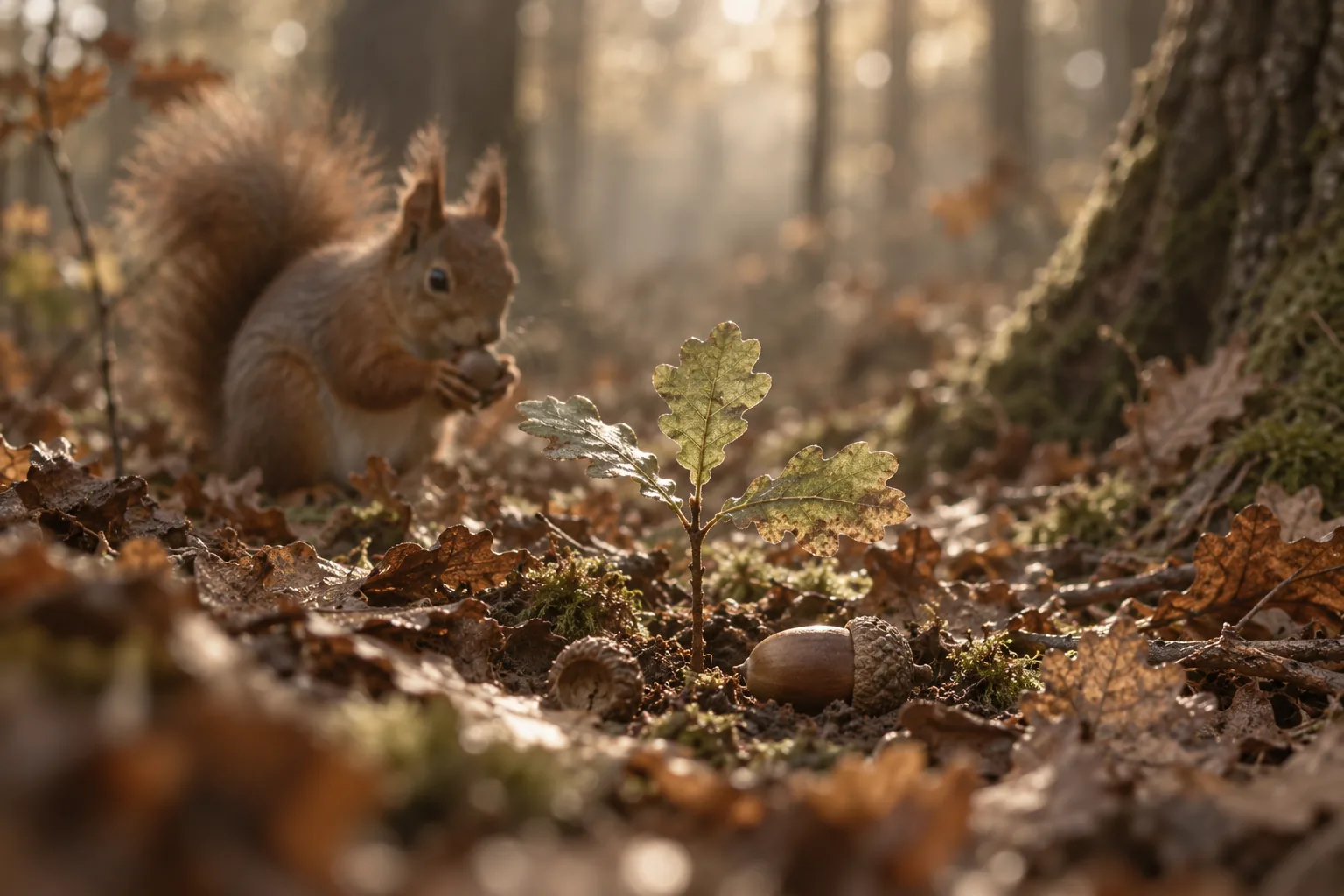
A seed beneath its parent tree has competition. There may be thousands of nearby seeds, hungry animals know where to look, and a young seedling will eventually compete with the adult tree above it for light and water. Carrying an acorn away changes those odds.
Scatter-hoarding rodents are therefore both seed predators and seed dispersers. They eat enormous numbers of seeds, but their caching also moves some seeds away from the parent tree and places them in or near soil. When an intact cache is not recovered, that burial can become a ready-made planting site.
The journey may not end with the first hole. Studies of acorn caching in eastern North American forests have documented re-caching: rodents recover a stored acorn and bury it somewhere else. That changes the seed's location again and can affect its chances of survival. In one eastern-forest study, re-caching was common, although the acorns did not consistently move farther from the original source with each new cache.
Not every acorn gets the same trip
Squirrels make choices about what is worth storing.
Nuts are not interchangeable little brown marbles. Squirrels respond to size, condition, species, germination, and the risk that a cache will be stolen. Those choices can affect which seeds get carried far from a tree and which are eaten immediately.
In a 2026 study of eastern fox squirrels in California oak woodlands, squirrels carried heavier acorns farther and tended to move non-infested acorns farther than insect-damaged ones. The same study found that the fate of an acorn changed with distance from tree trunks: acorns eaten completely tended to remain closer to the safety of trees, while some stored or partially handled acorns were moved farther away.
That is an important wrinkle in the story. The forest does not receive a random sample of whatever fell to the ground. Animal decisions help shape which seeds move, where they go, and whether they survive.
Helpful does not mean charitable
The squirrel and the oak are not trying to help each other.
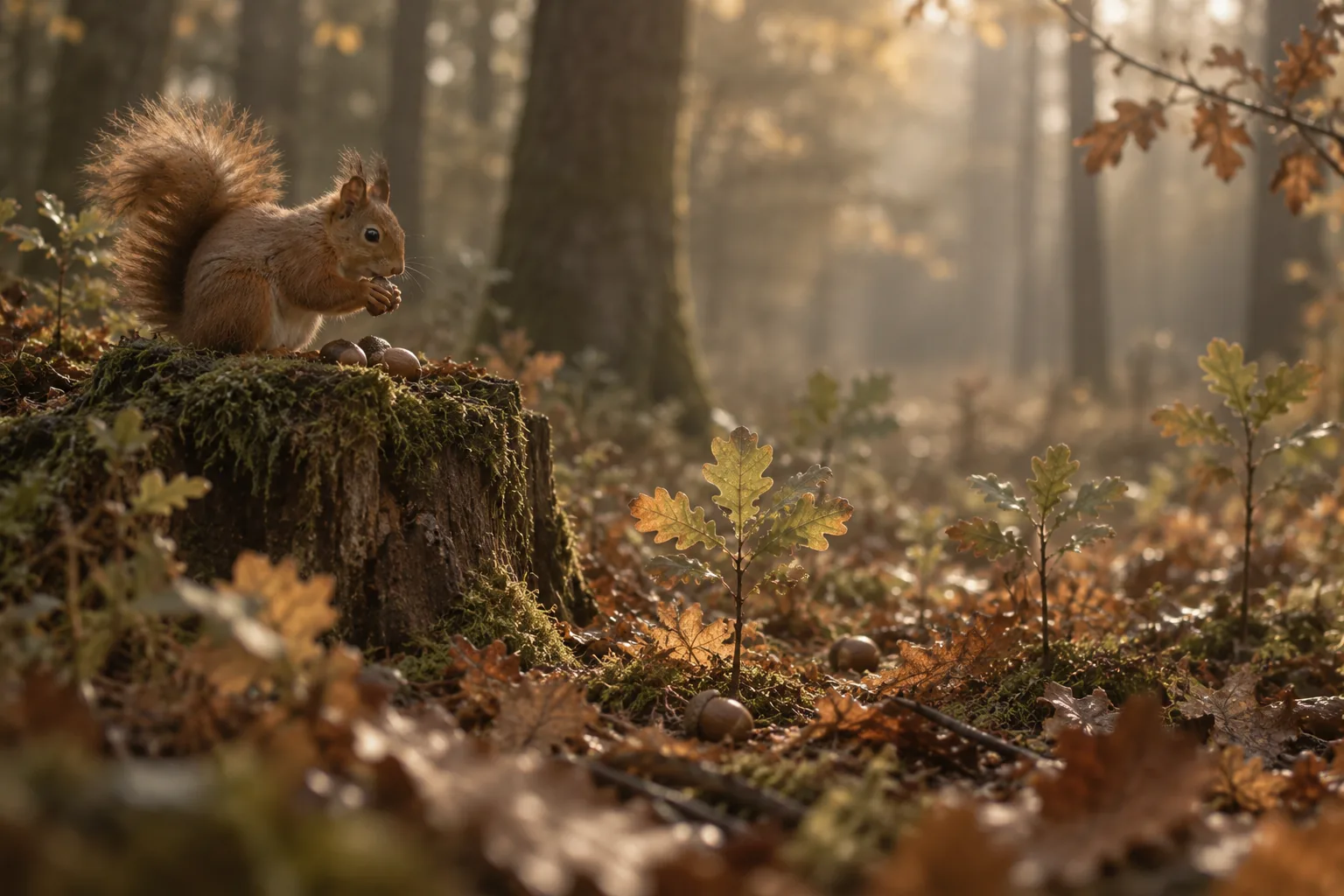
This relationship is sometimes described too sweetly, as though the oak offers lunch and the squirrel politely plants a few replacement trees. Nature is messier than that.
The squirrel wants calories. The oak wants a surviving seed. A squirrel may eat the acorn, lose it to another animal, move it several times, or cache it successfully. Some squirrels can even damage the growing part of an acorn in ways that keep it from germinating, making the seed better long-term food but worse at becoming a tree.
And yet the conflict produces a useful ecological side effect. The squirrel's need to store food moves seeds through the landscape. The tree's large, nutritious seed gives the squirrel something worth moving. Neither participant needs to understand the larger system for the larger system to emerge.
The next time one starts digging
You are watching a tiny decision with forest-sized consequences.
Most buried acorns will not become trees. Many will be eaten. Some will rot. Some will be stolen. Some will begin growing in places where a seedling cannot survive.
But a forest does not need every acorn to succeed. It needs enough of them to be carried, buried, overlooked, and lucky.
So the squirrel on the lawn is doing exactly what it thinks it is doing: saving dinner for later. It just happens to be participating in something much larger at the same time.
SHARE THIS WITH THE KIDS
The version you can actually repeat.
- Some squirrels are scatter-hoarders: instead of one giant pantry, they hide nuts in lots of separate places.
- Squirrels have good spatial memories and can remember many cache locations for weeks. They are not simply forgetting everything they bury.
- If an intact acorn stays buried and conditions are right, it may germinate. That makes caching one way seeds can move away from their parent tree.
- Squirrels sometimes dig up and re-bury nuts somewhere else, so one acorn can travel through several hiding places before its story is finished.
A FEW OF THE SOURCES BEHIND THIS PIECE
Read a little deeper
- Macdonald (1997), field experiments on gray and red squirrel spatial memory (opens in a new tab)
- Delgado & Jacobs (2017), spatial organization of fox-squirrel caches (opens in a new tab)
- Leaver et al. (2007), gray squirrels and strategies to reduce cache theft (opens in a new tab)
- Bartlow et al. (2018), re-caching of acorns and implications for oak regeneration (opens in a new tab)
- Puente-Ruiz et al. (2026), fox squirrels, acorn quality, dispersal, and oak recruitment (opens in a new tab)