LUNARA PROJECTS · SEASONAL COPYWORK
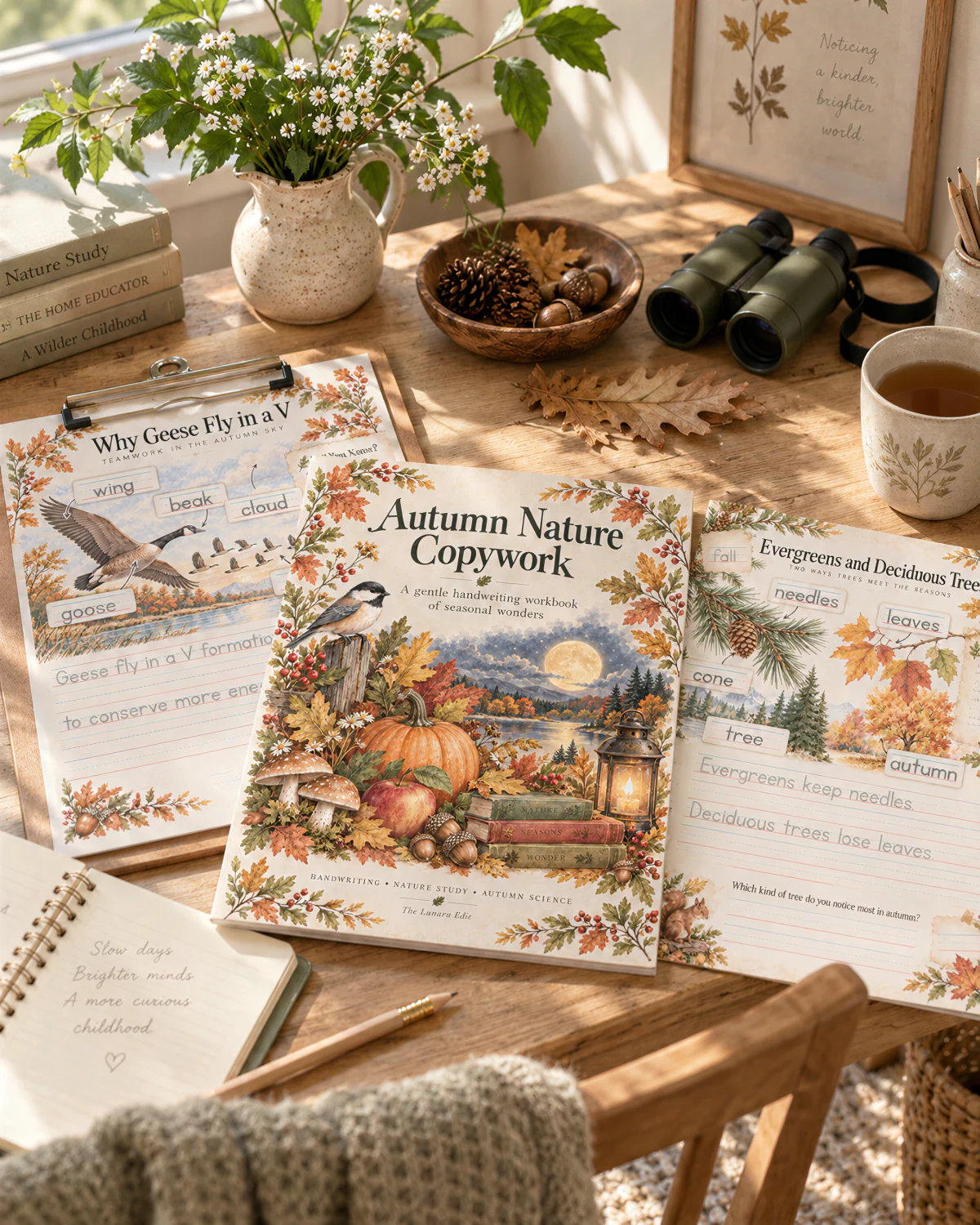
Autumn Nature Copywork
Ten small autumn wonders to trace, copy, and talk about
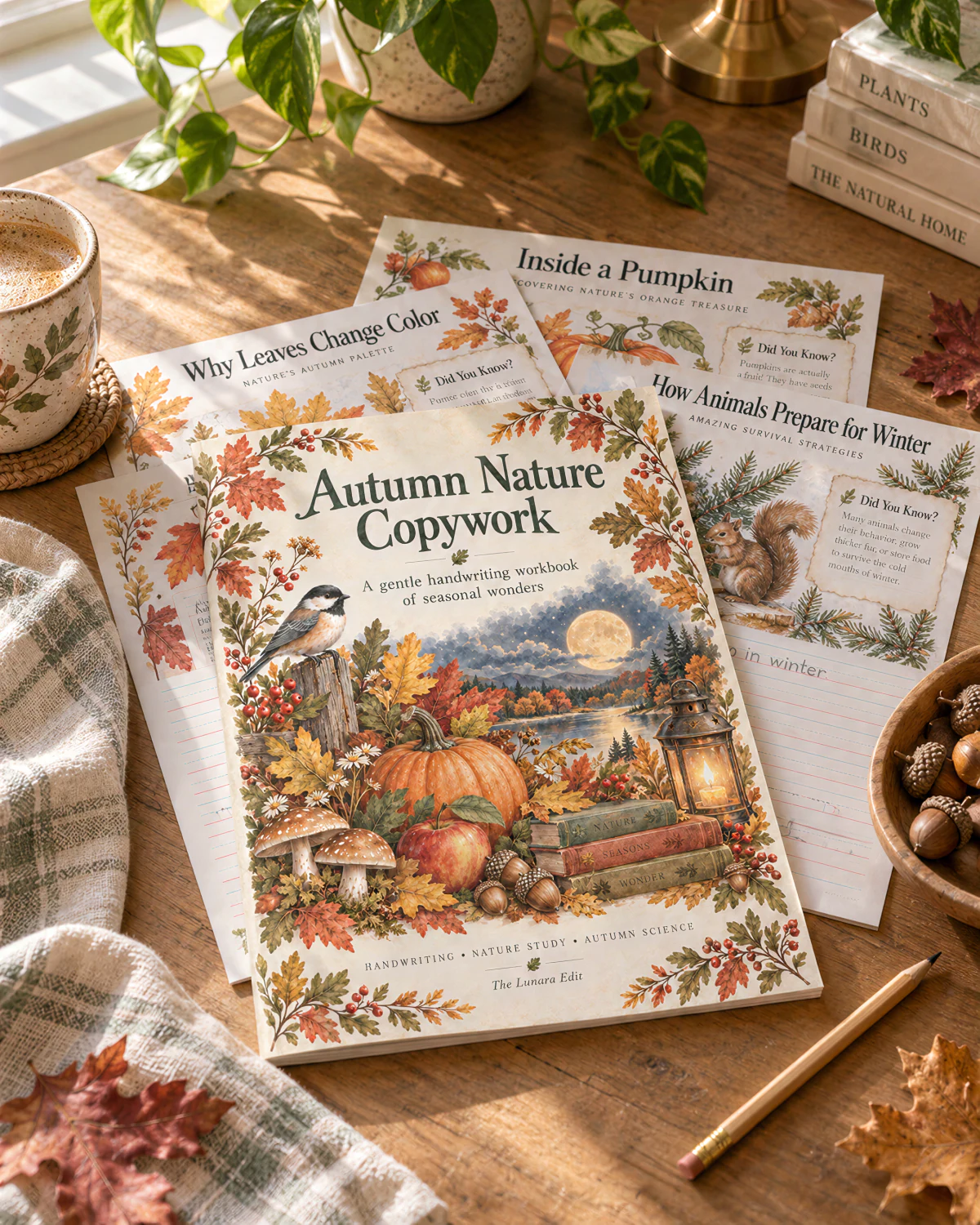
Why leaves change color, why geese fly in a V, and why an apple bobs instead of sinking. A gentle handwriting workbook that gives your child something worth writing about while they practice their letters.
WHY COPYWORK
Handwriting practice goes down easier with a squirrel in it.
Copywork is the plainest idea in homeschooling: a child copies a good sentence by hand. That’s it. Because the words are already written, all of their attention can go to forming each letter, spacing the words, and noticing the capital at the start and the period at the end. Spelling and punctuation sink in along the way, without anyone having to announce a spelling lesson.
The catch is that the sentences are usually dull. Nobody gets excited about copying “The cat sat on the mat” for the fourth time. So every sentence in this workbook is a small true thing about autumn, and it comes with a picture and a Did You Know? note that explains it. By the time your child writes “Acorns are oak tree seeds,” they know why that matters. Some of them will then tell you about it at dinner.
TEN LESSONS · ONE SENTENCE EACH
Pick whichever wonder is outside your window.
Why Leaves Change Color
“Autumn days grow shorter and green leaves change color.”
Inside a Pumpkin
“Pumpkins grow on vines, with seeds tucked inside.”
How Animals Prepare for Winter
“Some animals store food. Other animals sleep or migrate.”
Why Apples Float
“Tiny air pockets inside help apples bob and float.”
The Harvest Moon
“The bright Harvest Moon rises near the autumn equinox.”
Acorns and Oak Trees
“Acorns are oak tree seeds that can grow new trees.”
Mushrooms in Autumn
“Mushrooms often appear in cool, damp places.”
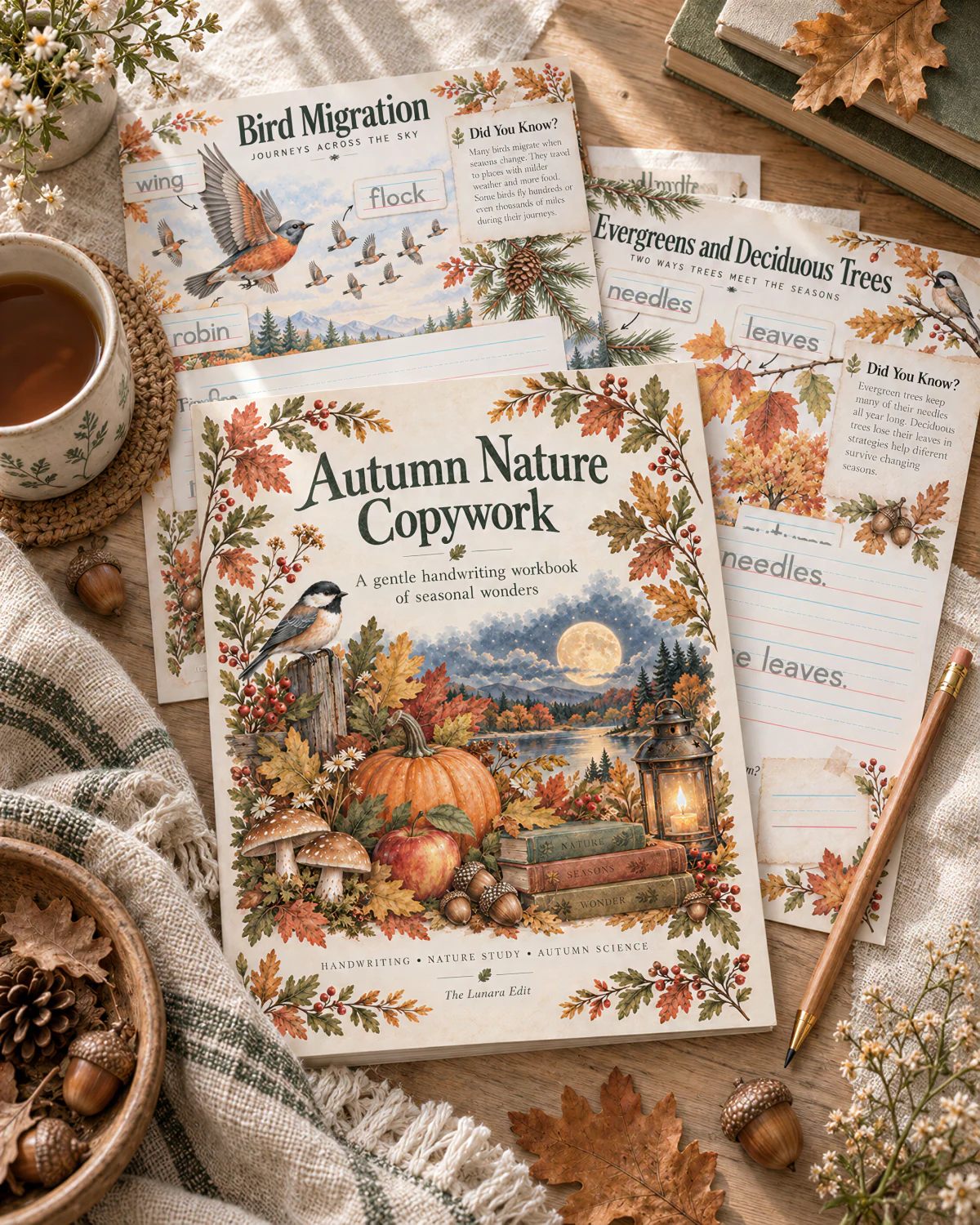
Bird Migration
“Birds migrate in autumn to find food and warmth.”
Evergreens and Deciduous Trees
“Evergreens keep needles. Deciduous trees lose leaves.”
Why Geese Fly in a V
“Geese fly in a V formation to conserve more energy.”
The tree lesson uses needle-bearing evergreens as its example; some evergreens have broad leaves. The lessons don’t build on each other, so there’s no need to go in order. Save the geese for the day you hear them honking overhead.
HOW A PAGE WORKS
Look, trace, copy, answer, talk.
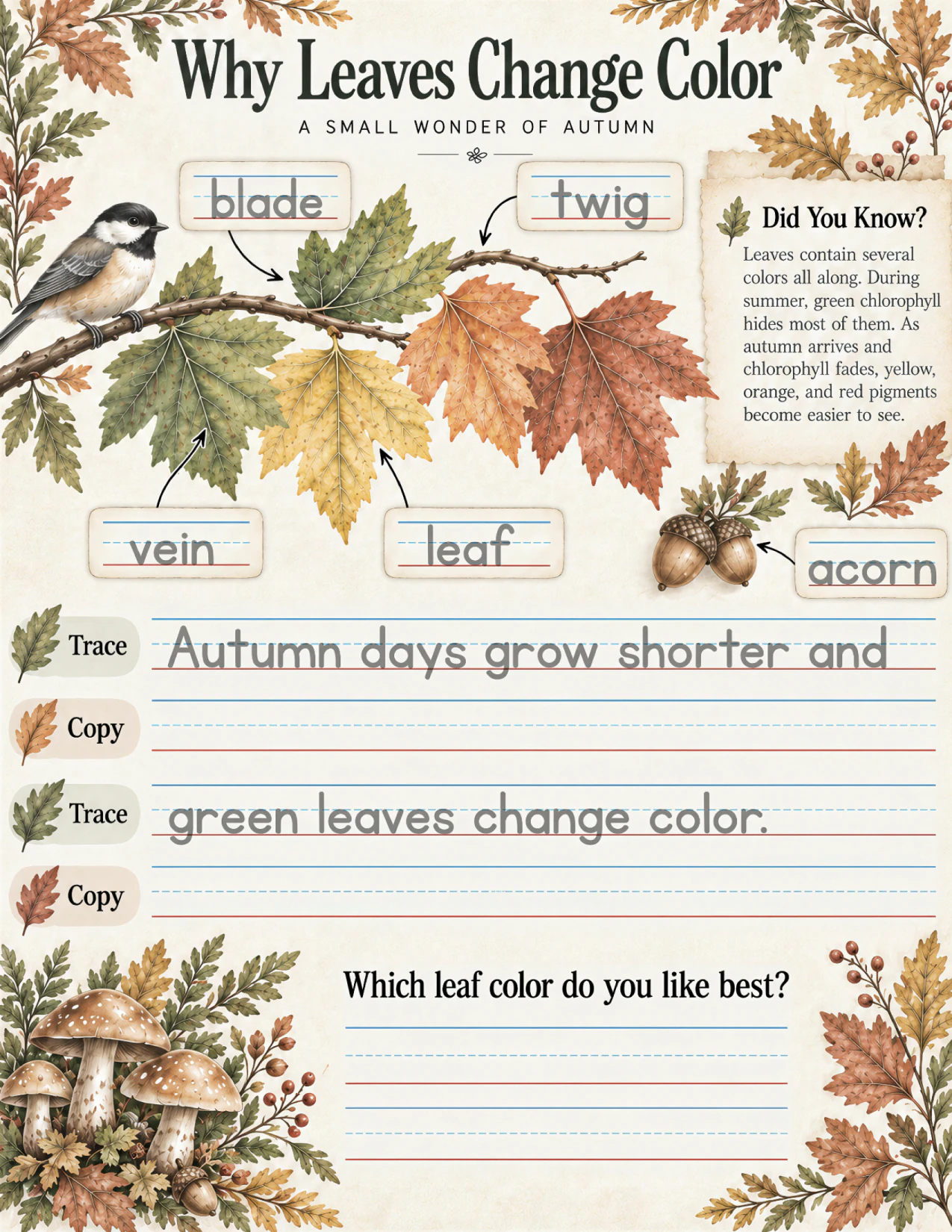
Every lesson page follows the same five steps. First, your child reads the picture labels: blade, twig, vein, leaf, and acorn on the leaves page. Each label has an arrow to the thing it names, so new words arrive attached to a picture. Then they trace each gray line and copy it on the blank line immediately below. The sentence spans two lines; each part gets traced and copied once.
Tracing first matters more than it looks. It lets a child feel each letter’s shape before they have to produce it from memory, and the copy line right underneath asks them to do exactly that while the shape is still fresh. The letters are simple manuscript print, the same as the handwriting reference page at the front of the book, including the difference between a capital I and the number 1.
The last two steps don’t involve a pencil at all, at least not necessarily. Each page ends with an open question, like “Which leaf color do you like best?” Some kids will write a whole sentence. Some will write one word, or tell you the answer while you write it down, or argue for red at length. All of that counts. The how-to page says it plainly: open-ended answers don’t need perfect spelling, and short responses are fine.
Each page is one short sitting. One a day is plenty; young hands do their best writing in small doses anyway.
TAKE IT OUTSIDE
Let the walk come first.
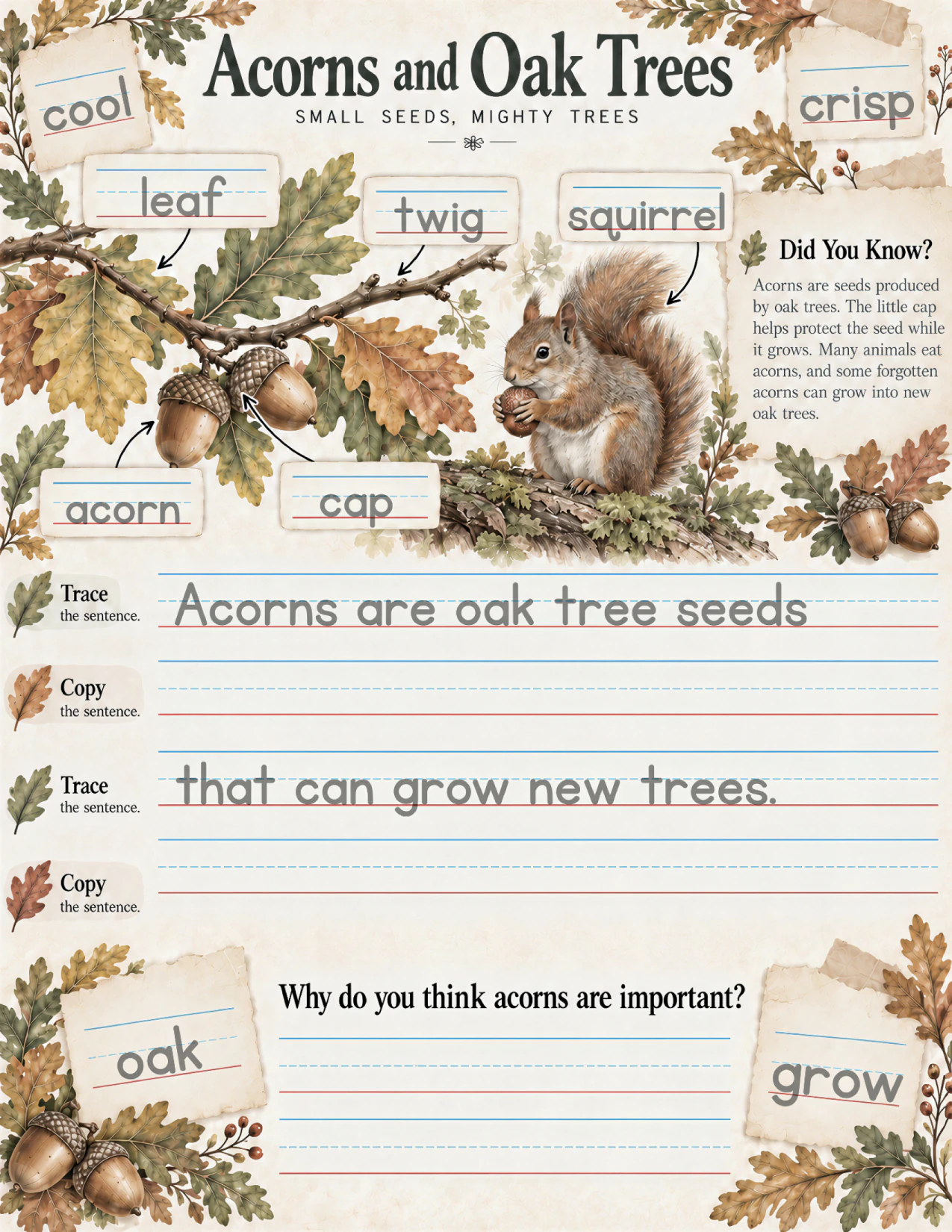
The workbook works perfectly well at the kitchen table, but it’s even better after a walk. Collect a few acorns before the Acorns and Oak Trees page, and the labels (cap, acorn, twig) stop being words and turn into the thing in your child’s pocket. If they want to know what happens to all those acorns, squirrels have a surprisingly big part in it; we wrote about how squirrels plant forests.
A few pages have natural partners outside. Look for a V of geese on a cold, clear morning. Float an apple in a bowl of water before the Why Apples Float page, and let your child test their own answer to the question at the bottom: “What other foods do you think might float?” Walk past a mix of trees and count which ones are keeping their needles.
For the mushroom page, look without touching. Plenty of wild mushrooms are poisonous and the safe ones are hard to tell apart, so this one is for noticing caps, gills, and moss, not collecting. And the Harvest Moon is the full moon nearest the autumn equinox, so it usually falls in September. Any bright autumn full moon will do for the question “What would you like to notice under the Harvest Moon?”
WHO IT’S FOR
Emerging writers, and anyone still polishing.
It’s written for the early elementary years, roughly ages four to seven, but handwriting doesn’t follow an age chart. Plenty of older kids are still working on their letters, and the sentences are interesting enough that an eight- or ten-year-old won’t feel talked down to.
For younger children, trace only and skip the copy lines until they’re ready. Let them dictate their answer to the question while you write. For older or more confident writers, try copying the whole sentence from memory after one look, or writing the copy lines in cursive. They could also answer the question in a full sentence and add a fact of their own from the Did You Know? box.
Neatness grows with practice, and a wobbly page from a child who loved the geese is a good page.
WHAT’S IN THE DOWNLOAD
One small book of autumn wonders.
- 13-page printable PDF, including the cover
- How to Use This Copybook page for parents and teachers
- Manuscript handwriting reference: A–Z, a–z, digits, and punctuation
- Ten illustrated nature lessons, each with five picture labels
- A Did You Know? note on every lesson page
- Two sentence lines to trace and two to copy on each page
- An open-ended question to answer and talk about
- US Letter pages; lovely in color, fine in black and white
- Instant digital download through Etsy
This is a digital PDF, not a physical book. Print at 100% or Actual Size so the writing lines stay the right height.
HANDWRITING · NATURE STUDY · AUTUMN SCIENCE
A few quiet minutes, a sentence at a time.
Print one page for today or the whole book for the season. Either way, it’s ready for the next time someone asks why the leaves are turning.
Get the PDF on Etsy (opens in a new tab)