A child can have plenty to say about a squirrel and very little patience for writing a sentence about one. That gives you two questions to work with: what do they understand, and what part of putting it on paper is difficult?
Nature copywork gives a learner a sentence to practice by hand, attached to something they can look at, discuss, or investigate. This guide explains how to use it in a short homeschool session, how to choose between tracing and copying, and how to adjust the task when writing becomes the hardest part.
Decide what you are practicing today
Copywork means copying a supplied word, sentence, or passage. The child does not have to invent the wording while also working out how to put the letters on the page.
That can make a useful practice task, but it still asks the learner to do several things. They may be looking between the model and the writing line, finding their place again, forming letters, managing spacing, and holding a pencil comfortably.
East Cheshire NHS occupational therapy guidance describes handwriting as a complex skill involving perception, movement planning, pencil control, and positioning. It recommends beginning with short bursts of activity and topics that interest the child.
Choose one focus for the session. You might practice forming a particular letter, leaving space between words, or copying a short phrase while keeping track of your place. Explain that focus before the pencil comes out.
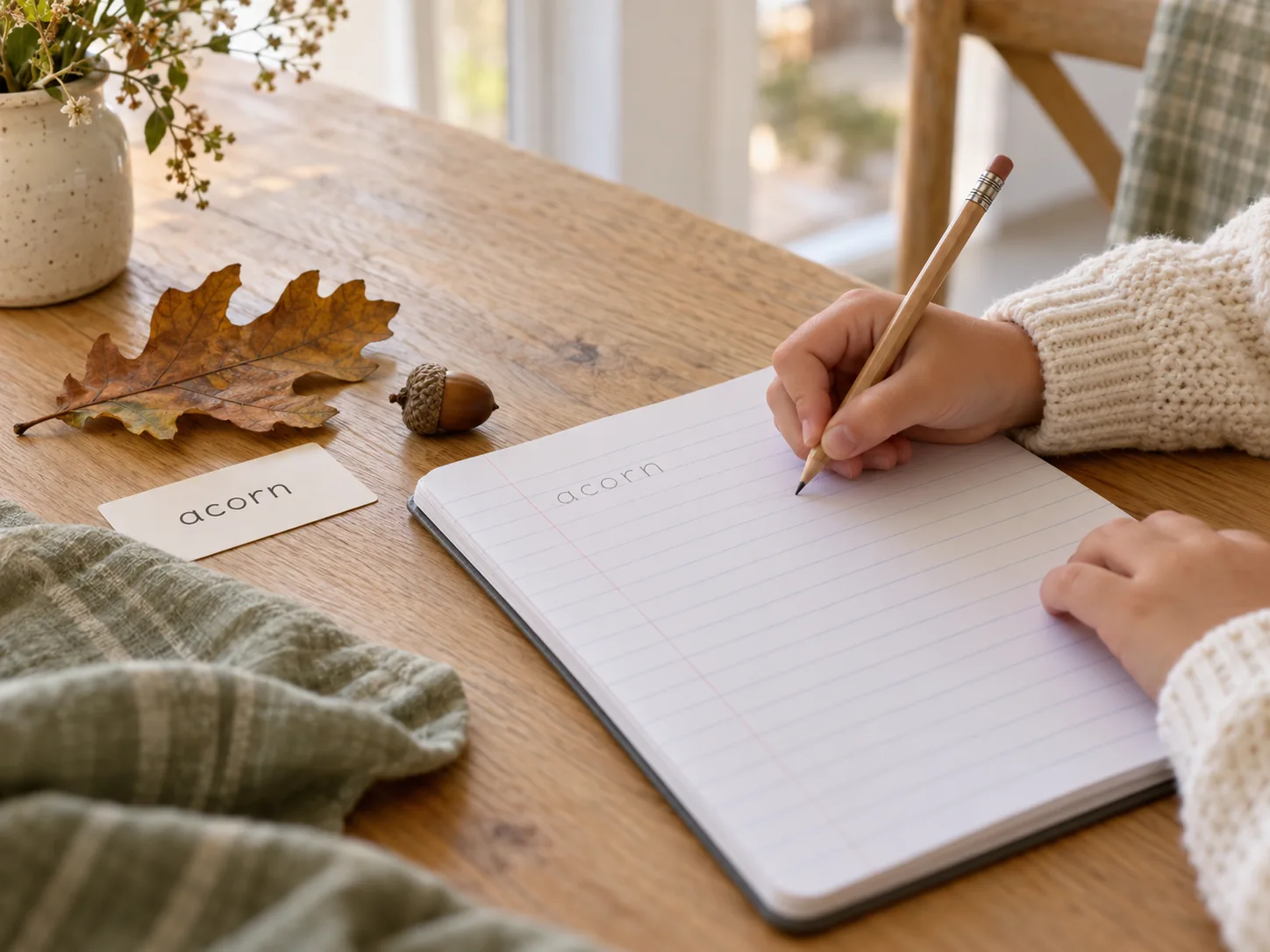
If your main question is whether your child understands what an acorn is, you can ask them to tell you. A handwritten answer adds a different demand.
Let the subject become familiar first
Start with something the learner has noticed. An acorn collected on a walk, geese heard overhead, or a pumpkin opened at the kitchen table gives the sentence a reason to be there.
Read the sentence together before asking for writing. If the child is still learning to read, read it aloud yourself. Talk through unfamiliar vocabulary and invite them to point to the relevant picture or object.
For an acorn lesson, you could look at the cap and seed, then ask what the child thinks might happen to an acorn left on the ground. The How Squirrels Plant Forests article offers a way to continue that question.
You can have this conversation on a day when you do no copywork at all. It gives you something to return to when the learner is ready to write.
Choose between tracing and copying
Tracing provides a visible path for the pencil. Copying asks the learner to produce the letters while referring to a model. They are related tasks, and a child may find one much easier than the other.
For a learner beginning a page, try this sequence:
- Read and discuss the sentence.
- Choose a manageable section to trace or copy.
- Name the one thing you are practicing.
- Review that feature together and finish.
The manageable section could be a word, part of a sentence, or the whole sentence. Those are options for adapting the activity, rather than a fixed sequence every child must complete.
If tracing is comfortable and copying brings everything to a halt, look more closely at the copying step. Is the learner losing their place? Unsure how to start a letter without a path? Tired by the time they reach the next line? Their answer helps you choose what to adjust.
A handwriting reference can provide a model when a letter is unfamiliar. If your child needs instruction in how to form a letter, demonstrate it and practice that small part; repeatedly copying a whole sentence may leave the same difficulty unresolved.
Give the session a visible finish
“We will practice the first three words, then talk about the picture” is a clearer task than “Work on your handwriting.”
Agree on a small amount before beginning. You might choose one word, one line, or another amount that has been comfortable recently. The first attempt tells you whether the task was a good fit.
If the learner finishes with capacity left, they can choose to continue. If the agreed amount is already difficult, make the next session smaller or change the support. A child does not need to complete every space on a printable for you to learn something from using it.
Keep the page at its intended print size. Shrinking a workbook to fit two pages on one sheet also shrinks the writing lines, which changes the task.
Let the response to the question be spoken
A nature-copywork page may also ask a question about the subject. Decide whether you want an explanation or more handwriting practice.
If you want the explanation, the child can speak while you write, record a short voice note, or draw and describe a picture. Kent Community Health occupational therapy guidance includes alternatives using assistive technology when handwriting or communication is challenging.
For example, a learner might carefully copy one word and then give a detailed spoken account of where squirrels hide food. You can preserve that explanation without asking their hand to do all the work of recording it.
Check the difficulty before adding more practice
Ask a specific question when the task starts to unravel: “Is your hand tired?” “Are you finding your place?” “Do you know which way this letter starts?”
Oxford Health handwriting guidance suggests checking comfortable seating and the writing tool, offering breaks, and allowing more time when children experience hand pain or fatigue.
Pause if writing hurts. Repeated discomfort or persistent difficulty is a reason to discuss the problem with a qualified professional who can help investigate it. A practice page cannot tell you why the difficulty is happening.
For ordinary frustration, you can also check the task itself. Perhaps the sentence is too long for today, the model is hard to see, or you are asking for neatness, spelling, and a full written answer all at once. Choose the part you meant to practice and reduce the rest.
Give feedback on the agreed focus
If today’s focus was spacing, look at spacing. You can point to an example the child can see: “There is room between these two words.”
Then choose one small thing to revisit, if needed. “Let’s try the starting point of this letter together” gives more information than “Write neatly.”
Keep the practice record simple. A note such as “Copied two words with a nearby model; tired after that” may help you plan the next session better than a judgment about whether the whole page was good.
Use Autumn Nature Copywork when the format fits
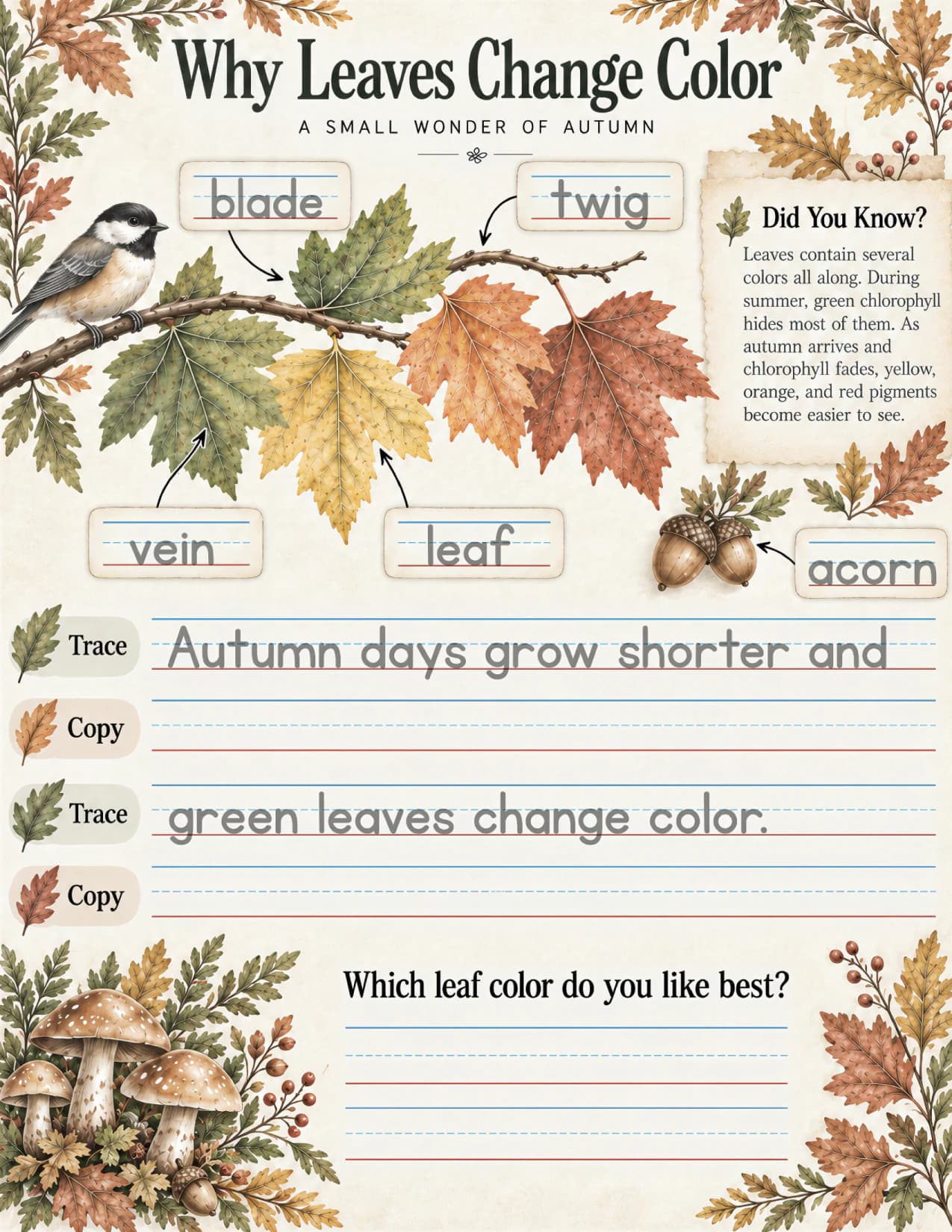
Autumn Nature Copywork is a 13-page printable with ten illustrated nature lessons and manuscript tracing and copying. It is designed for emerging writers, roughly ages 4–7 and up, with subjects that can also interest older children practicing their letters.
Choose a lesson connected to something your learner has noticed, then adapt the amount of writing to the task you want to practice. You can discuss the picture, use part of the writing section, and answer the question aloud.
The pumpkin nature study provides an activity to pair with the pumpkin lesson. For the broader approach, How to Use Seasonal Learning Without Turning It Into More School explains how to follow a seasonal question without making every discovery an assignment.
Let the next session begin with what you noticed in this one: the subject that caught their attention, the amount they could manage, and the support that helped.
Sources
- East Cheshire NHS Trust — Children’s Occupational Therapy: handwriting demands, short activities, and topics of interest.
- Oxford Health — Handwriting: comfort, pain or fatigue, breaks, and additional time.
- Kent Community Health — Pre-writing and Writing: alternatives using assistive technology.