
Your child is halfway through a drawing when the dog starts barking outside. Their pencil pauses, their head turns, and suddenly the dog has become the most interesting thing in the room. A few minutes later, you might do exactly the same thing when your phone buzzes beside your coffee.
We often talk about attention when we want someone to get back to what they were doing. But there’s an interesting question to ask before that: what caught their attention in the first place? A sound, a movement, or something they were waiting for can pull their focus even when they still want to finish the drawing.
Children can explore that question through ordinary moments at home. They don’t need their own phone, and you don’t have to arrange a room full of distractions. A familiar activity, a pencil, and a little curiosity are enough to begin.
Why some things are harder to ignore
Attention helps us select some of the information around us for closer processing. What we’re trying to do matters, but so does what stands out—and what we’ve learned to look for. Researchers study these influences together because attention doesn’t follow a simple rule such as ‘the loudest thing always wins.’ [1]
At home, you can start with examples children recognize. A timer might stand out because it makes a sudden sound. A quiet knock might matter because a friend is expected. Someone moving past the window may be interesting because your child wants to know who it is. These are possible explanations to discuss, rather than a set of answers you need them to memorize.
Ask, ‘Which one do you think you’d notice first?’ Then listen to their reason. One child might keep reading through the dog barking, while another would look up immediately. The difference gives you something to talk about.

Noticing something and responding to it are different
A useful distinction is whether something caught your attention and whether you acted on it. You might hear your phone, wonder who sent the message, and carry on reading. You didn’t open the message, but the alert still entered your awareness.
In a 2015 laboratory study with adult participants, phone notifications disrupted performance on an attention task even when participants didn’t interact with the phone. That finding helps explain why ‘I never picked it up’ doesn’t necessarily mean ‘it never interrupted me.’ The study wasn’t a test of children’s learning at home, so we shouldn’t assume the same effect for every child or activity. [2]
For a child, try asking, ‘Did you notice it? Did you decide to do anything about it?’ Those two questions make room for a more precise answer than simply calling the whole moment a distraction.
Try a ten-minute attention observation
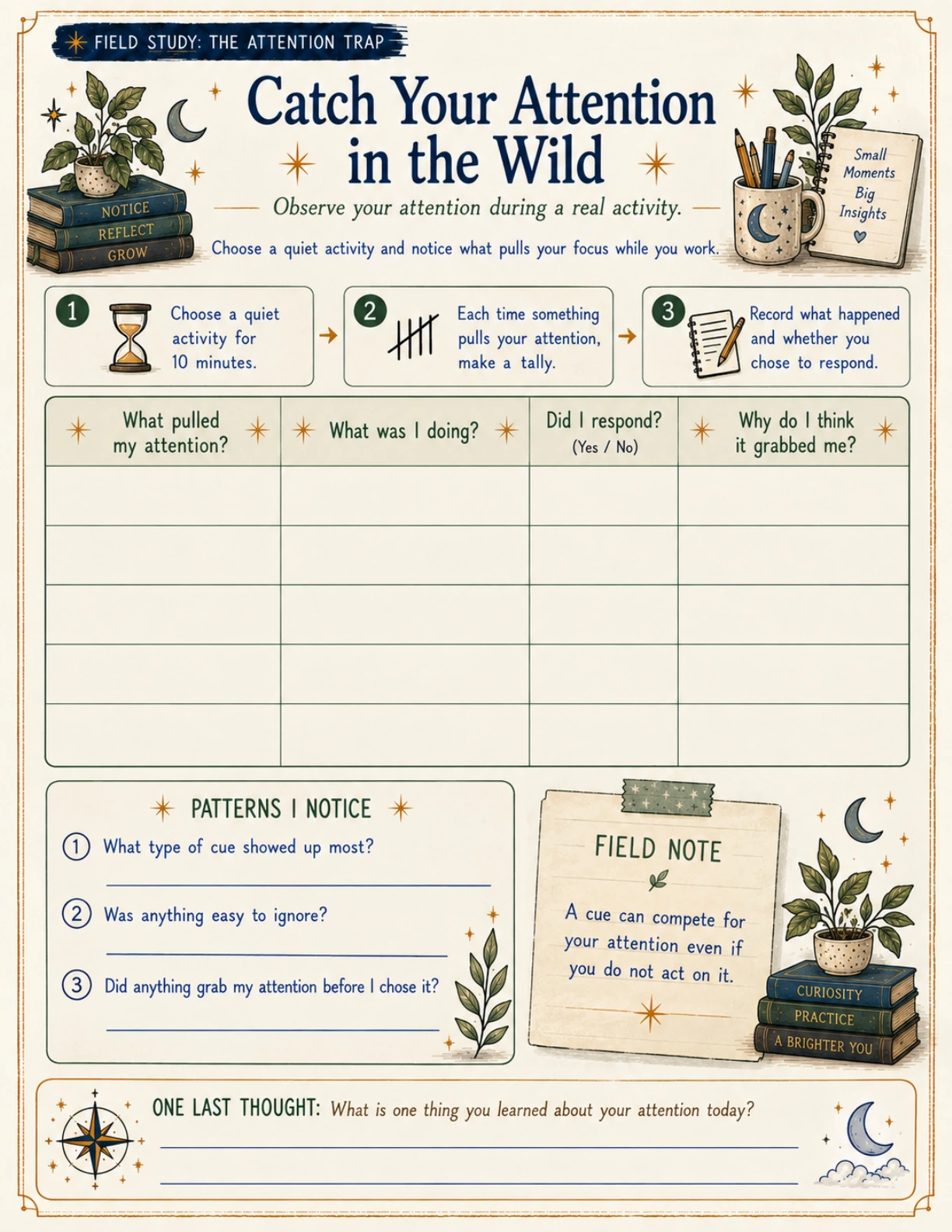
Invite your child to choose a quiet activity they’re comfortable doing for about ten minutes: drawing, reading, building, or working on a puzzle. Leave the room as it usually is. The point is to notice what already happens, so there’s no need to add surprise noises or send notifications.
- Keep a piece of paper nearby. Each time your child notices something pulling their attention, they can make a quick tally.
- Add a word or two about what happened: ‘dog,’ ‘timer,’ or ‘someone said my name.’ If writing interrupts the activity too much, talk afterward and record what they remember.
- At the end, choose a few moments to discuss. What were they doing? What caught their attention? Did they respond? Why do they think they noticed it?
A child who prefers talking can dictate while you write. You can also try the activity alongside them and compare your notes. If ten minutes feels too long, shorten it; the conversation can still be worthwhile.
The tally is a record of the moments they noticed, rather than a score for how well they concentrated. Keeping track can itself change the activity, and one short observation can’t tell you how someone’s attention works in every situation. It gives you examples you can both refer to.
Look for one pattern you can talk about
Once you have a few examples, ask what they have in common. Were most of them sounds? Was there something your child was waiting for? Did a cue catch their attention even though they chose to keep working?
You might hear, ‘I kept listening because I thought the doorbell would ring,’ or ‘I heard the timer, but it wasn’t for me.’ Those details are more useful than a total number of tallies. They help a child put words to what happened.
If the conversation suggests a change worth trying, choose one together. You could move a buzzing phone, let someone know it’s a reading break, or agree on how to ask for help while another person is working. Try it during a later activity and see what you both notice.
Inside The Attention Trap Mini
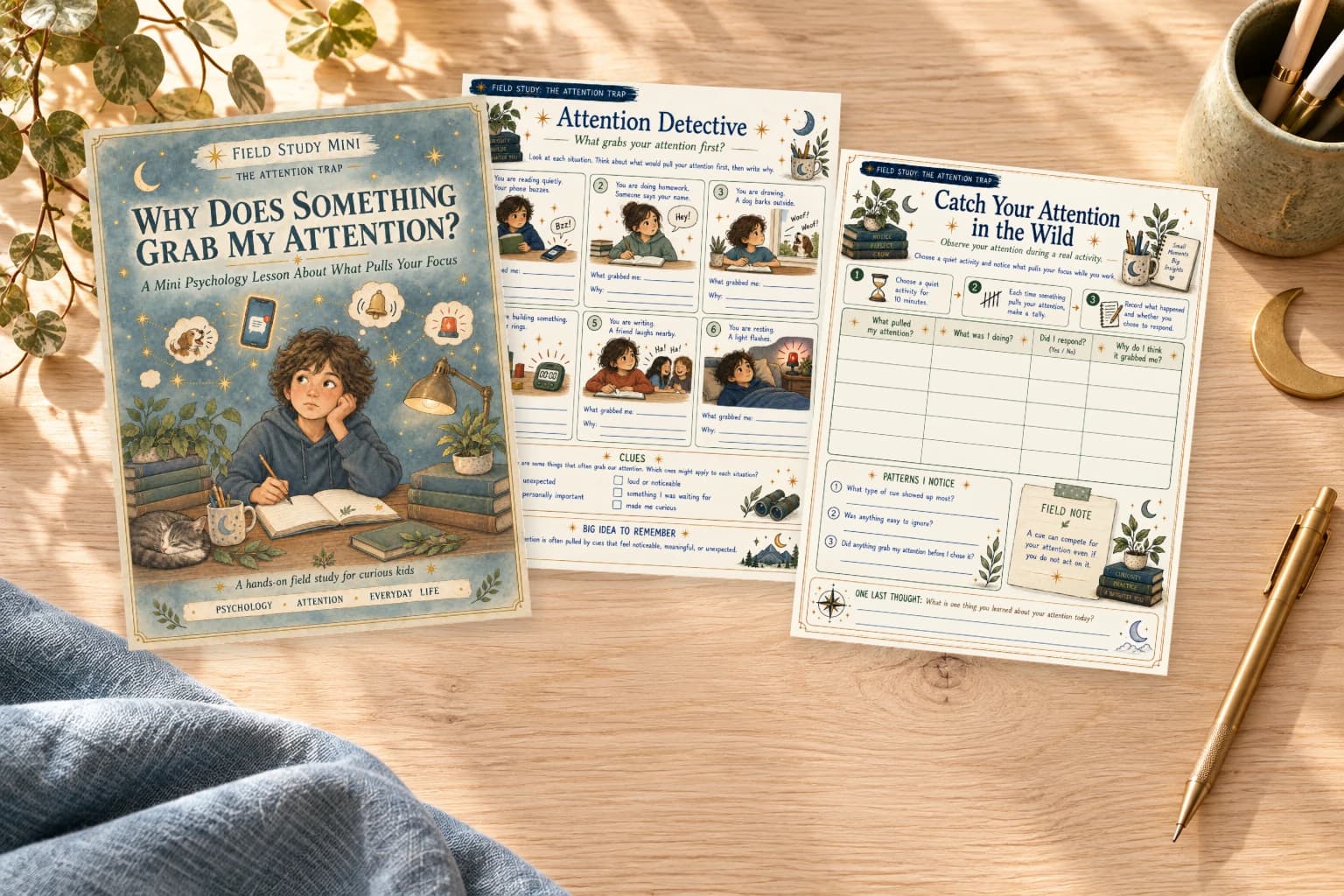
The Attention Trap Mini: Why Does Something Grab My Attention? is a six-page printable psychology lesson built around this everyday noticing. It gives children illustrated situations to consider, a page for observing their attention during a real activity, and room to reflect on what they found.
The PDF includes a cover and five learning pages. Print it on US Letter paper, 8.5 × 11 inches. Read the explanations together if that suits your learner, talk through the scenarios, and use the observation page when you’re ready to try the activity.
The mini will be $2.00. Its Etsy listing is being prepared; in the meantime, you can try the observation above on ordinary paper or browse the existing studies in the shop.
- Your Attention Has a Job — a short introduction to attention and the difference between noticing and responding.
- Which One Gets Your Attention First? — four paired situations with space to explain a choice.
- Attention Detective — six illustrated everyday situations and possible clues to discuss.
- Catch Your Attention in the Wild — the ten-minute observation, recording table, and pattern prompts.
- What Did You Notice? — reflection questions and a brief parent/educator note.
Choose the edition that fits what you want to explore
The mini is a smaller starting point for a conversation about what pulls attention in everyday life. The full Attention Trap is a 17-page field study for suggested ages 9–14 that goes further into notifications, comparing quiet and interrupted tasks, considering research evidence, and making a personal attention plan.
If you already own the full study, choose the mini when its simpler scenarios and observation sheet would be useful. You don’t need both to begin talking about attention.
| Edition | The Mini | The Full Study |
|---|---|---|
| Length | 6 pages, including the cover | 17 pages |
| Focus | Everyday cues and one observation | Notifications, experiments, and evidence |
| Useful when | You want a shorter introduction | You want a more detailed investigation |
Next time a pencil pauses or a head turns, you have something more specific to ask about: ‘What caught your attention just then?’ Their answer is a good place to begin.
Sources and reading
- Awh, E., Belopolsky, A. V., & Theeuwes, J. (2012). Top-down versus bottom-up attentional control: a failed theoretical dichotomy. Trends in Cognitive Sciences, 16(8), 437–443. (opens in a new tab)
- Stothart, C., Mitchum, A., & Yehnert, C. (2015). The attentional cost of receiving a cell phone notification. Journal of Experimental Psychology: Human Perception and Performance, 41(4), 893–897. (opens in a new tab)