LUNARA PROJECTS · FIELD STUDY
The Attention Trap
Why Notifications Are So Hard to Ignore
A hands-on psychology study for curious middle-grade learners. Try an attention experiment, weigh the evidence, and decide which notifications deserve your attention.
Regular price $8.00Sale price $6.00 USD25% off
USD · tax shown at checkout
Checkout with Polar
The Lunara shop download includes two PDFs and 30 pages. Etsy’s description still lists 20 pages, so check the included files there.
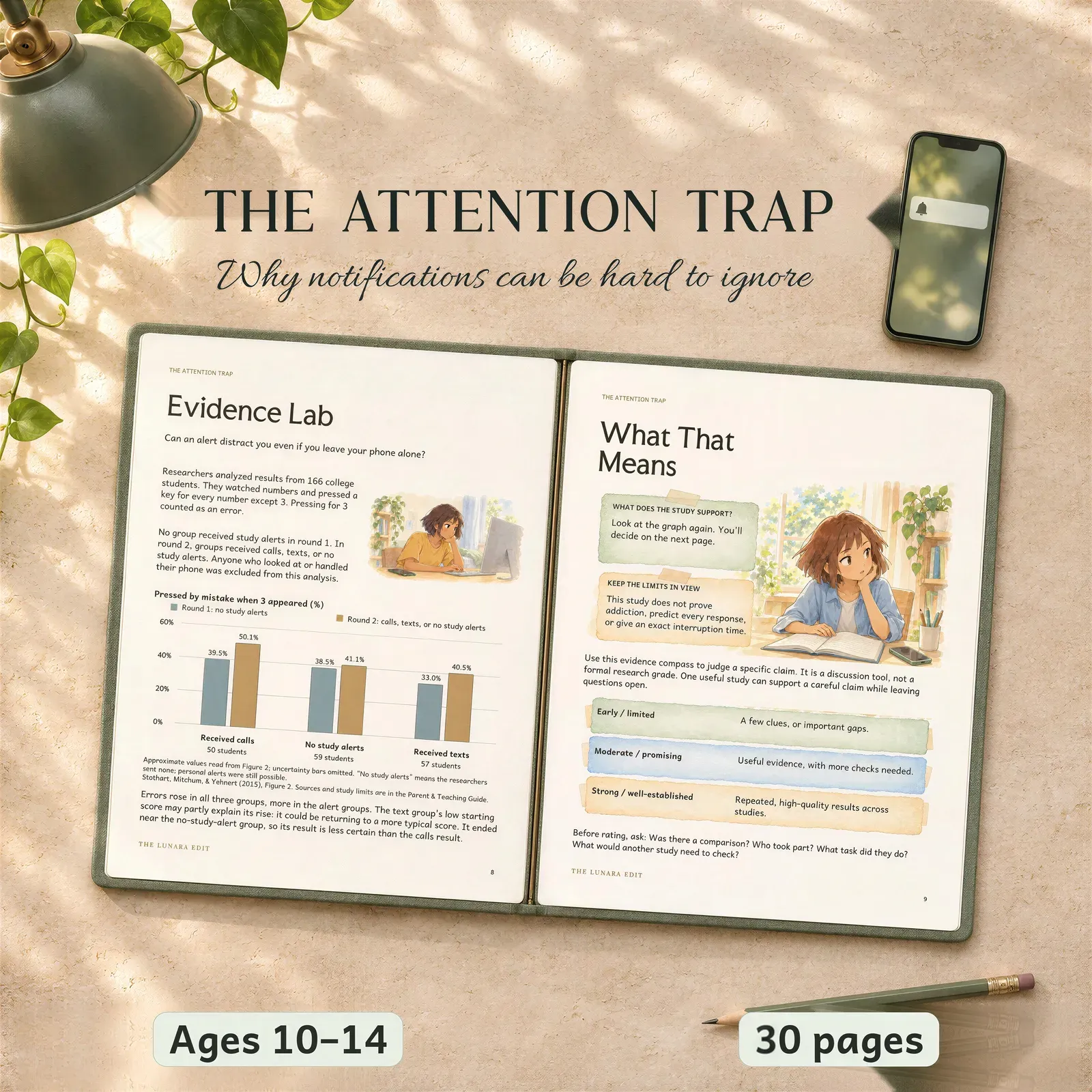
Plan the lesson
- Who it fits
- Ages 10–14. Start with a learner who can follow a timed letter-search task and give a reason for a choice. Read the research together as needed.
- What they’ll practice
- Compare quiet and interrupted trials, record what they noticed, and use research evidence to make a plan for their own notifications.
- Your part
- Skim the guide and have a willing helper make gentle pings during the interrupted round. Run the two rounds together and return to the reading later if you like.
- What to gather
- Print the learner pages and set out a pencil, a coin, and a timer. You can make the interruptions without a phone.
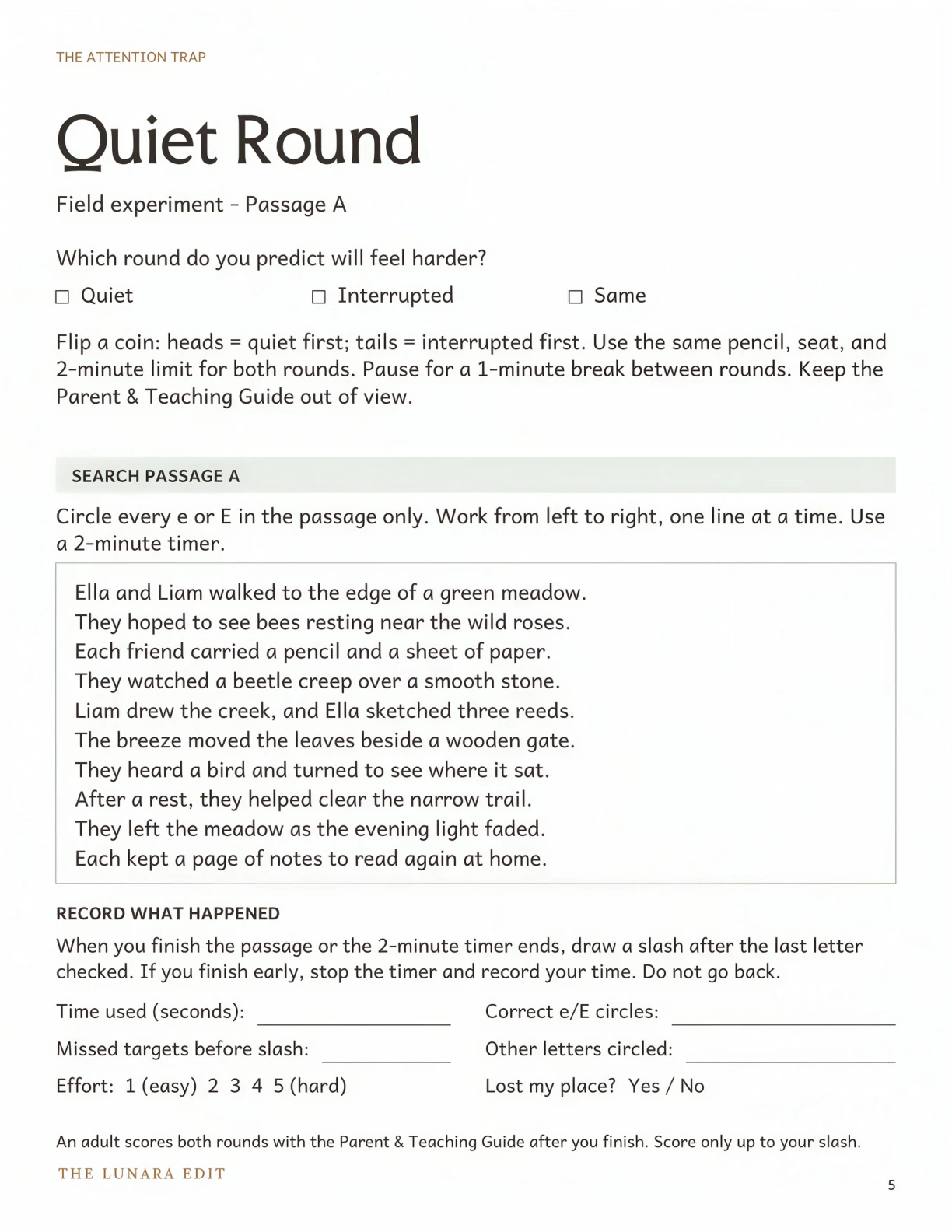
A QUESTION WORTH TESTING
What happens when attention gets interrupted?
Learners flip a coin to choose whether to begin with the quiet or interrupted task. They try both rounds, record what happened, and compare their results. The results give them something to investigate, though different people may respond differently.
The study then takes them beyond their own experiment: how do researchers investigate notifications, and what can a particular finding actually tell us?
FREE ACTIVITY · ABOUT FIVE MINUTES
What happens when a sound interrupts you?
Choose two short paragraphs from a book your learner can read comfortably. Give them a pencil and scrap paper. Explain that they’ll copy from one paragraph for 30 seconds and do the same with the second. Let them know there’ll be one gentle tap on the table during one of the rounds.
Time both rounds. Stay quiet during one and tap about halfway through the other. Ask your learner what they noticed and where they left off in each paragraph. The words may have been easier in one round, and they may have felt more settled by the second. What would they keep the same if they tried it again?
TRY IT YOURSELF
Compare a quiet task with an interrupted one.
A simple letter-finding task gives kids something concrete to measure and describe. In the interrupted round, a helper gives gentle pings at 20, 45, 70, and 95 seconds while the learner is still working. Gather a pencil, a timer, a coin, and a willing helper.
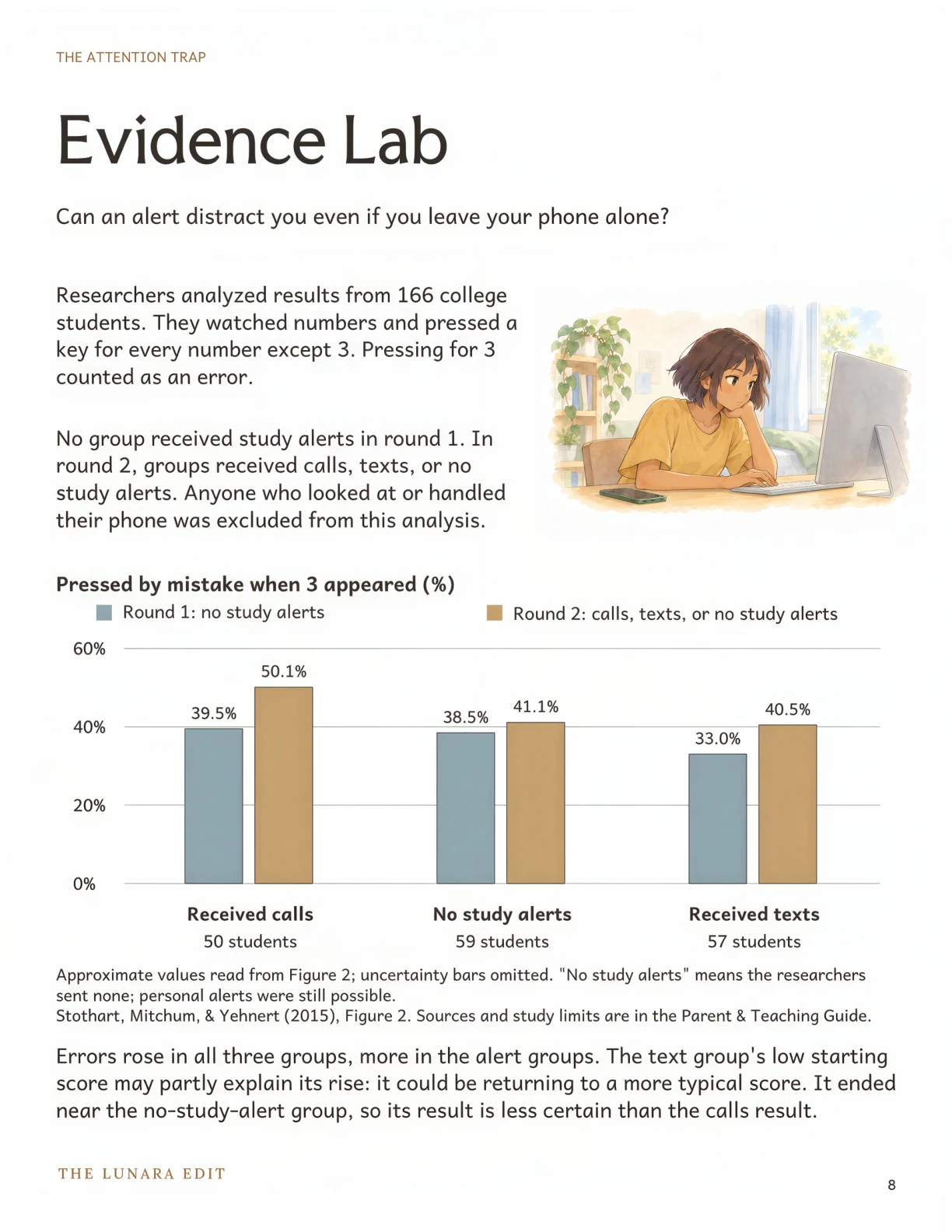
EVIDENCE LAB
Ask what the research supports.
Can a notification distract someone who never picks up the phone? Learners examine a research summary, consider its limits, and practice separating an observation from a bigger claim.
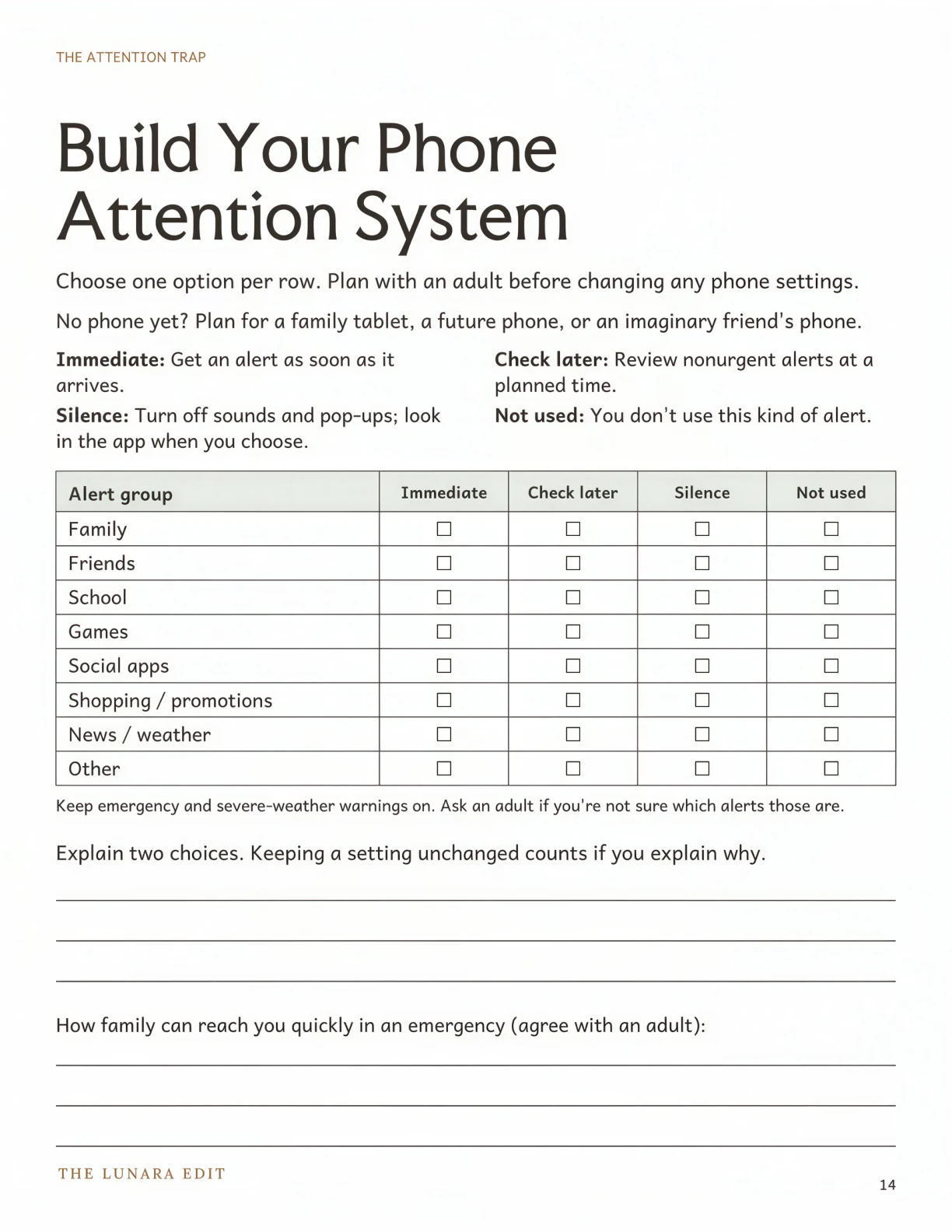
DESIGN DETECTIVE
Notice what asks for your attention.
Kids look at curiosity, urgency, reward, and social pressure in everyday notification scenarios. Then they plan with an adult which alerts to see right away, check later, or silence. Learners without a phone can plan for a family tablet, a future phone, or an imaginary friend’s device.
WHAT YOU’LL RECEIVE
A learner packet and a separate teaching guide.
- 18-page learner PDF and 12-page Parent & Teaching Guide
- Quiet and interrupted attention rounds
- Comparison and evidence activities
- Notification scenarios and a personal attention plan
- Recall check and two optional research pages
- Separate guide with directions, scoring, explained answers and sources
- Print on US Letter paper using “Fit to page”
Digital download delivered through Polar after purchase. No physical item is mailed. Research sources are on pages 11–12 of the separate guide. Keep the guide aside until the learner has finished a first attempt.
PSYCHOLOGY · TECHNOLOGY · HUMAN BEHAVIOR
Try the study with your learner.
Print the full study or choose the pages you want to try first.
Regular price $8.00Sale price $6.00 USD25% off
USD · tax shown at checkout
Checkout with Polar
Printing and distribution
For one household or one co-op, pod, or learning group of up to 30 learners, unless the product’s own terms say otherwise. Reprint for those learners; keep complete digital files within the licensed household or group staff. The copying restrictions concern original human-authored writing and complete packets. We do not claim exclusive copyright over purely AI-generated imagery.
See the product license, safety guidance, and download support. For larger groups or a file problem, contact us.
Created by The Lunara Edit using a mix of human and AI techniques. How I create and review these resources.