
Some days, homeschooling feels like being touched out without anyone actually touching me.
I’m a software engineer working full-time from home, and my two younger kids do school beside me. One does better with spoken instructions; the other would prefer silence. A lesson reads the same answer choices aloud for the fifth time. Someone has a math question while I’m holding the shape of a work problem in my head. Then the other child needs something too.
It’s not that I don’t want to help. It’s that I’m switching between code, conversations, lessons, and two very different children while trying to keep track of all the unfinished pieces. I’m highly sensitive to that kind of noise and mental crowding. By afternoon, the smallest request can feel much bigger than it is.
What has helped us most is treating frustration as information. When I’m overwhelmed, I look for the part of our day that is asking too much of us. When one of my kids is frustrated, I try to investigate the task before insisting they push through it. We keep changing the setup until it fits the people who actually live here.

Our actual day
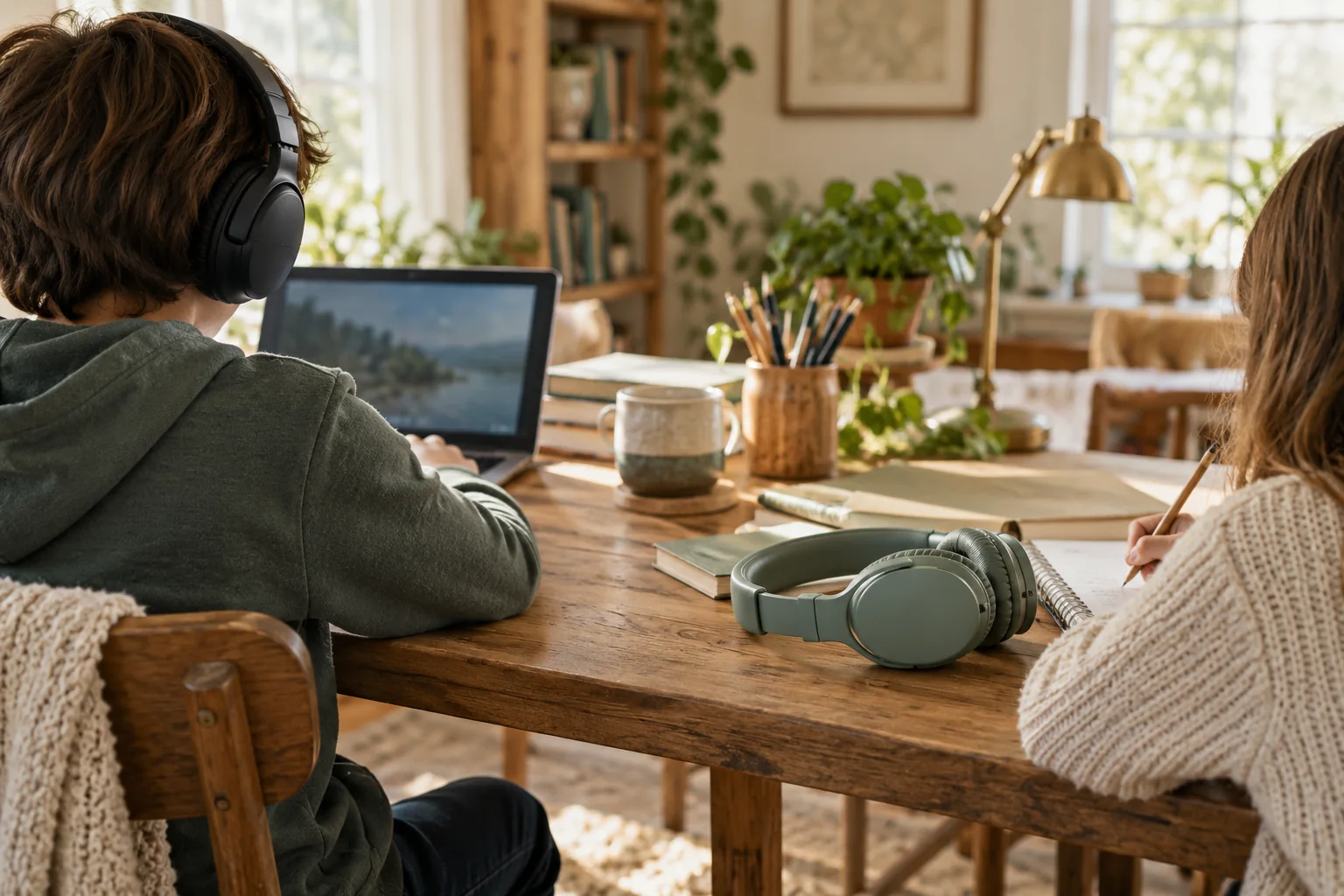
Three desks, two learners, one working parent.
We start around 9:30 with breakfast and a short walk around the block. Then we sit at desks beside one another: I work, and the kids begin their schoolwork. Their online curriculum, Miacademy and MiaPrep, gives them a place to start without waiting for me to present every lesson. They’re old enough for that now, and they enjoy the format.
My meetings usually happen after they finish their classes, so I can help during this part of the day. They generally just ask me. If I’m deep in thought, I might hold up a finger for a moment. If both need help at once, they take turns. Fidget toys, doodle pads, and the option to move to another task make the wait easier.
Sometimes my work needs a longer uninterrupted stretch, so I pause the homeschool help and finish work later. That flexibility helps, but it also means our rhythm depends on my job and on having older children who can work independently for a while. I would not hand this schedule to a parent of toddlers and promise it would magically work.
We save hands-on projects for after dinner, when I can give them my attention without also thinking about code. On Wednesday evenings, we spend half an hour reading together in the same room. Everyone brings their own book. It’s connection without another round of noise.

Make room for different needs
One child needs sound. The other needs quiet.
Noise-canceling headphones have been the simplest fix. One child can hear a lesson clearly while the other can block it out. I can put mine on when I need to focus, too. We aren’t asking the child who learns by listening to give that up, or asking the child who needs quiet to endure it all morning.
Solitude matters as well. My kids have activities they enjoy doing on their own, and we’ve spent time helping those interests grow. My youngest is more social, and after the neighborhood kids get home from school, he often finds his people outside. It has become easier as my children have gotten older. If yours are still little and you cannot find a quiet minute, I remember that stage, and I would not pretend this part is equally available to you yet.
A four-day week
We keep the formal work focused.
We school Monday through Thursday and take Friday through Sunday off. Some weekdays are a little longer, particularly when there’s copywork or repetitive math, but we try to avoid work that exists only to fill time. That three-day break gives all of us space to reset.
We do the schoolwork we need to do, then let learning keep happening in ordinary life. A conversation over dinner might bring a concept back. A project makes an idea tangible. A question in the car sends us looking for an answer. I don’t need to label every one of those moments “school” for it to count as learning in our family.
Instead of drilling one topic for hours, we bring older skills back in small pieces. A short weekly sheet might have sixteen problems drawn from multiplication, division, addition, or subtraction, with subjects mixed across weeks. It helps me see what has stuck and what needs another pass. If something hasn’t stuck, that’s a useful clue, not a verdict on the child.
Look underneath the frustration
Ask what is making this hard.
If my son is resisting notes, “try harder” tells me very little. Is his hand tired? Is there a learning difficulty we haven’t recognized? Did we choose the wrong time of day? Does he need food or sleep? Would typing, dictating, a shorter passage, or a different way to practice let him show what he knows?
When either of us is close to throwing up our hands, I try to reset first: take a breath, walk for a few minutes, get a snack, splash water on our face, pick up a fidget, or switch subjects. Then, when things are calmer, we look for the cause. Maybe a video explains the idea better. Maybe we need to go back to a foundational step. Maybe the assignment itself is the problem.
I want my kids to carry that curiosity into their own learning. When they get stuck, we practice asking: What information do I have? What do I already know? What have I tried, and what happened? What else could I try? Where could I look? Independence grows through having a process, with me still available when they need help.
Let a system remember
I built something to carry the details.
Homeschooling while working full-time creates a whole second job in my head: which assignments are next, what got finished, what we need to revisit, and where I left off before somebody asked about a lesson. As a software engineer, I eventually built our family a homeschool portal called Lunara Quest.
The kids can see their assignments, practice spelling in a program I made for them, and earn Moons to exchange for rewards I’ve set up. I can see completed work on a dashboard and keep a record of our days. It gives them more ownership and lets me stop holding every small detail in my memory.
Lunara Quest is a working project I’m still refining for our family. You can take a look at its public homepage. You don’t need to build an app to get the same kind of relief. A paper checklist, a shared planner, or a simple weekly board can take the next task out of your head and put it somewhere everyone can see.
A gentler way to check in
“Are we doing enough?” deserves a useful answer.
That worry can get very loud. Sometimes you really do notice a skill your child hasn’t learned yet. I’d rather take inventory than let the worry hover over every day. About once a quarter, I look at what each child knows, what feels shaky, and what I’d like to teach next. Then I can choose a new explanation, a different activity, or a little more practice.
A gap is something we can work with. It doesn’t mean we need to recreate an entire conventional school day at home. My children learn more willingly when the method fits them and when we have room to enjoy being together.
Our homeschool isn’t free of noise, interruptions, or days when I’m tired of being needed. But we can notice when the day is no longer working and change it. That has made more room for their learning and for me to be a person inside this home, too.