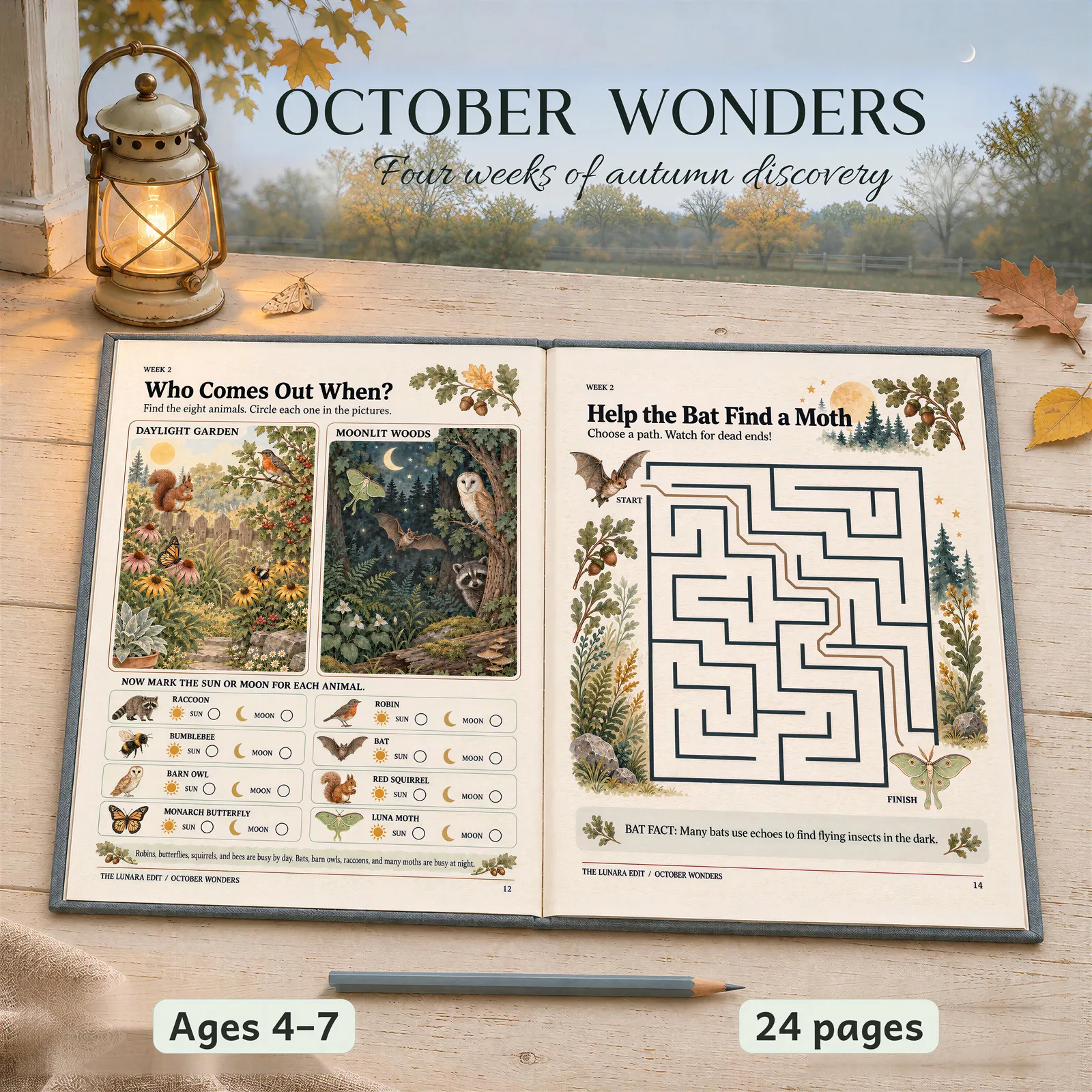
Pumpkins to take apart, bats to follow, and leaves to look at far more closely than anyone usually does. A hands-on October activity book for curious kids and whichever grown-up is holding the crayons.
Ages 4–724 printable pages4 themed weeksUS Letter PDF
Plan the lesson
Who it fits
Ages 4–7. Start with a child who can point to a picture, make a guess, or tell you one thing they noticed.
What they’ll practice
Make a pumpkin prediction, sort daytime and nighttime animals, look closely at a leaf, and tell a short story.
Your part
Choose one activity for a sitting, read the directions aloud, and handle any cutting or pumpkin carving yourself.
What to gather
Print the pages you plan to use and set out crayons or a pencil. For the pumpkin measurement, add string and a real pumpkin, or work from the illustrations.
A LITTLE FIELD GUIDE TO OCTOBER
Autumn has already done half the lesson planning.
A pumpkin on the table. A leaf somebody carried inside and will not, under any circumstances, let you throw away. The question of how a bat finds anything in the dark. October is full of things worth investigating, and four-to-seven-year-olds rarely need convincing to investigate them.
I made October Wonders to help families follow those questions. Each week pairs looking, touching, and trying things with a little science, early math, visual puzzles, and storytelling. You can use the pages in order or linger over whatever interests your child. A long conversation about whether an owl counts as a neighbor belongs here too.
FOUR WEEKS · SIXTEEN ACTIVITIES
Start wherever your child’s curiosity takes you.
WEEK ONE · PUMPKIN DETECTIVES
Start with a pumpkin.
Learn the parts of a pumpkin, guess what’s inside before anyone looks, measure around the widest part with string, and go on an illustrated pumpkin hunt. A real pumpkin is lovely. The pictures and a little imagination also work.
WEEK TWO · NIGHT NEIGHBORS
Follow the creatures of the night.
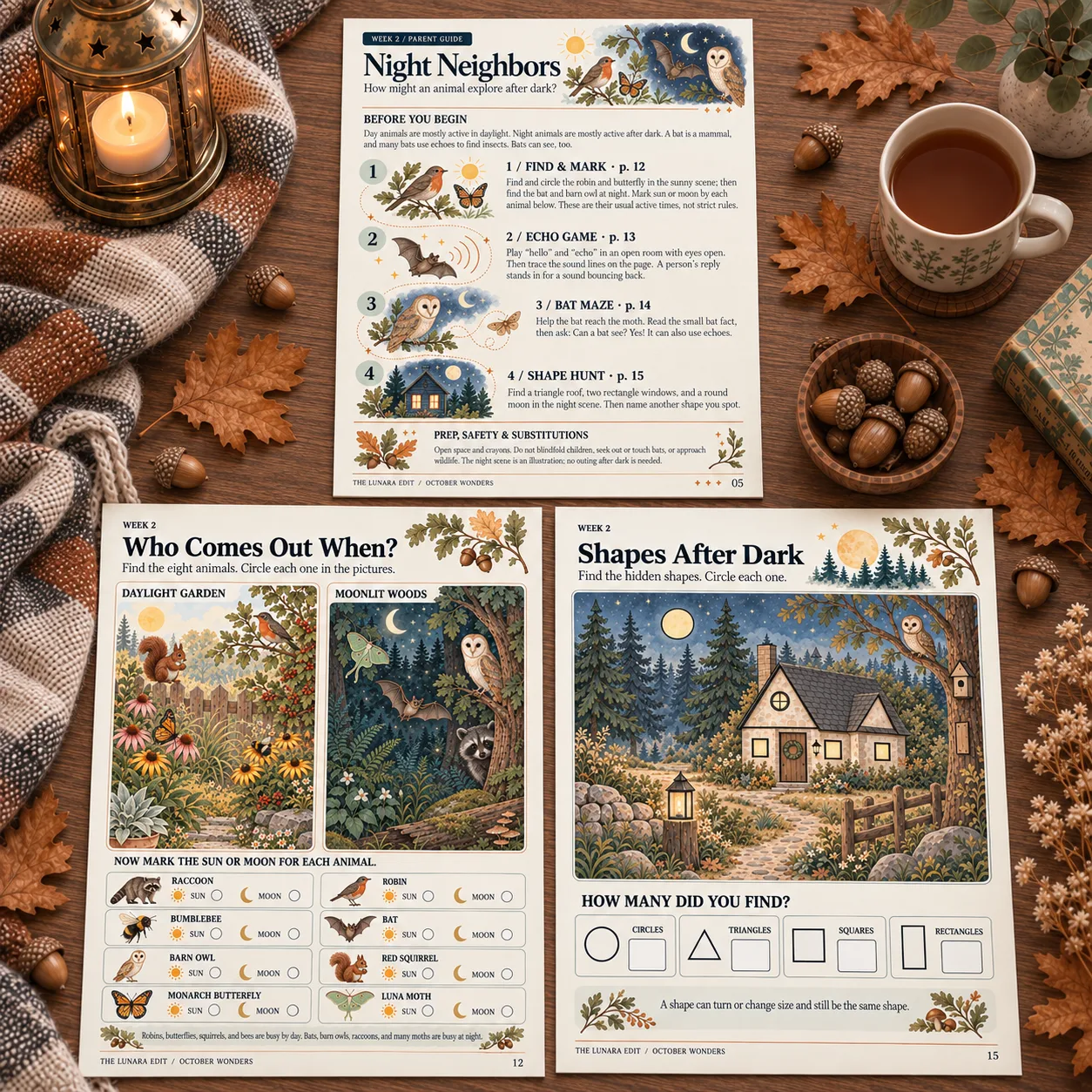
Sort daytime animals from nighttime ones, play an echo game, help a bat through a maze, and find the circles and triangles hiding in a moonlit scene.
WEEK THREE · AUTUMN CLUES
Look for autumn clues.
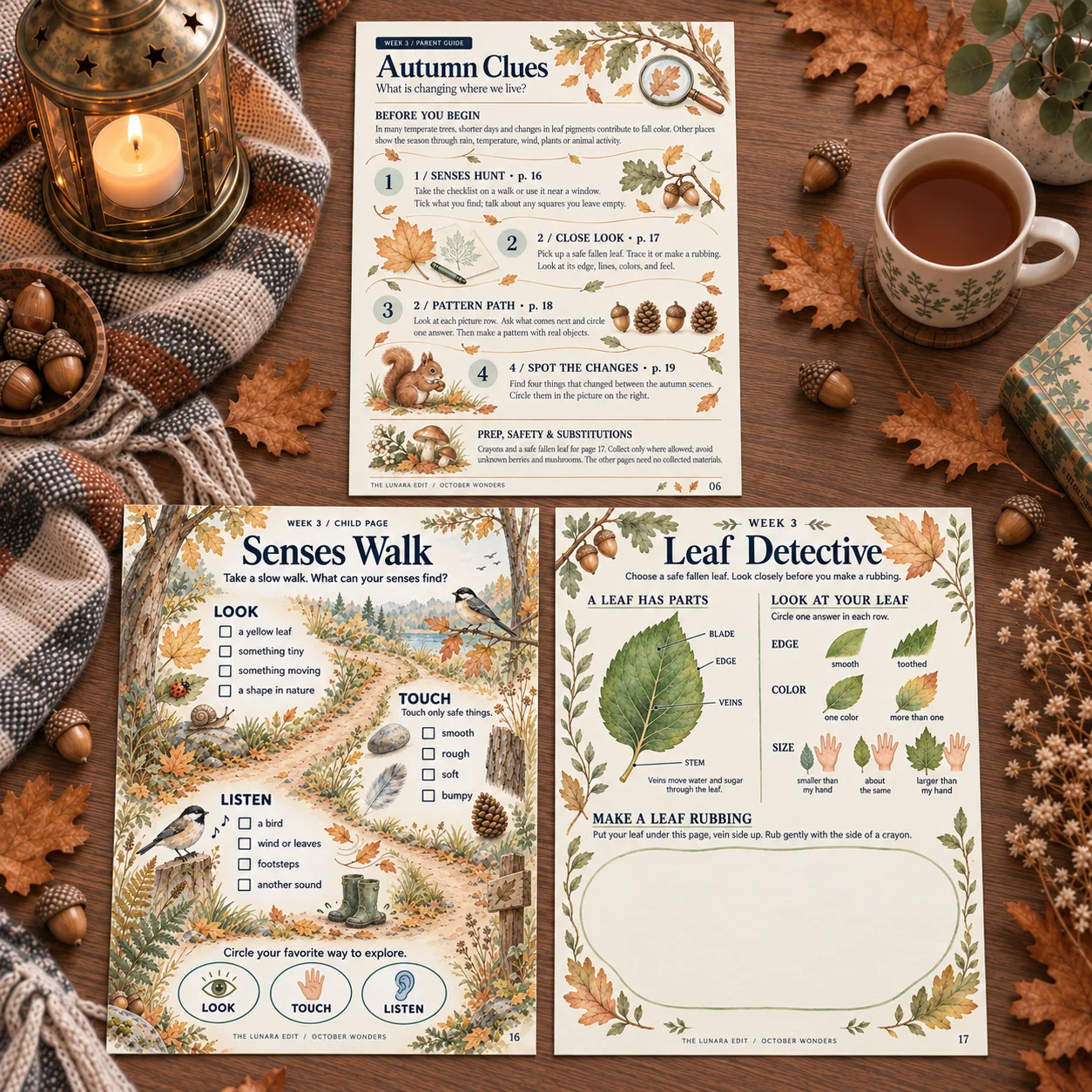
Take a senses walk, investigate one fallen leaf properly, finish some seasonal patterns, and spot what changed between two autumn pictures. A backyard, a park, or a window will do.
WEEK FOUR · STORIES & TRADITIONS
Tell a story and look back on the month.
Sort real-life happenings from make-believe, choose the pieces of a nighttime story, color a paper lantern by number, and look back on a month of favorite discoveries.
HOW A WEEK GOES
Three core days, with a fourth if you feel like it.
Week two: the Night Neighbors parent guide, Who Comes Out When?, and Shapes After Dark. Open full-size preview
Every week opens with a parent guide: what the activities are about, what to set out, and what to swap in if you don’t have it. Then come four child pages. The rhythm is simple. Meet it, try it, play with it, and if the week still has room, finish with a game or a look back.
Week two shows how that works. Kids find the robin and the butterfly in a sunny garden, then the bat and the barn owl in the moonlit woods, and mark who is awake when. They play a call-and-echo game to feel how bats use sound, help a bat through a maze to reach its moth, and hunt for triangles and circles in a nighttime cottage scene. Nobody has to go outside after dark. The night is an illustration, which is honestly a relief.
Most sit-down activities take 15 to 25 minutes. The echo game and the debate about whether raccoons are technically neighbors can take as long as they take.
Four to seven is a wide range, so answers can look different from child to child. Some will write; others will point, dictate, draw, or explain at great length while coloring something else entirely. You can record a few words for them or simply enjoy the conversation. There’s no need to fill every space.
A FEW REAL THINGS GO A LONG WAY
Use what you’ve already got.
Week three: the Autumn Clues parent guide, the Senses Walk, and Leaf Detective. Open full-size preview
Paper, crayons, string, a ruler, and a story you love are enough to begin. A pumpkin or squash helps in week one and a fallen leaf makes week three better, but the activities have a picture-based way through when the real thing isn’t handy.
Week three is where the season does most of the work. Take the senses checklist on a walk, or to a window, which absolutely counts. Then pick up one fallen leaf and look at it properly: its edge, its veins, its colors, how big it is next to a hand. Finish with a leaf rubbing, which remains undefeated as a way to make a five-year-old gasp.
Each parent guide ends with prep, safety, and substitutions. Adults do any pumpkin cutting. Collect only where collecting is allowed, and leave unknown berries and mushrooms where they are. No open flames anywhere. They’re the notes I’d want if I were picking this up the night before.
And when week four arrives, stories and seasonal traditions are offered as possibilities, not assumptions. Your family gets to decide which customs and conversations belong at your table.
WHAT’S IN THE DOWNLOAD
One month of little adventures.
24-page printable PDF, including the cover
Four themed weeks with 16 child activity pages
Parent introduction, materials list, and weekly guides
Pumpkin anatomy, measuring, nature observation, and seasonal puzzles
Day-and-night animals, echolocation, patterns, and creative storytelling
Parent answer guide and safety notes
US Letter pages, designed to print at home
Digital PDF download after purchase
This is a digital PDF, not a physical book or a shipped activity kit. You can see more of the actual pages in the Etsy listing.
OBSERVE · WONDER · MAKE · EXPLORE
Choose a few activities for your October.
Work through the four weeks or pick a few favorites. You can start with the pumpkin on your table, a leaf from a walk, or a question your child has been asking.
For children who want a little handwriting alongside their fall nature study. Ages 4–7; paid PDF.
Printing and distribution
For one household or one co-op, pod, or learning group of up to 30 learners, unless the product’s own terms say otherwise. Reprint for those learners; keep complete digital files within the licensed household or group staff. The copying restrictions concern original human-authored writing and complete packets. We do not claim exclusive copyright over purely AI-generated imagery.