WINTER WONDER DAYS
Start with an owl’s hidden meal
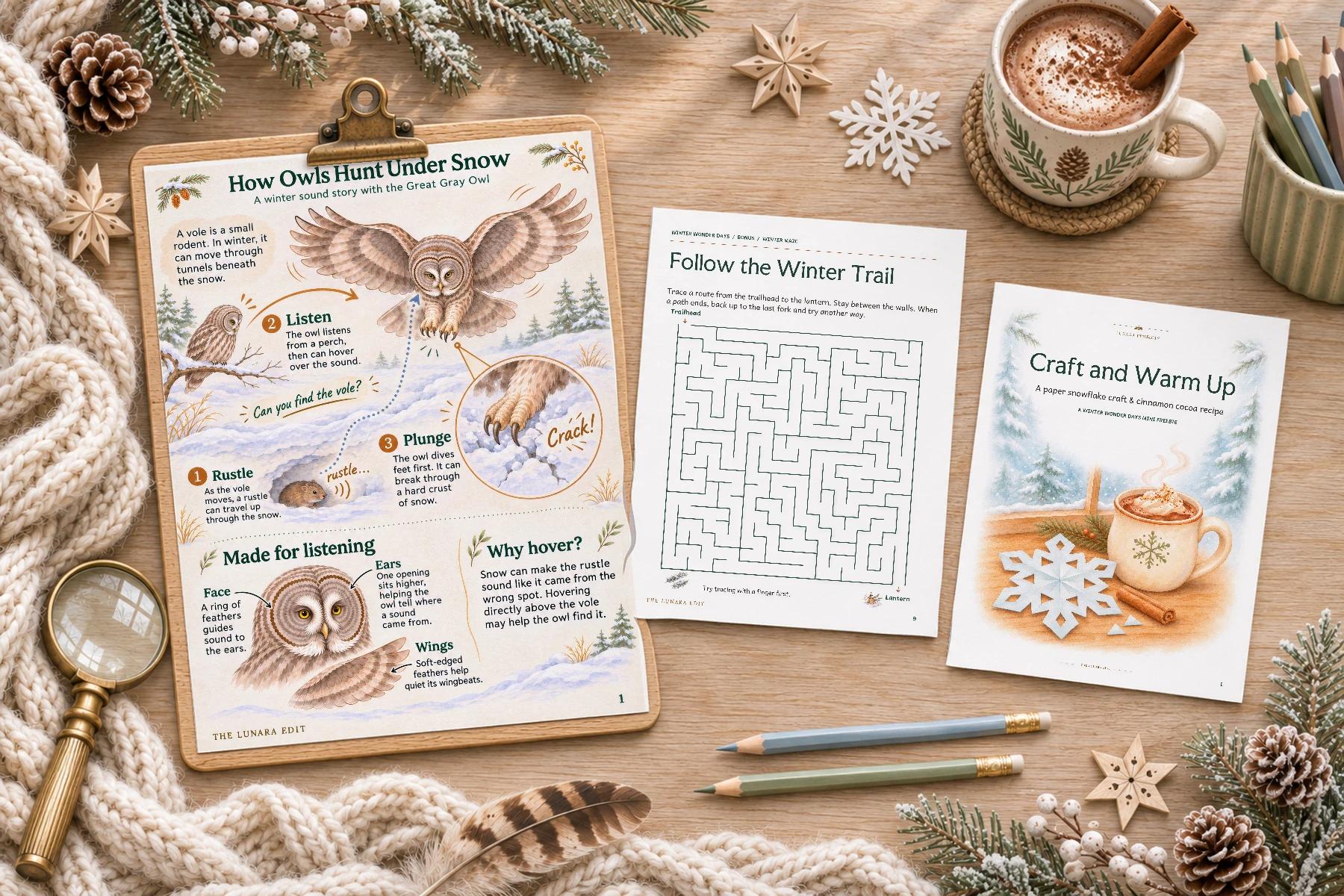
A vole can be moving beneath the snow while an owl listens from a branch above. Great Gray Owls can use sound to find small mammals under that cover, then plunge into the snow feet first. It’s a good picture to linger over together. Find the vole, trace the sound, and follow where the owl goes next.
Winter Wonder Days begins with that illustrated explainer. The other pages give children several ways into the season, from counting shapes on a string of lights to working out why someone left a lantern in the snow. The pack is written for ages 6–10, with reading help as needed. Children can point, draw, talk, or have someone write down their words.
How do owls hunt under snow? Read the science behind the picture →
Read more about the owl’s hunting and hearing at the Cornell Lab of Ornithology.
LEARNER PAGE 1
Read the owl picture
Follow a vole’s rustle through the snow, then follow the owl from its perch to its feet-first dive.
LEARNER PAGE 2
Try a listening game
Keep facing forward while a partner makes one gentle paper rustle. Record where you thought it came from and where your partner stood.
LEARNER PAGE 3
Count the winter lights
Make a guess, count the stars, circles, and diamonds, then shade a bar graph.
LEARNER PAGE 4
Draw a branching snowflake
Start at the center and repeat your branch pattern on all six arms.
LEARNER PAGE 5
Watch one ice cube
Draw or describe it right away, at about five minutes, and at about ten minutes. Record what actually happens in your room.
LEARNER PAGE 6
Return to a window
Choose one view and look twice. Compare a detail from your two visits.
LEARNER PAGE 7
Tell a lantern mystery
The tracks end at a glowing lantern. Decide what happened and let your character notice two clues before the reveal.
LEARNER PAGE 8
Look for eight little things
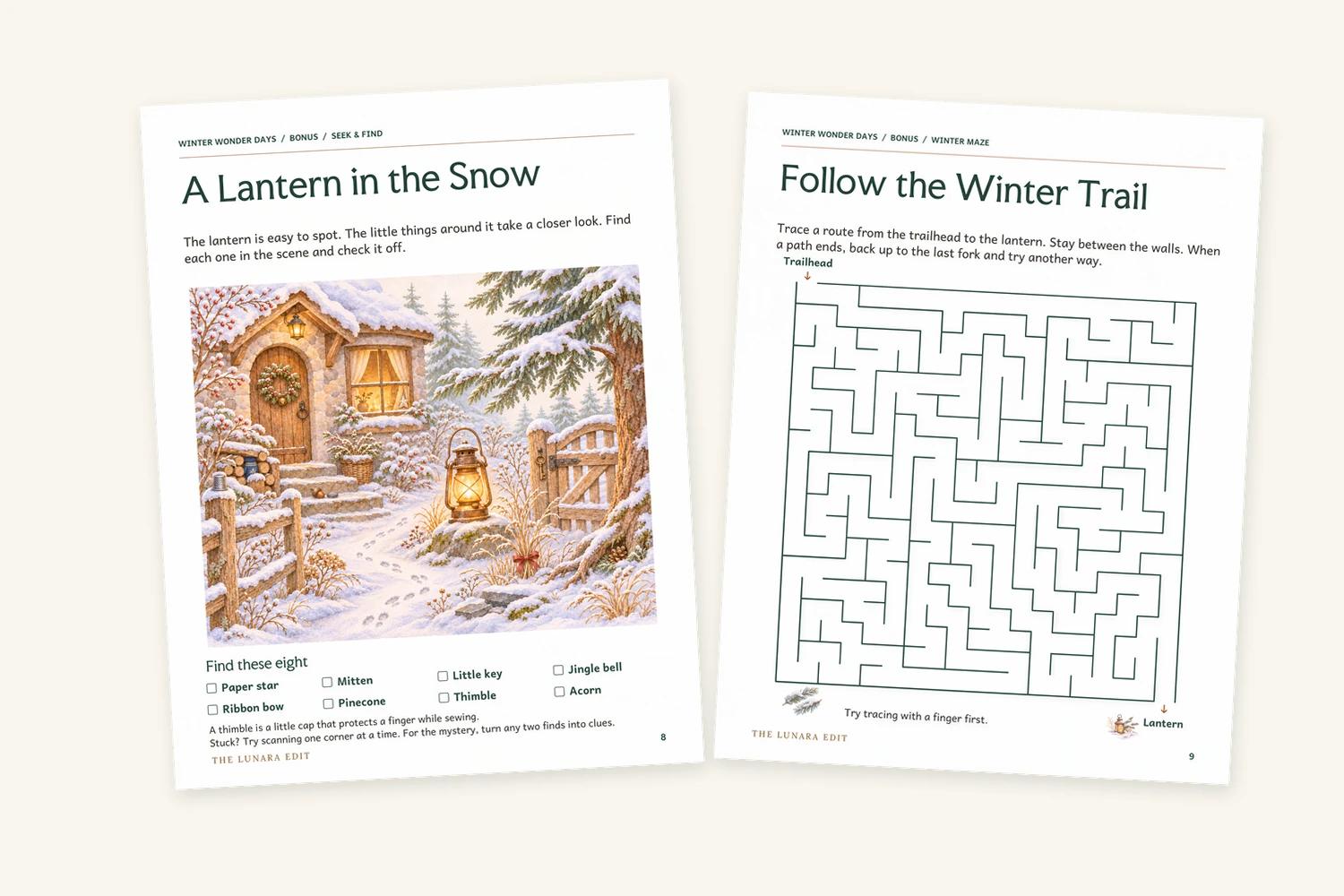
Find a paper star, mitten, key, bell, ribbon bow, pinecone, thimble, and acorn in a snowy scene.
LEARNER PAGE 9
Follow the winter trail
Trace the maze from the trailhead to the lantern, backing up when a path ends.
TRY IT BEFORE YOU PRINT
Which way did the rustle come from?
Bring a chair, a sheet of paper, and a partner. Have the listener sit facing one spot. From the listener’s point of view, choose places to the left, right, and behind them, each about the same distance from the chair.
- Let the listener hear a gentle practice rustle first.
- Move to one of the three places before they say they’re ready. Make one gentle rustle while they keep facing forward.
- Let them guess, or say “not sure,” before you show where you stood. Try another round from a different place.
The printable gives you a place to record four rounds. Ask what helped them choose a direction, or what made it hard to tell. This is a way to notice clues in sound around your room. The owl picture and teaching guide explain the animal’s different listening equipment and what snow can do to a sound.
A lantern mystery, with a few things to find
The story page begins with tracks that end at a glowing lantern. Your learner chooses an explanation, then plants two clues before the reveal. They can tell the story aloud, write it, or draw a few scenes.
If they’re looking for an idea, try the picture hunt first. A mitten, a small key, or a ribbon bow could become part of the mystery. The maze is a separate pencil challenge, with the route in the teaching guide for when you need it.
THE SEPARATE COMPANION
Craft and Warm Up
For a day when you’d like something to make, this mini pack pairs six illustrated paper-folding steps with a cinnamon cocoa recipe. Fold one square, snip small shapes from the edges, and open it slowly to see how the cuts repeat.
The snowflake craft also follows naturally from the drawing page in Winter Wonder Days. You can draw a branching pattern first, then see what a few folds and cuts produce in paper. Try a simple first snowflake before adding more tiny cuts.
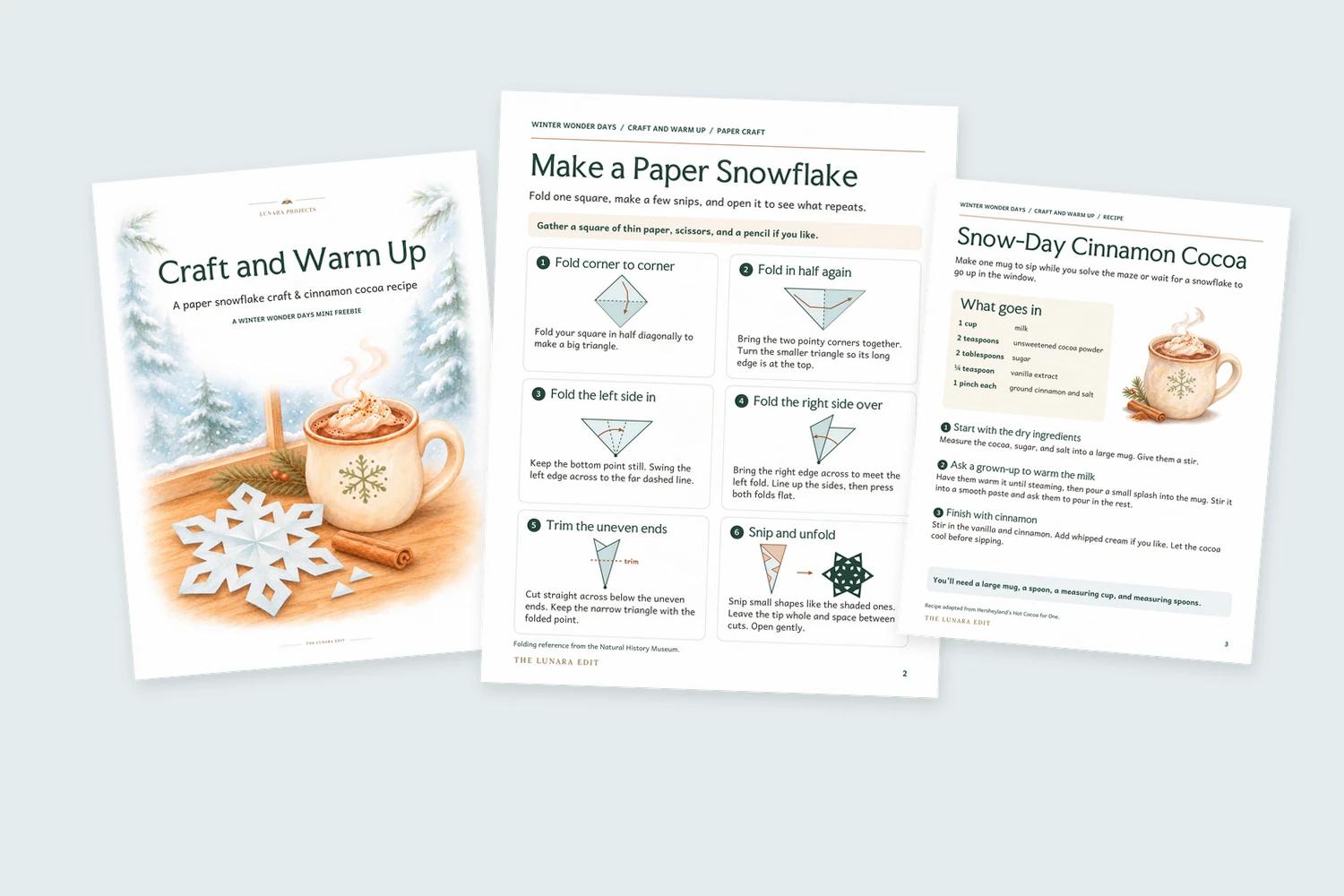
A grown-up handles warming and pouring the milk and helps with scissors as needed. Let the cocoa cool before sipping. You’ll find the full measurements and directions on the recipe page.
What to prepare
For Winter Wonder Days
Print the pages you want and skim the guide beside them. Bring a pencil. Colored pencils are optional for the graph and snowflake drawing.
The listening activity needs a partner, chair, and sheet of paper. The ice observation needs one ice cube, a shallow dish, and a timer or someone to keep track of time. Choose a window or another view you can return to for the observation page.
The nine learner pages can be used separately. The ice page has three checks across about ten minutes, and the window page asks for a return visit later that day or another day. There’s no need to work through the whole packet at once.
For Craft and Warm Up
Bring a square of thin paper, scissors, and a pencil if you’d like to mark your cuts. The cocoa uses milk, unsweetened cocoa powder, sugar, vanilla, cinnamon, and a little salt.
You’ll also need a large mug, spoon, measuring cup, and measuring spoons. Have a grown-up take care of the hot milk and give folding and cutting help where it’s useful.
The download includes a cover, one craft page, and one recipe page. You can print just the two activity pages.
THE PRINTABLE PACKS
The pages that go with these activities
The printable downloads are coming soon. You can try the listening game above now with a partner, a chair, and a sheet of paper. This page will hold the US Letter PDFs when they are available.
Winter Wonder Days
Nine learner pages, with a separate six-page Parent & Teaching Guide. The guide includes preparation, ways to help, sources, and explained answers.
Craft and Warm Up
A separate three-page mini pack with the illustrated cover, paper snowflake directions, and cinnamon cocoa recipe.
For printables you can download now, visit the Freebies page. If you’re still in an autumn mood, The Spooky Homeschool Week has the bat echolocation page that began this little seasonal collection.
Behind the resource
I’m Kai, the homeschooling parent behind The Lunara Edit. I direct the development and make the publication decisions. I use generative AI for drafting, revision, illustrations, and page design. Read how I create and review the resources.
Using the free printables
For one household or one co-op, pod, or learning group of up to 30 learners, unless the product’s own terms say otherwise. Reprint for those learners; keep complete digital files within the licensed household or group staff. The copying restrictions concern original human-authored writing and complete packets. We do not claim exclusive copyright over purely AI-generated imagery.
See the product license, safety guidance, and download support. For larger groups or a file problem, contact us.