The Spooky Homeschool Week
Seven free US Letter pages for six October activities. The nature study includes a second sheet for repeat visits. Read the prompts below each preview, or download the PDF to print.
For all seven lessons, including the ghost experiment, read the activity guide.
1. How Bats Find Their Way
Read the page text and prompts
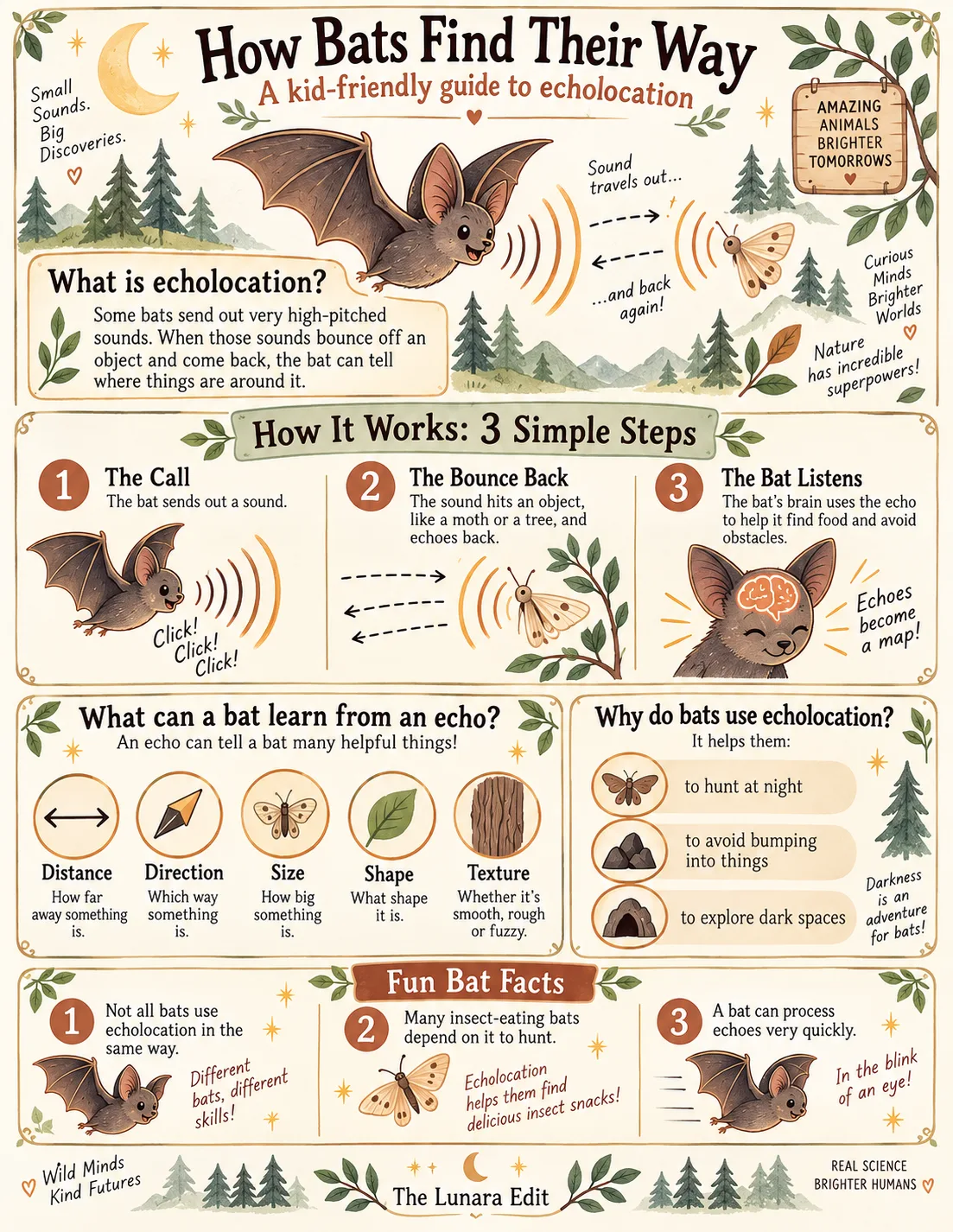
A kid-friendly guide to echolocation.
- What is echolocation? Some bats send out very high-pitched sounds. When these sounds bounce off an object and come back, the bat can tell where things are around it.
- How it works: 1. The call — the bat sends out a sound. 2. The bounce back — the sound hits an object, like a moth or a tree, and echoes back. 3. The bat listens — its brain uses the echo to help it find food and avoid obstacles.
- What can a bat learn from an echo? Distance: how far away something is. Direction: which way something is. Size: how big something is. Shape: what shape it is. Texture: whether it is smooth, rough, or fuzzy.
- Why use echolocation? To hunt at night, avoid bumping into things, and explore dark spaces.
- Fun bat facts: not all bats use echolocation in the same way; many insect-eating bats depend on it to hunt; a bat can process echoes very quickly.
You can use these prompts in a notebook or answer aloud.
2. Candy Probability
Read the page text and prompts
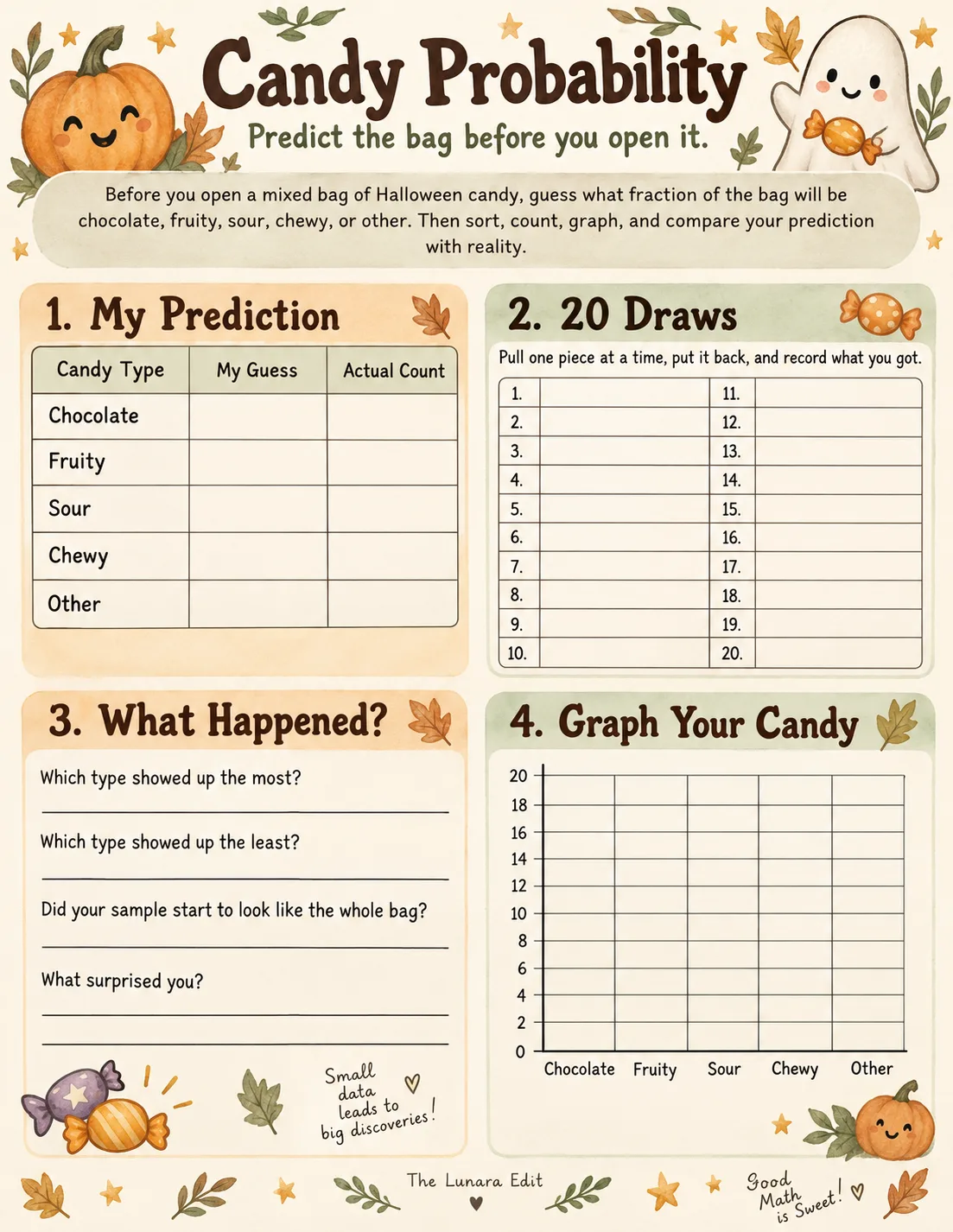
Predict the bag before you open it. Guess what fraction will be chocolate, fruity, sour, chewy, or other. Then sort, count, graph, and compare your prediction with reality.
- My prediction: for each candy type — chocolate, fruity, sour, chewy, and other — record your guess and the actual count.
- 20 draws: pull one piece at a time, put it back, and record what you got for each of twenty draws.
- What happened? Which type showed up the most? Which showed up the least? Did your sample start to look like the whole bag? What surprised you?
- Graph your candy: use the five candy types along the horizontal axis and counts from 0 to 20 along the vertical axis.
You can use these prompts in a notebook or answer aloud.
3. Spiderweb Geometry
Read the page text and prompts
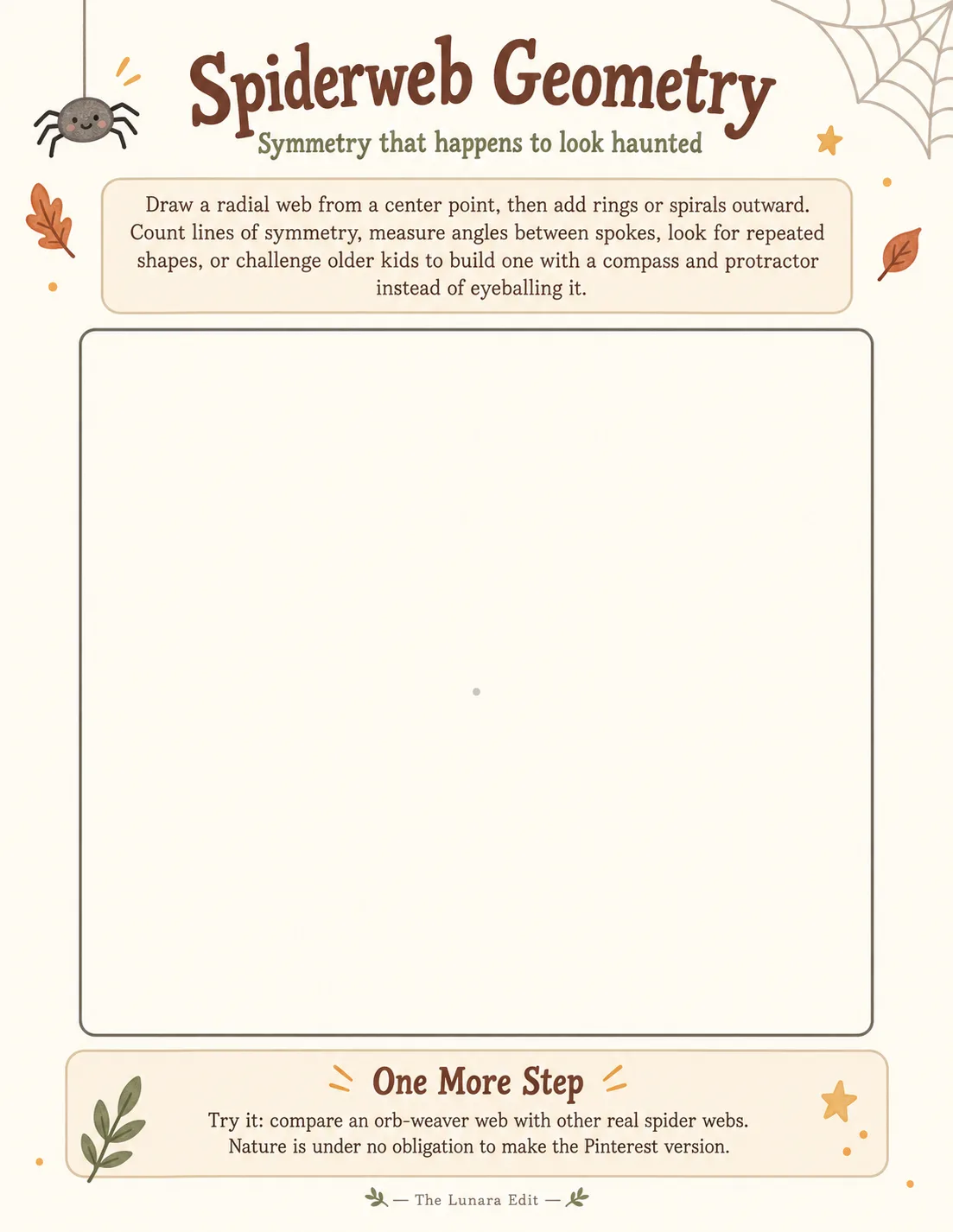
Symmetry that happens to look haunted. Draw a radial web from a center point, then add rings or spirals outward.
- Count lines of symmetry, measure angles between spokes, and look for repeated shapes. Older kids can build the web with a compass and protractor.
- Use the center dot in the drawing space as your starting point.
- One more step: compare an orb-weaver web with other real spider webs. Nature is under no obligation to make the Pinterest version.
You can use these prompts in a notebook or answer aloud.
4. Pumpkin Observation Lab
Read the page text and prompts
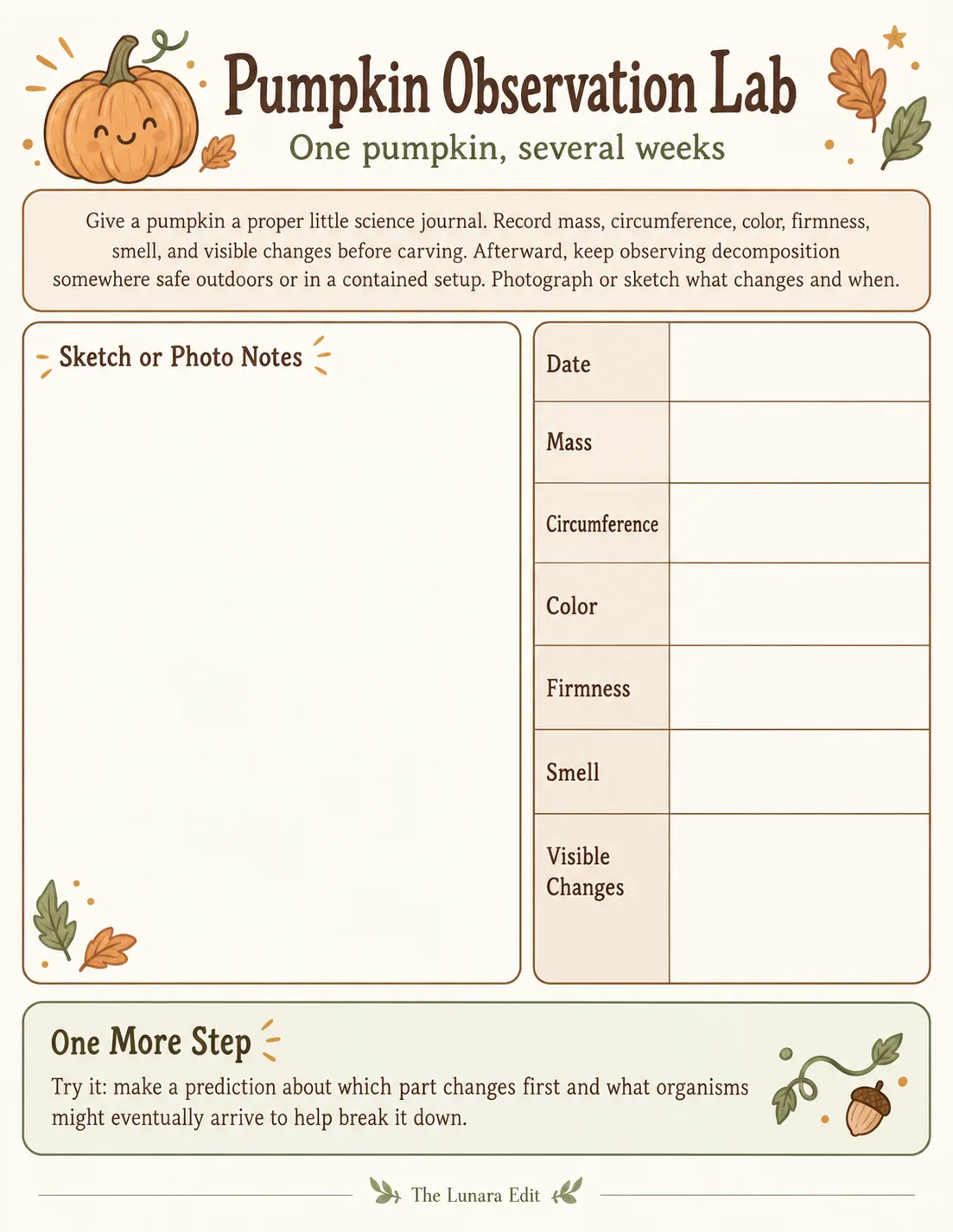
One pumpkin, several weeks. Give a pumpkin a science journal before carving, then keep observing decomposition somewhere safe outdoors or in a contained setup.
- Sketch or photograph changes and record when they happen.
- Record: date, mass, circumference, color, firmness, smell, and visible changes.
- One more step: predict which part changes first and what organisms might arrive to help break it down.
You can use these prompts in a notebook or answer aloud.
5. Nocturnal Nature Study
Read the page text and prompts
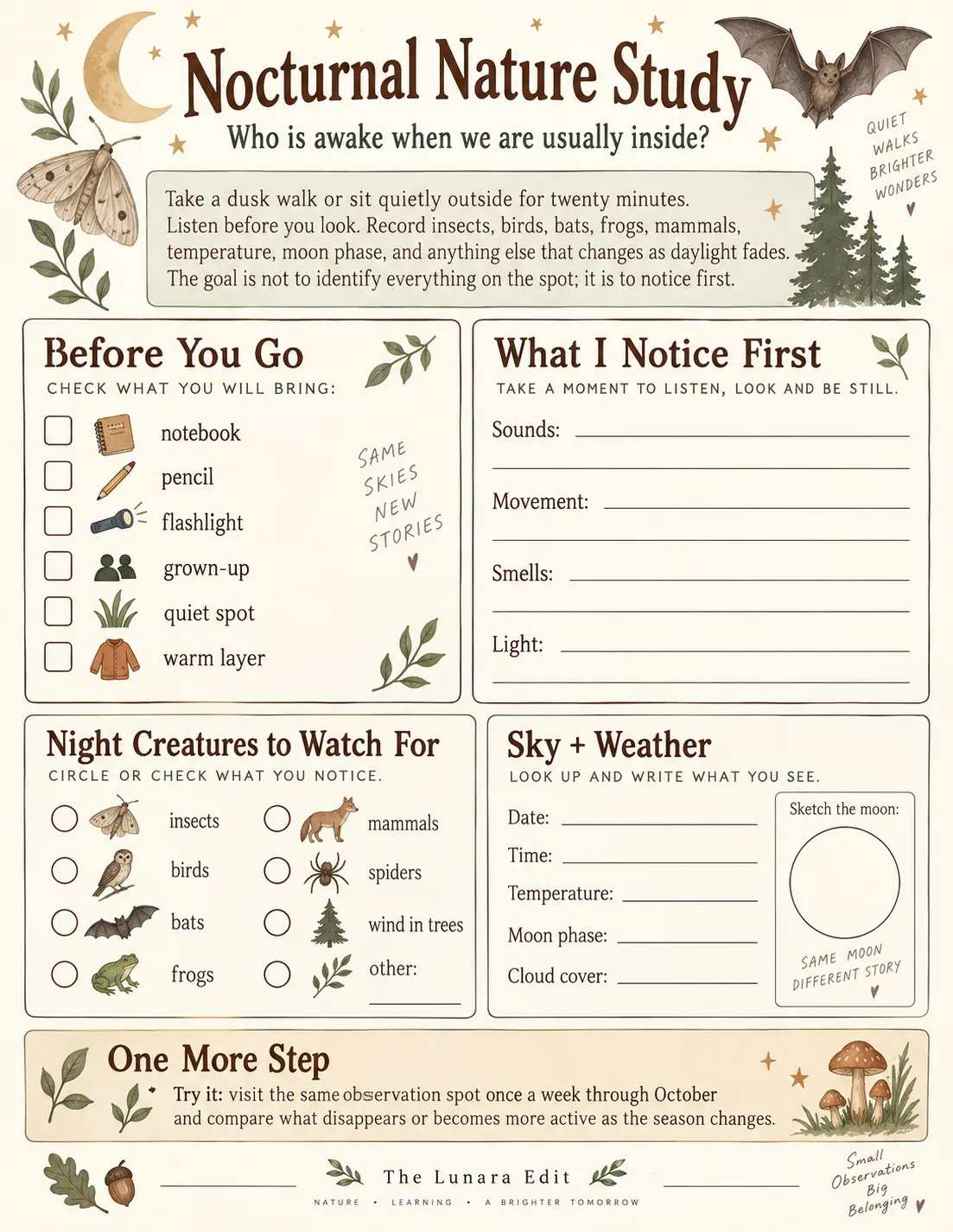
Who is awake when we are usually inside? Take a dusk walk or sit quietly outside for twenty minutes. Listen before you look. Notice first; you do not need to identify everything on the spot.
- Before you go, check what you will bring: notebook, pencil, flashlight, grown-up, quiet spot, and warm layer.
- What I notice first: take a moment to listen, look, and be still. Record sounds, movement, smells, and light.
- Night creatures to watch for: circle or check insects, birds, bats, frogs, mammals, spiders, wind in trees, and anything else you notice.
- Sky and weather: record date, time, temperature, moon phase, and cloud cover. Sketch the moon.
- One more step: visit the same observation spot once a week through October and compare what disappears or becomes more active as the season changes.
You can use these prompts in a notebook or answer aloud.
6. Nocturnal Nature Log
Read the page text and prompts
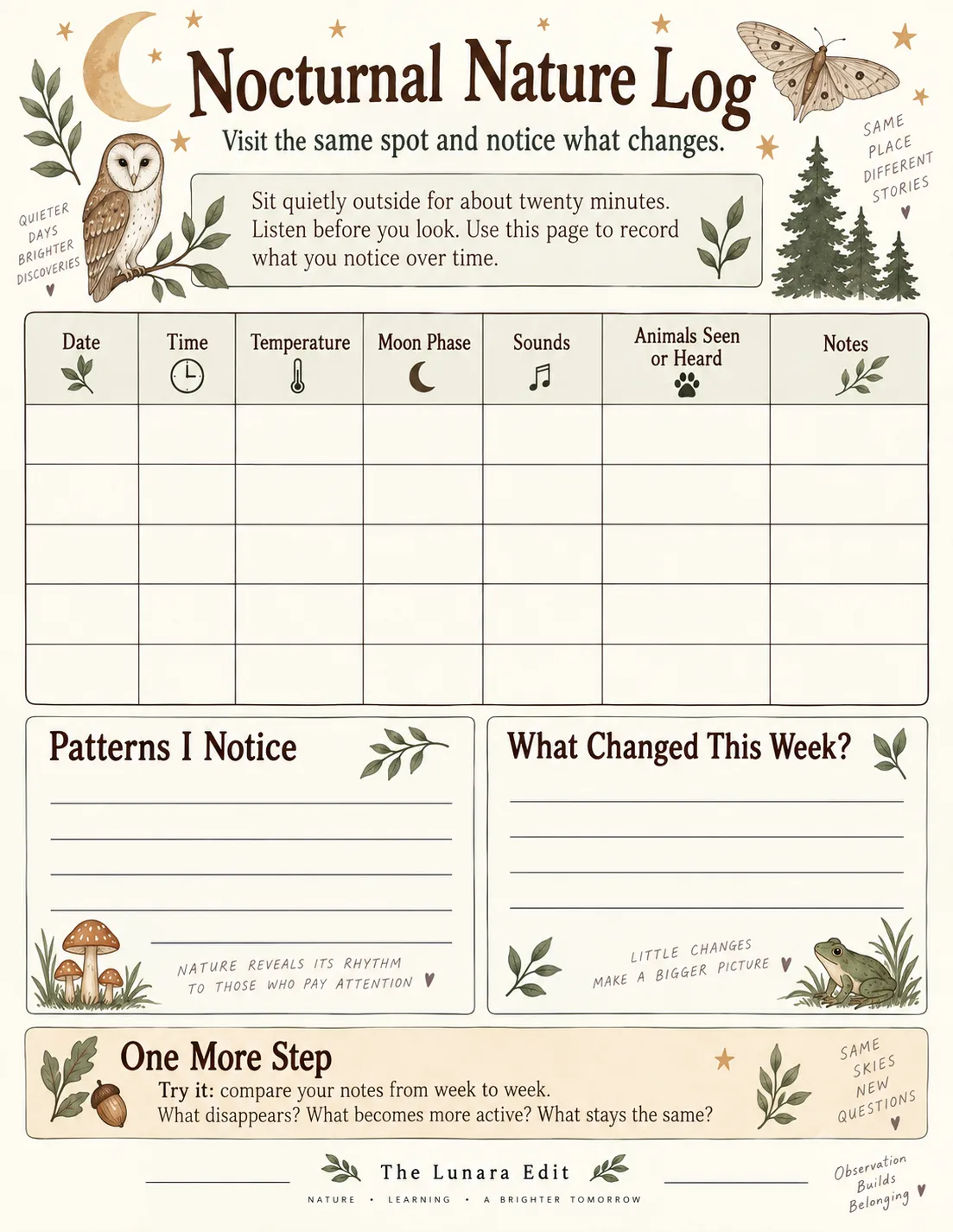
Visit the same spot and notice what changes. Sit quietly outside for about twenty minutes. Listen before you look, and record what you notice over time.
- For each visit, record: date, time, temperature, moon phase, sounds, animals seen or heard, and notes. The sheet has space for five visits.
- Patterns I notice: write down patterns across your visits.
- What changed this week? Compare your observations with last week.
- One more step: what disappears? What becomes more active? What stays the same?
You can use these prompts in a notebook or answer aloud.
7. Tiny Gothic Mystery
Read the page text and prompts
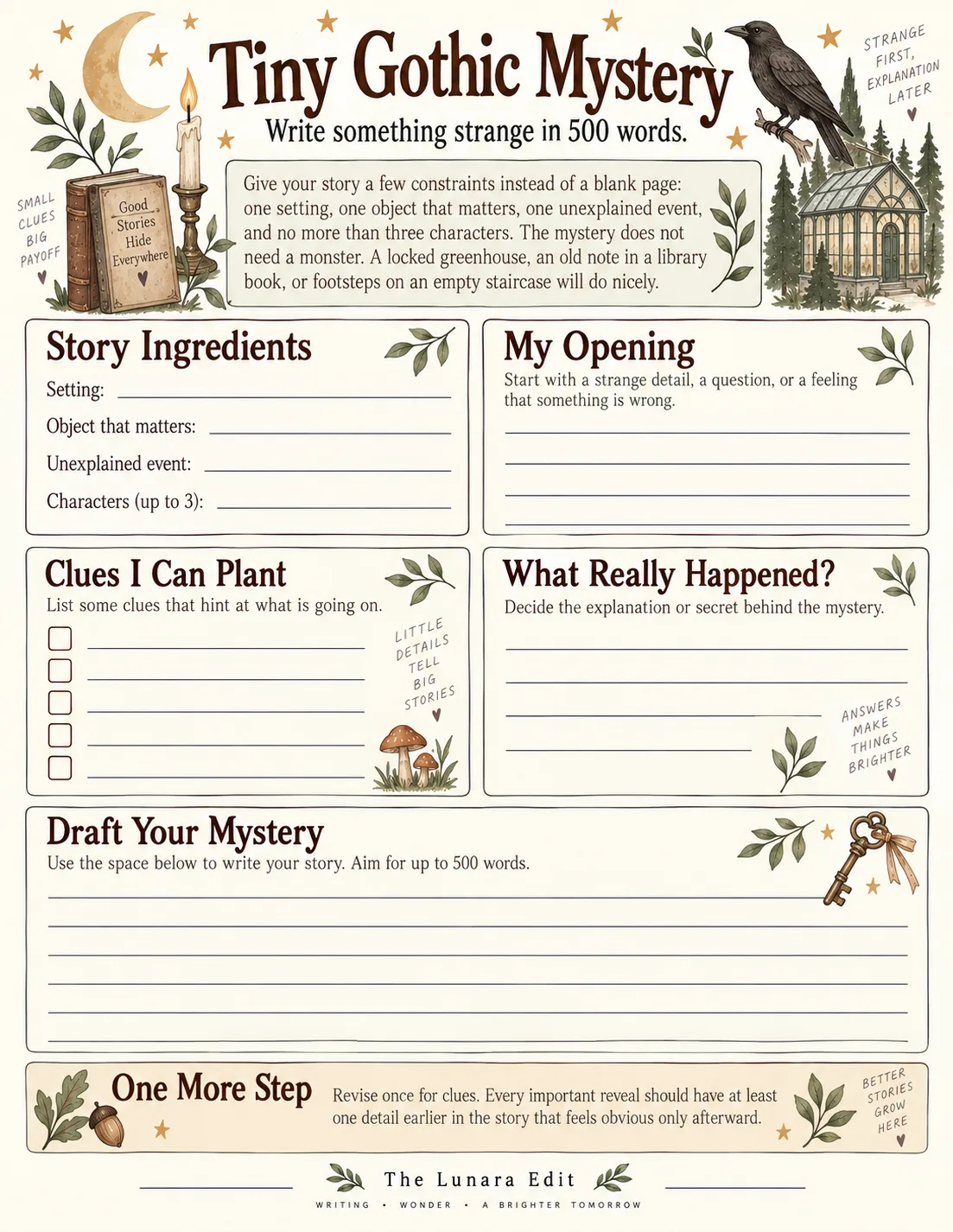
Write something strange in up to 500 words. Use one setting, one object that matters, one unexplained event, and no more than three characters. A monster is optional.
- Story ingredients: name your setting, object that matters, unexplained event, and characters (up to three).
- My opening: start with a strange detail, a question, or a feeling that something is wrong.
- Clues I can plant: list clues that hint at what is going on.
- What really happened? Decide the explanation or secret behind the mystery.
- Draft your mystery: write your story, aiming for up to 500 words.
- One more step: revise once for clues. Every important reveal should have at least one detail earlier in the story that feels obvious only afterward.
You can use these prompts in a notebook or answer aloud.
Behind the resource
I’m Kai, the homeschooling parent behind The Lunara Edit. I direct the development and make the publication decisions. I use generative AI for drafting, revision, illustrations, and page design. Read how I create and review the resources.
Using the free printables
For one household or one co-op, pod, or learning group of up to 30 learners, unless the product’s own terms say otherwise. Reprint for those learners; keep complete digital files within the licensed household or group staff. The copying restrictions concern original human-authored writing and complete packets. We do not claim exclusive copyright over purely AI-generated imagery.
See the product license, safety guidance, and download support. For larger groups or a file problem, contact us.