LEARN · SEASONAL HOMESCHOOL
7 spooky homeschool lessons for October.
A week of science, math, writing, and nature study with enough Halloween in it to feel like October — without turning the whole thing into a packet of themed worksheets.
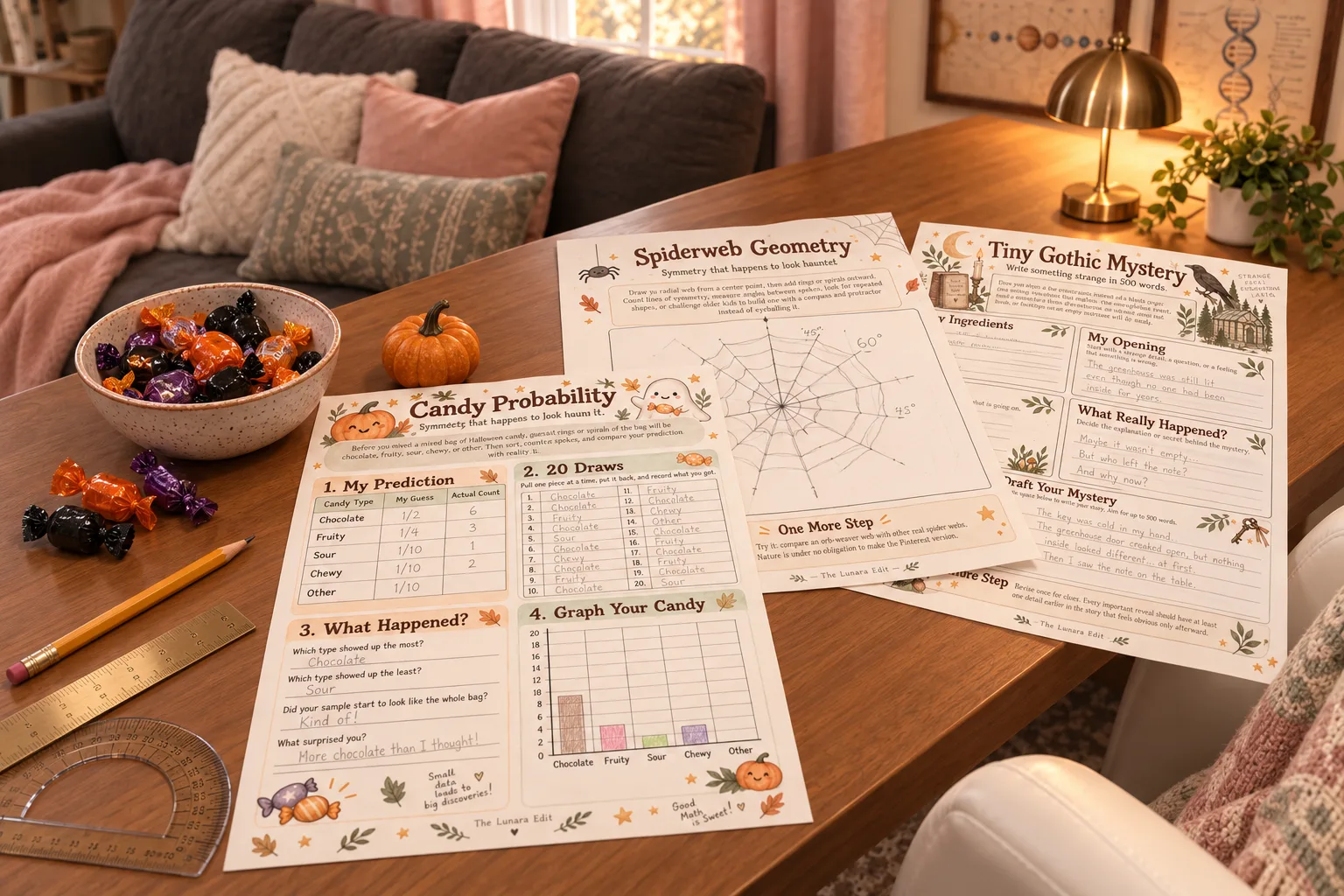
Seven printable pages for the activities below. Grab the whole set as one PDF, or preview the pages online.
Download the whole pack →A spooky week without busywork
Let October do some of the motivational work for you.
Seasonal homeschool can get painfully close to taking an ordinary worksheet, putting a pumpkin in the corner, and calling it festive. I would rather use Halloween as permission to ask better questions. Why can bats navigate in the dark? What does a rotting pumpkin become? Can a candy bag teach probability? Why do spiderwebs look geometric even though spiders have never owned a protractor?
None of these needs to become a giant project. Most work as a thirty-to-sixty-minute lesson, and several can keep going quietly in the background for the rest of the month.
The bat can be cute. The lesson should still be about sound.
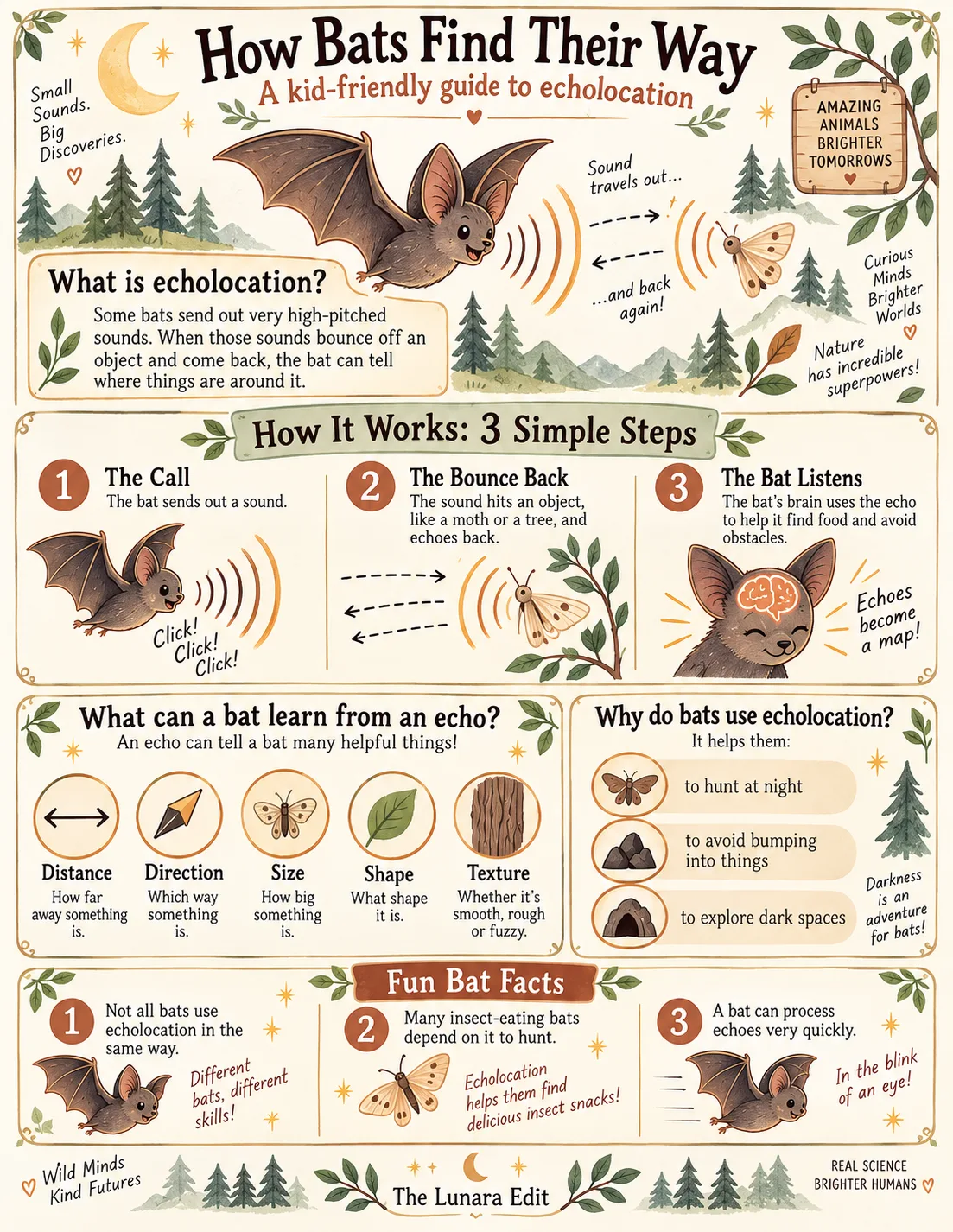
1. Bat echolocation: can you map a room without seeing it?
Start with the actual question bats solve: how do you move through darkness when vision is not useful? One kid closes their eyes while another makes soft clicks from different positions. Talk about echoes, reflected sound, distance, and why real bat echolocation is much more precise than our human version.
Make it more fun: if you have a LiDAR-equipped iPhone, a parent can try the Night Vision LiDAR Camera app and let one kid try to locate the other using the phone’s depth view instead of ordinary vision. It is not how bats echolocate, of course — which makes the comparison useful. Both systems build information about space without relying on a normal bright visual scene.
Try it: compare a bare room, a room with blankets or pillows, and a hallway. Which space gives you the clearest reflected sound? Why?
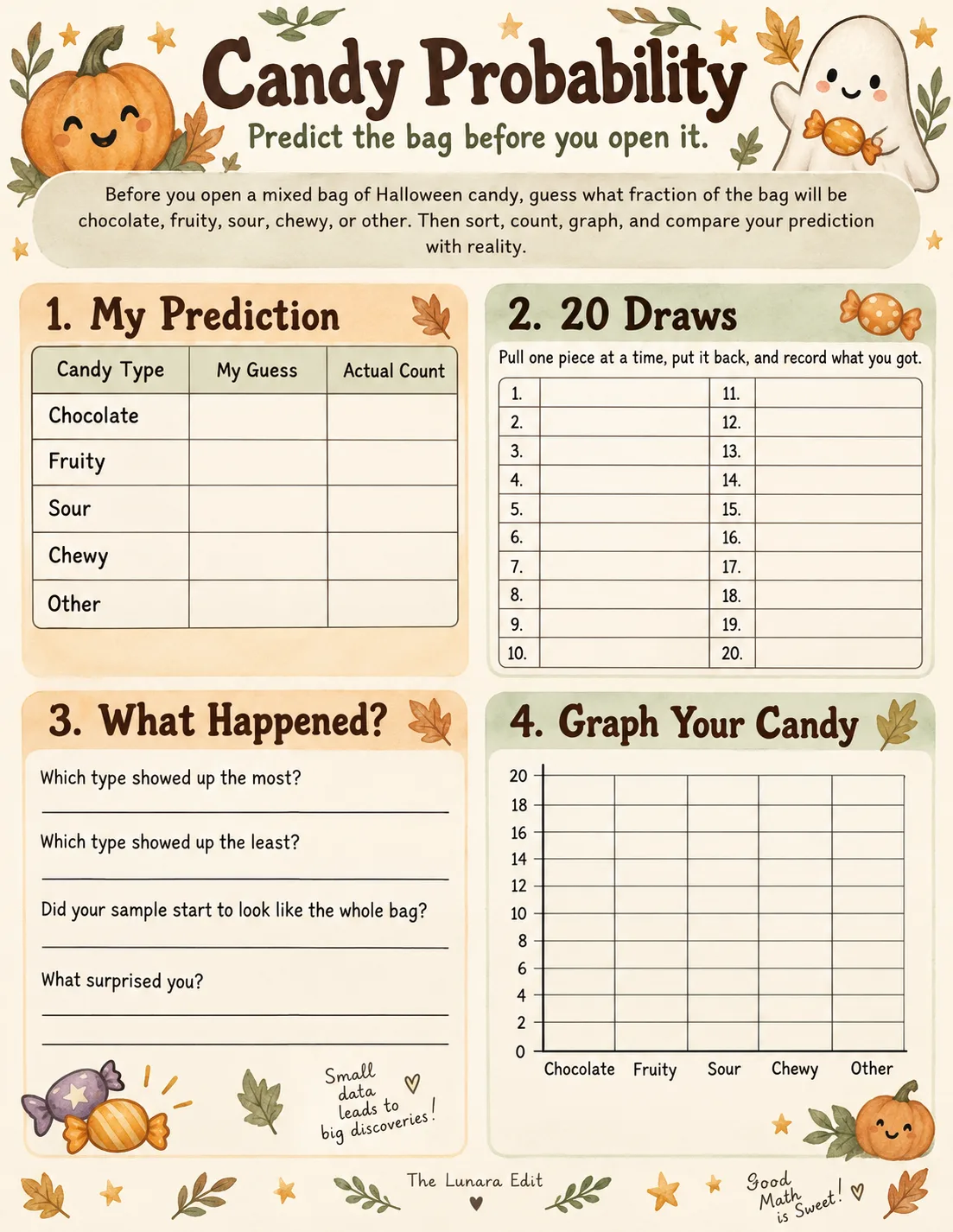
2. Candy probability: predict the bag before you open it
Before opening a mixed bag of Halloween candy, estimate what fraction will be chocolate, fruity, sour, or whatever categories make sense for your bag. Then sort, count, graph, and compare the prediction with reality. For older kids, turn counts into fractions, percentages, or experimental probability.
Try it: pull one piece at a time, replace it, and record 20 draws. Does the sample begin to resemble the whole bag?
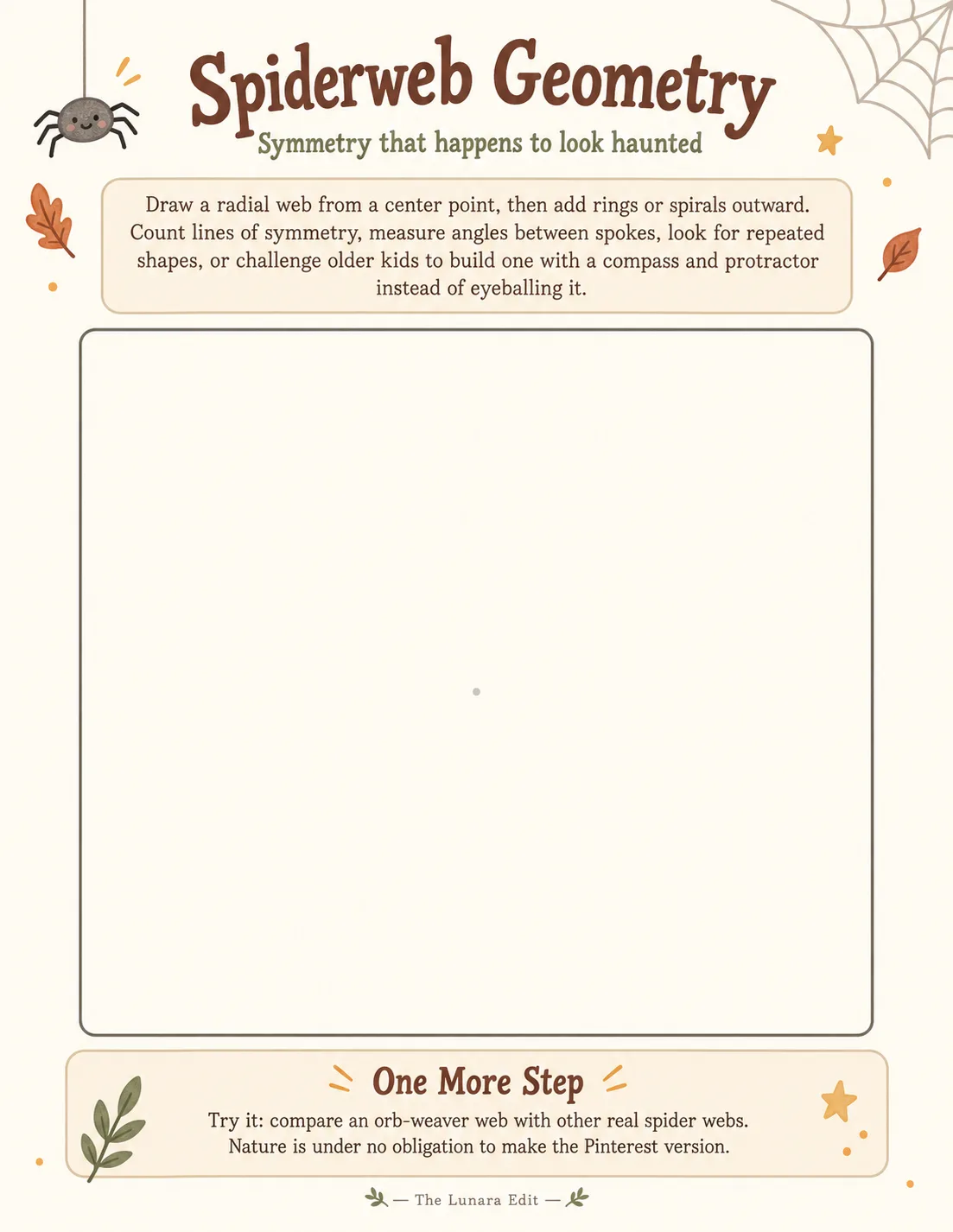
3. Spiderweb geometry: symmetry that happens to look haunted
Draw a radial web from a center point, then add rings or spirals outward. Count lines of symmetry, measure angles between spokes, look for repeated shapes, or challenge older kids to build one with a compass and protractor instead of eyeballing it.
Try it: compare an orb-weaver web with other real spider webs. Nature is under no obligation to make the Pinterest version.
FOR THE GROWN-UPAngles, symmetry, and what to say — open if geometry is not fresh in your mind
This is the lesson most likely to stall at the table, so here is the whole thing before you sit down. The printable has a small dot pre-printed in the middle of the box — everything starts from that dot.
The entire idea, in one sentence
A full turn around a point is 360 degrees. If you want the spokes evenly spaced, divide 360 by how many spokes you want. Eight spokes means 360 ÷ 8 = 45° apart. Six spokes means 60°. Twelve means 30°. That is the lesson. Everything below is just how to get it onto paper.
No protractor? Fold the paper instead
This gets you eight perfectly even spokes with no measuring at all, and for younger kids it lands better:
- Fold the sheet in half through the center dot. The crease is a straight line — that is 180°.
- Fold in half again. Now you have quarters, 90° each.
- Fold once more. Eighths, 45° each.
- Open it flat and trace over the creases outward from the dot.
Same math, done with hands instead of numbers. It is also a genuinely good way to show why 45° is the answer rather than asserting it.
If you do have a protractor
- Put the small hole or crosshair at the bottom of the protractor exactly on the center dot.
- Line up 0° with your first spoke.
- Make a small mark at 45, 90, 135, and so on, then draw each line back to the dot.
The mistake everyone makes: a protractor has two rows of numbers running in opposite directions. If your 0° is on the right, read the row that starts at 0 on the right. If an angle you called 45° looks obviously wider than the corner of the page, you read the wrong row.
Questions that do the teaching for you
You do not have to explain any of this. Ask instead:
- “If we want six spokes instead of eight, how far apart should they be?” (360 ÷ 6 = 60°)
- “If we add one more spoke, does the angle get bigger or smaller?” Smaller — more spokes, less room each.
- “Where else have you seen this shape?” A bike wheel, a pizza, an orange slice — and the useful one, a clock face. A clock is a twelve-spoke web where every hour is 360 ÷ 12 = 30°. A kid who can read a clock already understands this lesson; they just have not been told that is what it is.
- Once it is drawn: “How many ways could you fold this so both halves match exactly?”
The two kinds of symmetry
Worth naming out loud, because school usually only covers the first one. Reflective symmetry is the folding kind — a web with eight even spokes folds onto itself eight different ways. Rotational symmetry is the spinning kind — turn that same web by 45° and it looks untouched. A web has both, which makes it a much better example than the butterflies usually used for this.
If you want to keep going
After the spokes come the rings, and there are two ways to draw them. If the gap between rings stays the same the whole way out, that is an Archimedean spiral — roughly what an orb weaver’s sticky capture spiral does. If the gaps get wider as you go out, that is a logarithmic spiral, the nautilus-shell one. Ask which one they drew. For a teenager: an Archimedean spiral is written r = a + bθ, which is a gentle first look at a coordinate system that is not x and y.
Roughly by age
- 4–6: count the spokes, fold to make them even, ask whether this wedge is the same size as that one.
- 7–9: do the 360 ÷ n division, then check a couple of angles with a protractor to see if the division was right.
- 10–13: name rotational versus reflective symmetry, then try an odd number of spokes — five gives 72°, and the fold lines still work out, which is worth sitting with.
- 14+: Archimedean versus logarithmic spirals, polar coordinates, and why an evenly spaced capture spiral costs the spider less silk for the same catching area.
What tends to go wrong
- Spokes that do not quite meet in the middle. Start every single line at the dot, not at the outside edge.
- Reading the wrong row on the protractor, as above.
- A kid upset that theirs is not perfect — which is the best possible lead-in to the step at the bottom of the sheet. Real orb webs are not even. The spokes sit at uneven angles, there is often a gap, and the whole web is usually tilted. That is not a sloppy spider; it is one solving for the anchor points it actually has and for gravity. Holding the drawing next to a photo of a real web and asking what is different is the real science in this lesson.
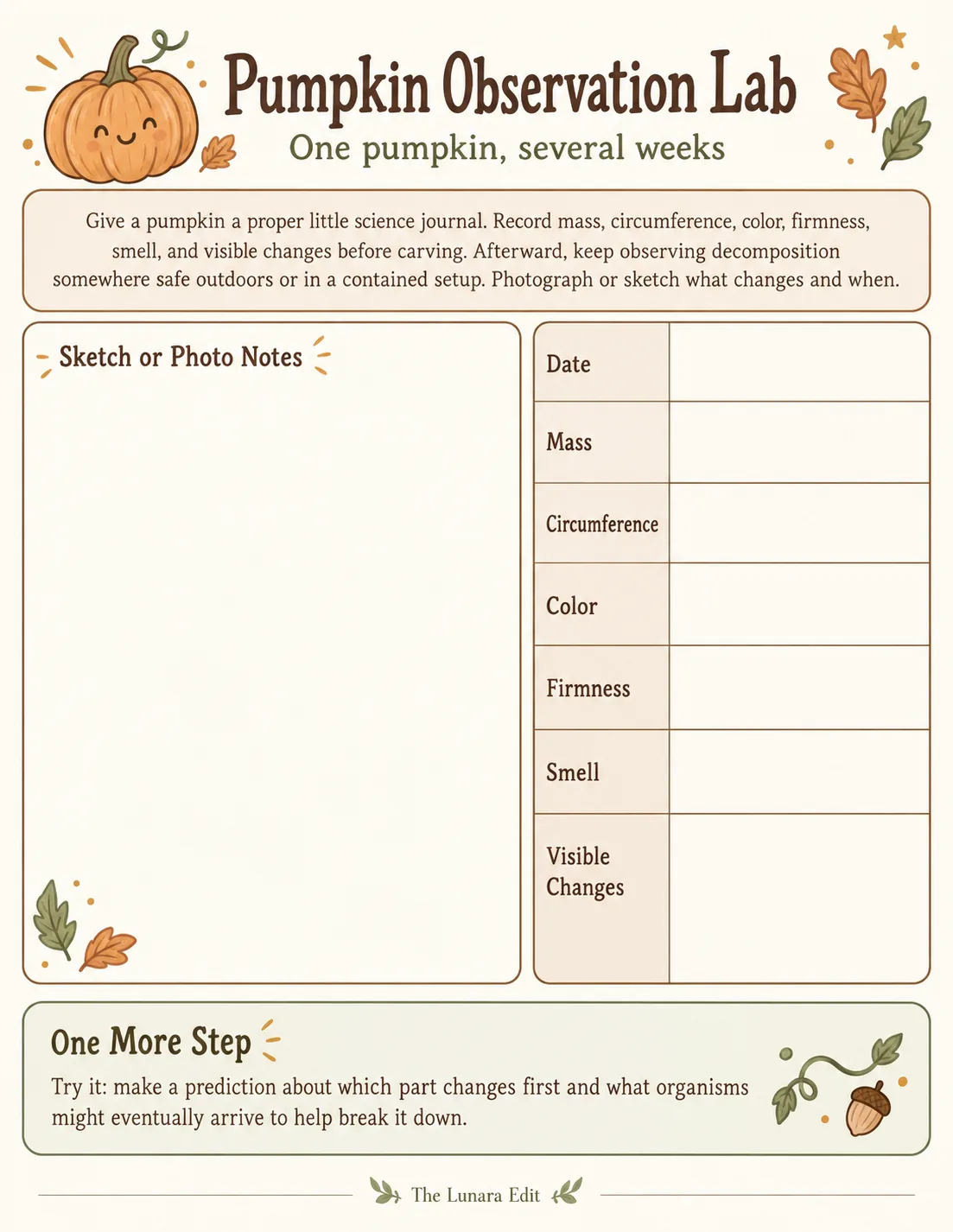
4. Pumpkin observation lab: one pumpkin, several weeks
Give a pumpkin a proper little science journal. Record mass, circumference, color, firmness, smell, and visible changes before carving. Afterward, keep observing decomposition somewhere safe outdoors or in a contained setup. Photograph or sketch what changes and when.
Try it: make a prediction about which part changes first and what organisms might eventually arrive to help break it down.
5. Ghost density: make a ghost that sinks, floats, or hovers
Build tiny “ghosts” from different lightweight materials and test them in air or water, depending on the version you choose. Tissue, foil, cotton, paper, foam, and clay all behave differently. The Halloween part is decoration; the useful part is asking what makes something float, fall slowly, sink, or stay suspended.
Try it: change only one variable at a time — material, mass, shape, or trapped air — and see what actually changes the result.
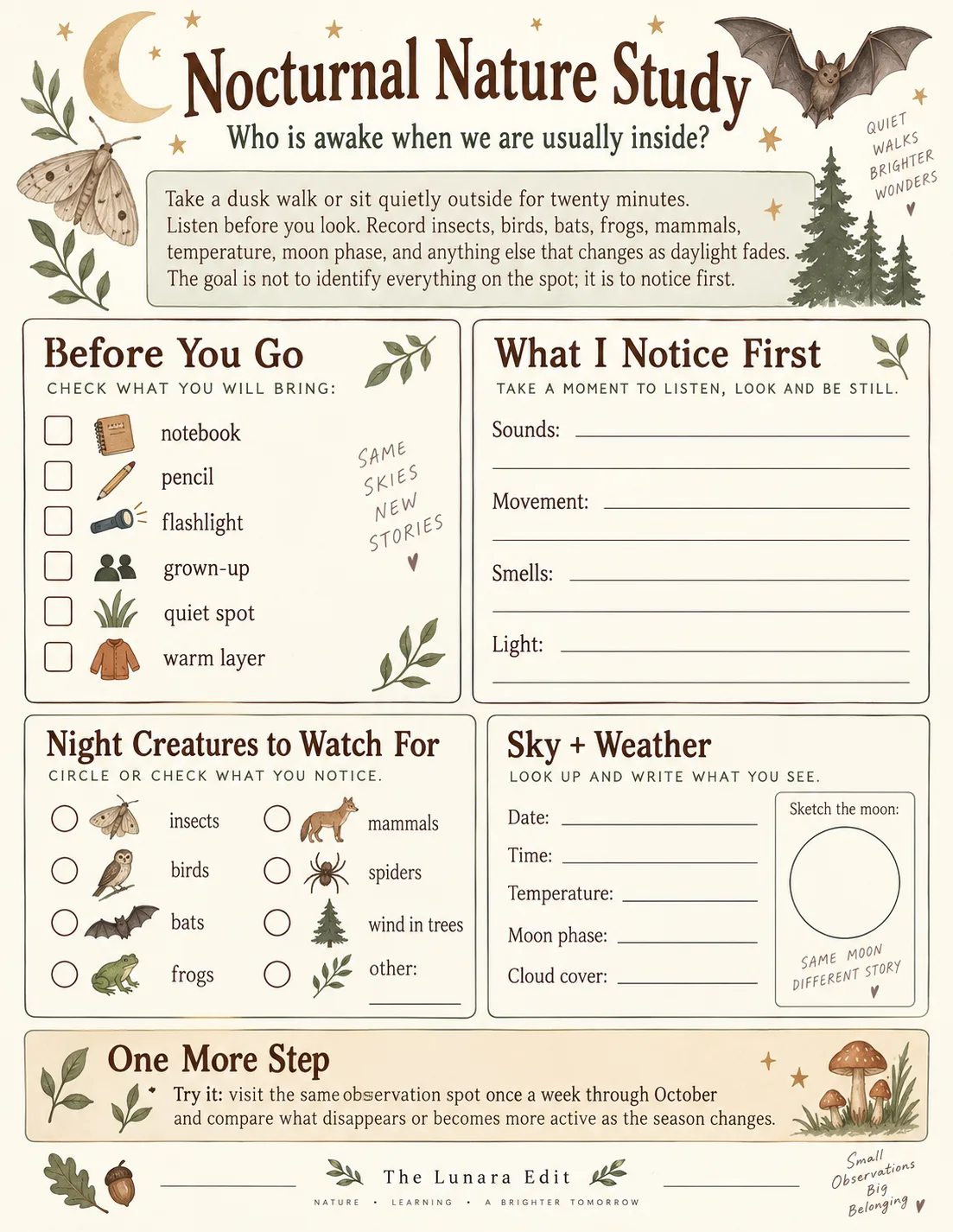
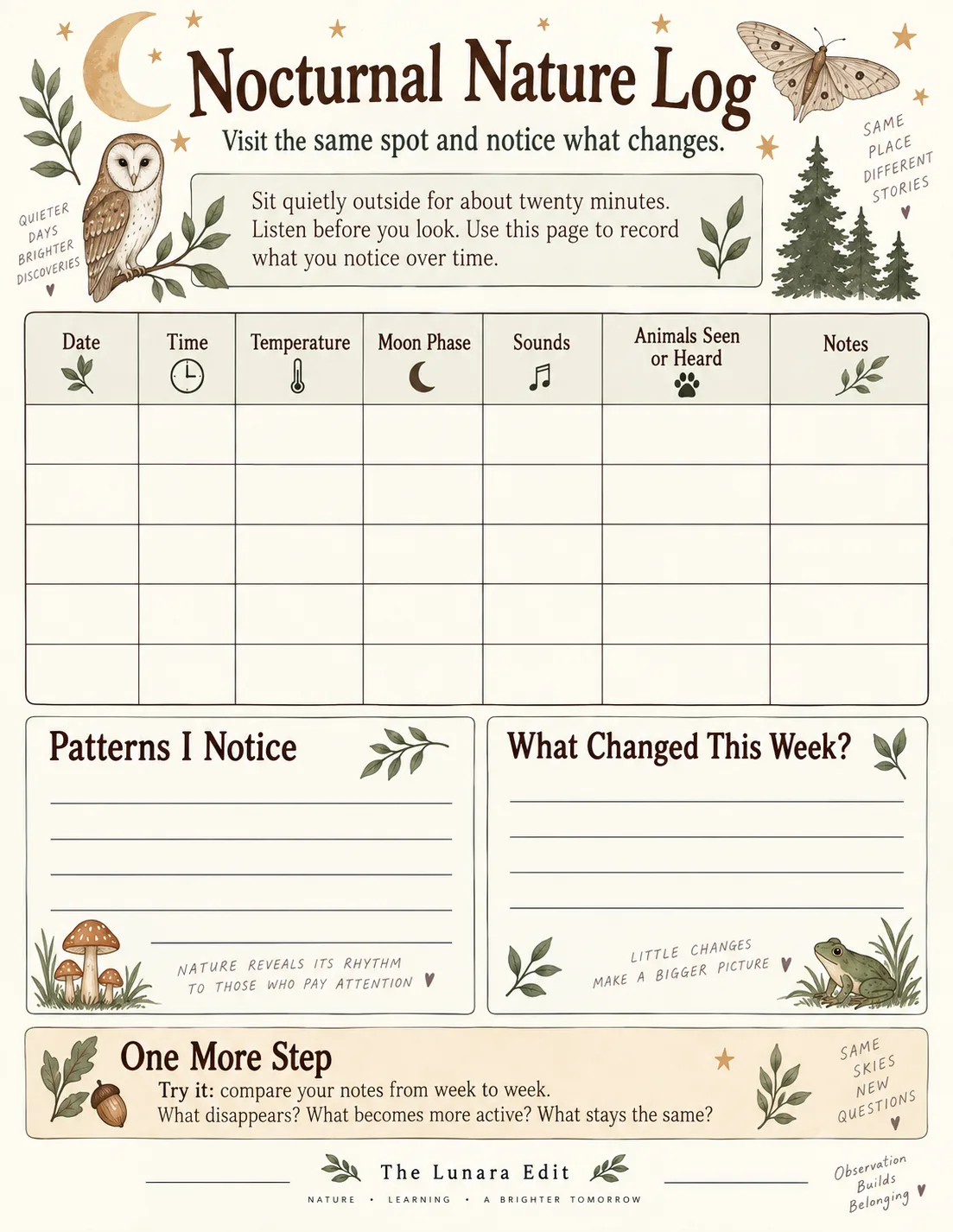
6. Nocturnal nature study: who is awake when we are usually inside?
Take a dusk walk or sit quietly outside for twenty minutes. Listen before you look. Record insects, birds, bats, frogs, mammals, temperature, moon phase, and anything else that changes as daylight fades. The goal is not to identify everything on the spot; it is to notice first.
Try it: repeat the same observation spot once a week through October and compare what disappears or becomes more active as the season changes.
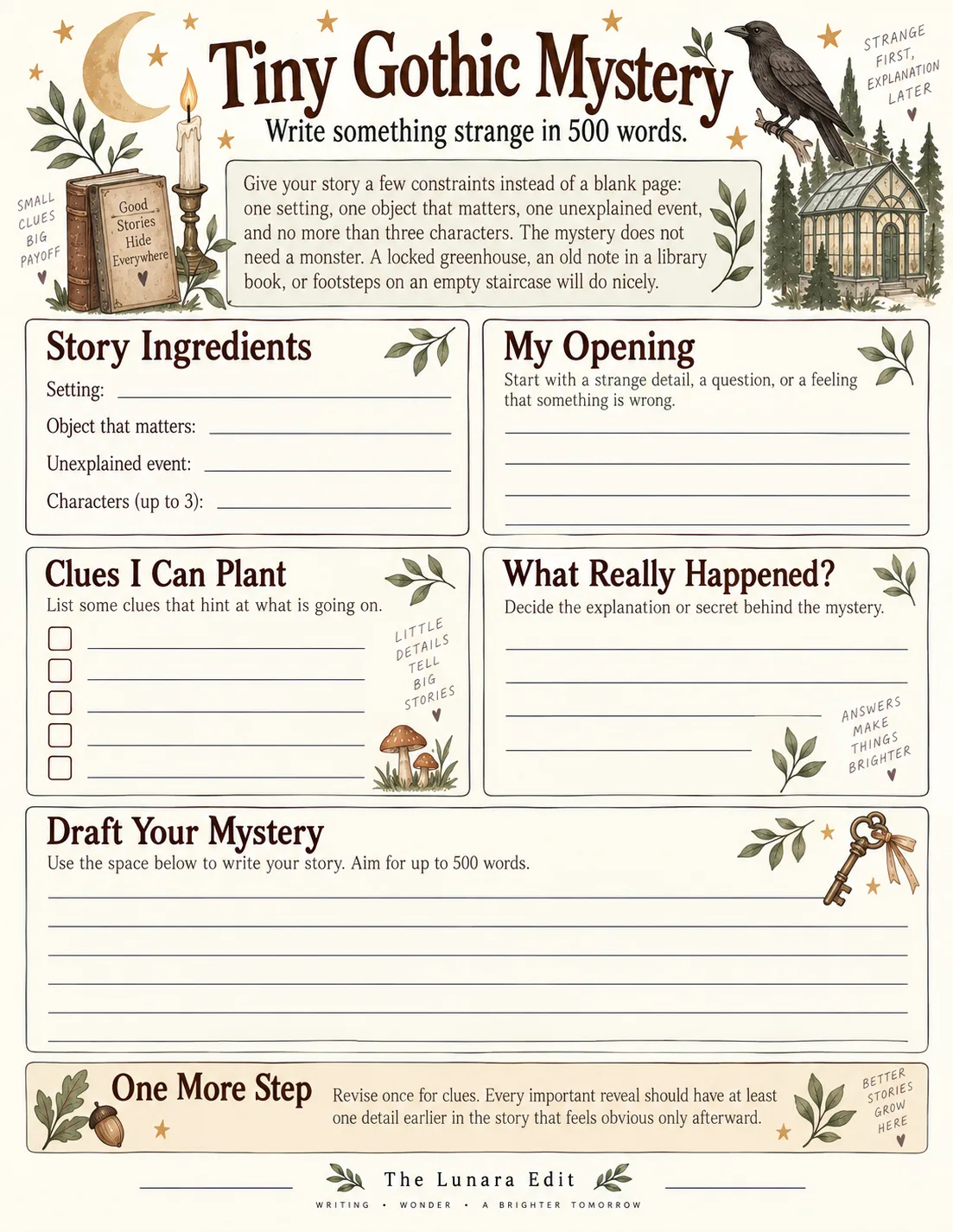
7. Tiny gothic mystery: write something strange in 500 words
Give the story constraints instead of a blank page: one setting, one object that matters, one unexplained event, and no more than three characters. The mystery does not even need a monster. A locked greenhouse, an old note in a library book, or footsteps on an empty staircase will do nicely.
Try it: revise once for clues. Every important reveal should have at least one detail earlier in the story that feels obvious only afterward.
A supply list that won’t haunt you
You do not need a Halloween homeschool haul. Most of this can happen with paper, pencils, a ruler, a measuring tape, a kitchen scale if you have one, a flashlight, a pumpkin, whatever candy was already going to enter the house, and ordinary craft scraps. A magnifying glass is delightful but hardly a prerequisite for scientific thought.
- Notebook or observation pages
- Pencils, ruler, measuring tape
- Kitchen scale
- Flashlight
- Magnifying glass or inexpensive hand lens
- Basic craft paper, foil, cotton, string
- One pumpkin willing to make the ultimate sacrifice
- Matching Halloween bins
- Seven different themed printable packs
- A cart full of seasonal manipulatives
- Buying a special product for every lesson
- Making the entire house look like a classroom in October
Stretch it across ages instead of teaching three separate lessons.
Younger kids can draw observations, count, sort, narrate what happened, and make predictions aloud. Older kids can calculate percentages, control variables, research mechanisms, graph repeated observations, or revise the gothic story with actual narrative structure. Same table, same general activity, different depth. That is one of my favorite homeschool tricks because I enjoy learning considerably more when I am not running three classrooms.
KEEP THE WHOLE SET
The Spooky Homeschool Week
All seven activity pages, combined into a single PDF. Print the whole week at once, pick out just the pages you want, or keep it on a tablet and hand it over.