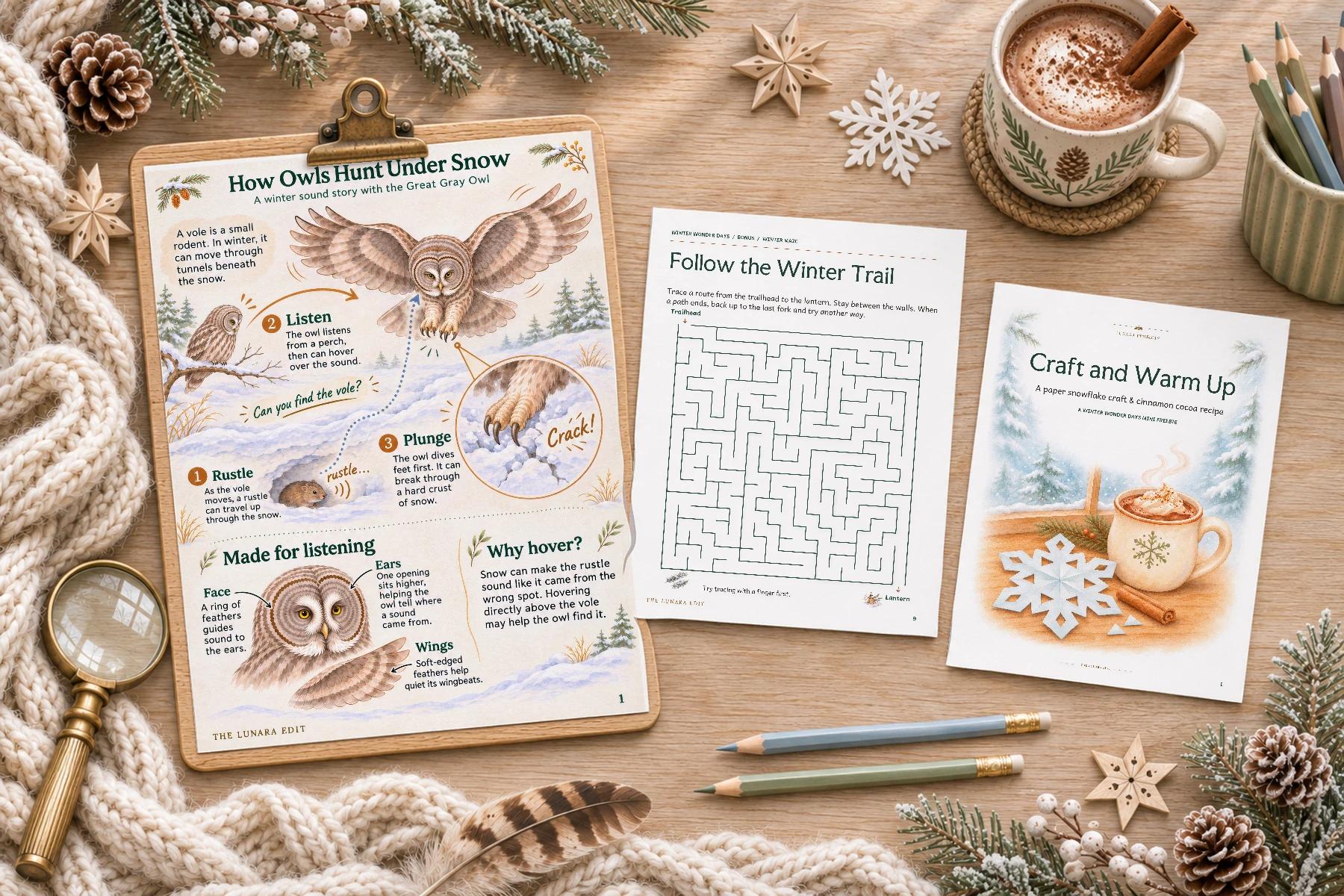
Follow the sound
Great Gray Owls hunt small mammals, including voles. In winter, an owl can listen from a perch for prey beneath the snow, move above it, and drop talons first to catch it. The animal is hidden, but some of its sound reaches the air.
Look at the owl’s broad, round face. The ring of feathers around it is called a facial disc, and it helps gather sound toward the ears. The ear openings also sit at different heights, helping the owl work out where a sound begins. Those features give it useful clues about a meal it cannot see. [1]
On the printable picture, find the vole first. Then follow its rustle toward the owl and look for the owl’s feet in the plunge. Asking a child to trace what happens often gives you a clearer starting point than asking them to explain the whole page at once.
Snow can shift the apparent source
Snow muffles sound, but it also changes its path. Researchers Christopher Clark, James Duncan, and Robert Dougherty studied this by placing a speaker beneath snow and measuring the sound above it. In their 2022 study, snow made the speaker seem to be in a different position when the sound was measured from an angle. They called this an acoustic mirage. [2]
Think of hearing a rustle and looking toward the place it seems to begin. If the snow has shifted that apparent position, the owl has another problem to solve before it dives.
The researchers found the smallest shift when listening directly above the buried sound source. This helps explain why Great Gray Owls may hover before plunging: that position can give them a clearer location. It is an explanation supported by measurements of sound passing through snow; it does not mean scientists followed an owl’s thoughts through each hunt. [2]
When you return to the picture, look at where the owl pauses above the vole. Its position is part of the story, too.
Try a paper-rustle listening game
You can explore the question “Where did that sound begin?” at home with a partner, a chair, and a sheet of paper. The printable listening page gives you room to record four rounds.
- Have the listener sit looking straight ahead. From their point of view, choose three spots: left, right, and behind, each about the same distance from the chair. Let them hear a gentle practice rustle.
- Move to one spot before the listener says they are ready, so your footsteps are not the clue. Keep the rustle gentle and use the same sheet of paper each time.
- Make one rustle while the listener keeps facing forward. Let them choose left, right, behind, or “not sure.”
- Reveal where you stood and record both the guess and the actual spot. Try four rounds, mixing up your positions.
Choose one round to talk about afterward. What helped the listener decide? Did a sound seem to come from somewhere else? “I heard it, but I couldn’t tell where” is useful information to record, too.
This activity lets you notice how you use sound to judge direction in a room. It does not recreate sound traveling through snow or test whether someone hears like an owl. If listening for direction is uncomfortable or difficult, read the owl picture together instead, or have your child help make and reveal the sounds.
Take the question a little farther
With an older learner, look back at what stayed the same during the game: the paper, the gentle rustle, and roughly the distance from the chair. Keeping those similar helps you focus on the changing position. If you want to try a different distance, start a new set of rounds and write down what you changed.
You can also ask what the room game leaves out. There is no hidden vole, no layer of snow changing the sound’s path, and no hovering owl. Naming those differences helps a child see how an activity can explore one part of an animal’s world without reproducing the whole thing.
The owl and listening printables
Both pages are included in Winter Wonder Days, along with a winter lights graph, snowflake drawing, ice and window observations, a lantern mystery, a picture hunt, and a maze. The main pack has nine learner pages and a separate six-page Parent & Teaching Guide with preparation notes, sources, and explained answers. It is written for ages 6–10 with reading help as needed.
The printable downloads are coming soon. You can try the listening game above with a partner and a sheet of paper, then explore the winter collection for the other activities.
Sources
- Cornell Lab of Ornithology: Great Gray Owl life history. Hunting behavior and hearing adaptations.
- Clark, C. J., Duncan, J., & Dougherty, R. (2022). Great Gray Owls hunting voles under snow hover to defeat an acoustic mirage. Proceedings of the Royal Society B, 289, 20221164. Sound measurements and the proposed role of hovering.
Behind the resource
I’m Kai, the homeschooling parent behind The Lunara Edit. I direct the development and make the publication decisions. I use generative AI for drafting, revision, illustrations, and page design. Read how I create and review the resources.
Using the free printables
For one household or one co-op, pod, or learning group of up to 30 learners, unless the product’s own terms say otherwise. Reprint for those learners; keep complete digital files within the licensed household or group staff. The copying restrictions concern original human-authored writing and complete packets. We do not claim exclusive copyright over purely AI-generated imagery.
See the product license, safety guidance, and download support. For larger groups or a file problem, contact us.