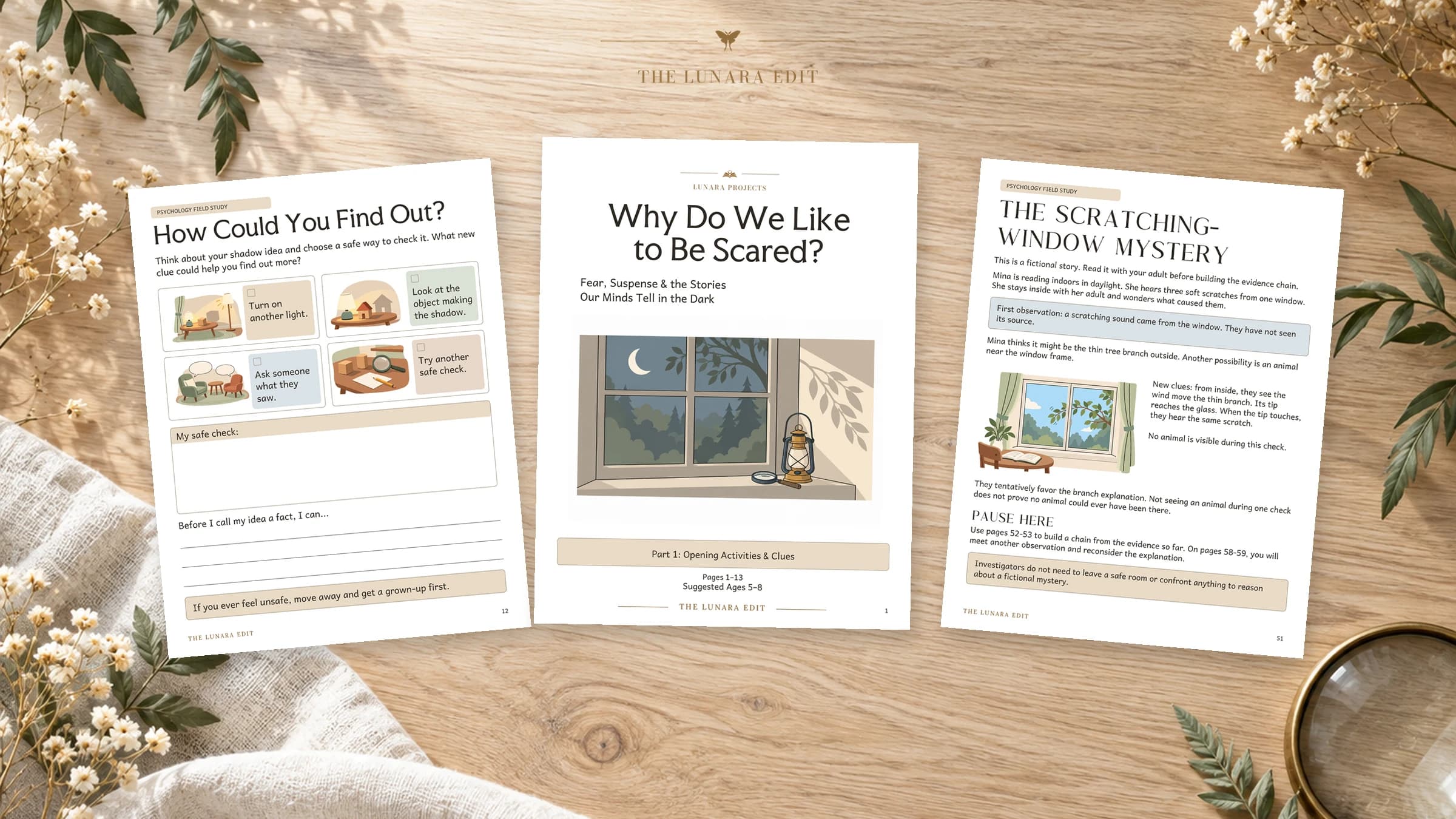
If your child enjoys a spooky story, they might like finding out how it works. You can look at what a character actually saw or heard, talk about what they guessed, and see whether another clue changes their mind.
In Why Do We Like to Be Scared?, you’ll explore those ideas through picture clues, body maps, stories and simple activities you can try together. The printable study comes in two editions, for ages 5–8 and ages 8+, each with a teaching guide to help you set things up and talk through the answers.
There is plenty to investigate without anyone needing to feel frightened. A child who would rather watch, draw or discuss a fictional mystery can still follow the questions. You agree on what will happen, keep the examples harmless and stop when someone wants to stop.
Start with what you actually noticed
A clue and an explanation are easy to muddle together. “I heard scratching” describes an observation. “Something is trying to get in” adds a story about its cause. The study gives learners practice separating those steps, suggesting another explanation and deciding what information could help.
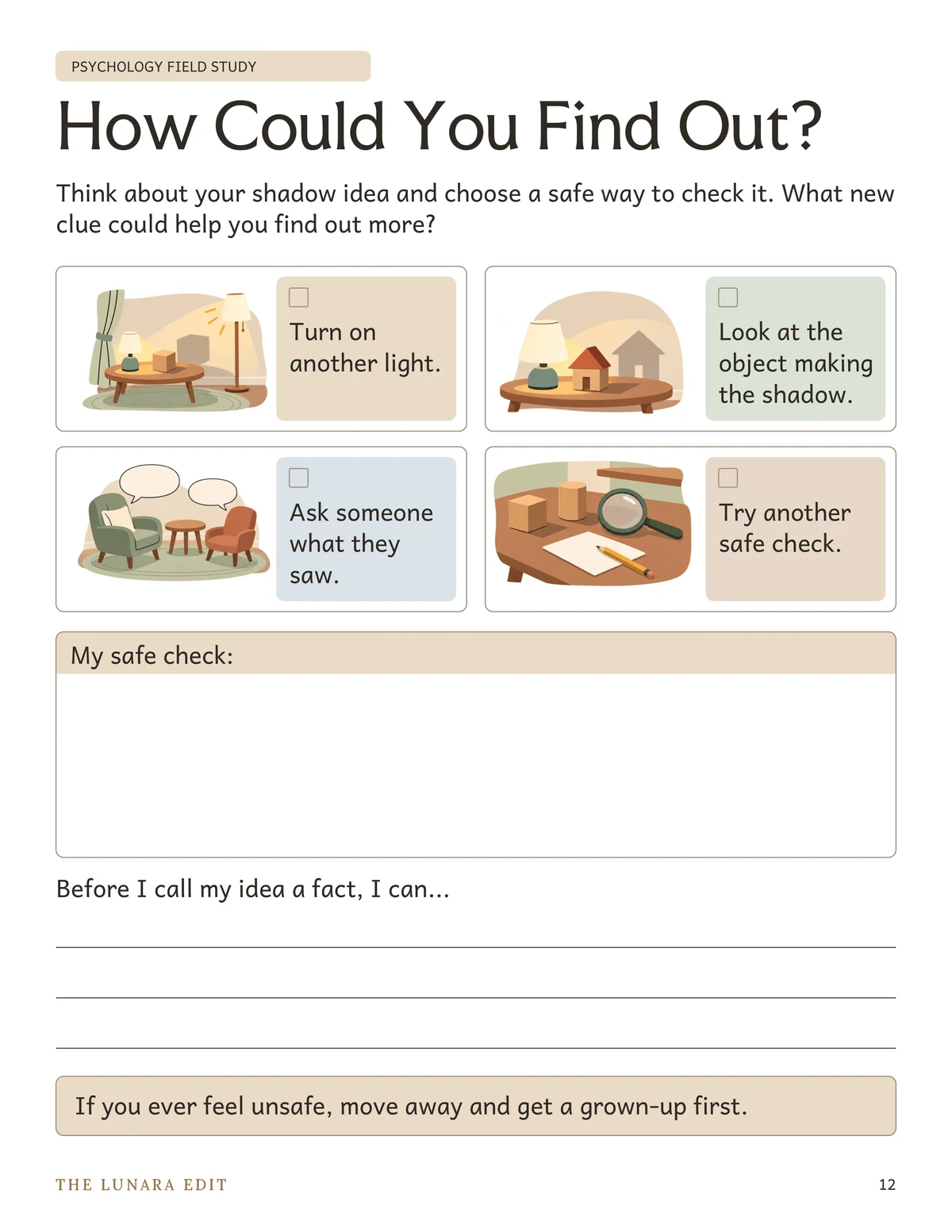
Younger children work with pictures, short examples and safe-check choices. Older learners build evidence chains, compare the strength of different claims and revisit an explanation when a later clue no longer fits. The same questions run through both editions: What did I notice? What might it mean? What else could explain it?
Choosing between the two editions
The ages 5–8 edition is designed for exploring alongside a grown-up. You read and talk together, and your child can point, circle, draw, speak or dictate. Picture clues, a body map and short story activities make room for children who have ideas to share but are not ready for long written answers.
The ages 8+ edition asks for more sustained comparison and explanation. Learners examine variables, plot fear and enjoyment ratings, consider samples and research limits, and design a harmless suspense experience. Some can read or respond independently between activities, while the adult remains involved in setup, consent and feedback. Abstract vocabulary and multi-step reasoning mean that the sample pages are a better guide to fit than an age label by itself.
| Edition | Learner pages | Guide | Total |
|---|---|---|---|
| Ages 5–8 | 47 in 3 parts | 10 pages | 57 pages / 4 PDFs |
| Ages 8+ | 78 in 3 parts | 26 pages | 104 pages / 4 PDFs |
Each edition will be a separate purchase; one age edition does not automatically include the other.
What the activities look like
The younger study begins with gentle changes in a familiar room, then moves into clues and guesses, shadow explanations, body feelings and the difference between something feeling spooky and feeling fun. Children compare short stories and plan a harmless mystery through drawing or telling. The guide offers a lighter route using one example and spoken responses when that suits the day.
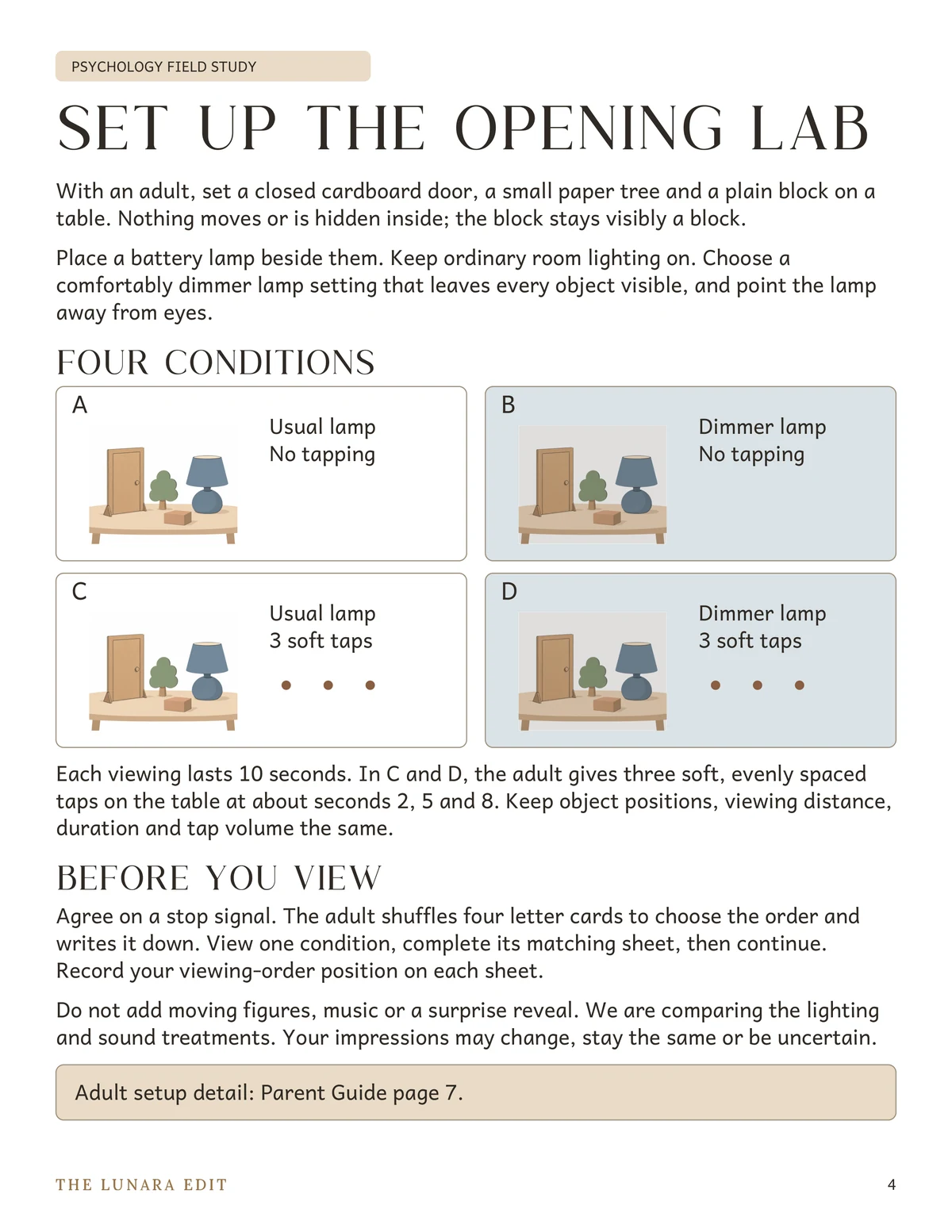
Older learners start with a four-condition Opening Lab, then explore the Mystery Bag, body signals, paired ratings and uncertainty. A fictional window mystery lets them follow evidence without leaving the room to investigate a real disturbance. Later, they plan a suspense experience, ask a willing helper to try it and consider how the feedback compares with their prediction.
Making room for different reactions
Fear and enjoyment get separate attention in the study. Something can be a little spooky and enjoyable for one person, while another would happily choose a different activity. A learner who notices no change in body feelings has still recorded a useful response. The activities do not need a particular reaction to count as learning.
In a 2020 haunted-attraction study of 110 visitors ages 12–57, reported enjoyment was highest around a middle range of fear. That describes a pattern in that setting and sample; it does not supply a target intensity for a family activity. The accompanying almanac article, Why a Little Fear Can Feel Like Fun, takes a closer look at that research.
Planning a session
For ages 5–8, the guide suggests around 15–30 minutes per session, with interest and comfort setting the pace. You can pause after a clue example, the object reveal or a drawing. There is no required total completion time.
For ages 8+, most sessions are estimated at 15–30 minutes, with longer story or design work taking 30–45 minutes or another sitting. The guide’s overall planning range is roughly 4–8 hours of core learner work, with additional time for optional projects, extended writing and discussion. Those are planning estimates rather than times measured with a class or family.
The younger edition calls for paper, pencils or crayons, a battery lamp, a familiar room and table, a cloth bag or pillowcase, and a clean, familiar safe object. The older edition also uses a small cardboard door, paper tree, plain block, timer, four letter cards and a coin. A willing family member or trusted adult helps with the final older-learner design test. The activities do not require internet access or frightening videos.
An adult previews the guide, prints and orders the selected pages, checks the object and explains the activity before inviting anyone to join. The older guide estimates 20–35 minutes for initial preparation, with shorter resets later. Keep ordinary visibility and use a battery lamp for the lighting activities. No surprise touch, jump scare or pretend real danger is needed.
Subjects and the work they support
Psychology appears through body responses, attention, choice and uncertainty. Science reasoning comes through comparing explanations and asking what evidence supports a claim. Language arts appears in discussing clues, explaining an idea and planning a story. The older edition also brings in mathematics through paired ratings and graphing, and media literacy through questions about sources and unsupported additions to a story.
The activities give learners practice with these ideas, and the guides include explained answers, setup notes and sources to help you talk through the questions together.
What comes with the download
Each edition contains three learner PDFs and its own Parent & Teaching Guide. They are static US Letter printables, 8.5 × 11 inches, with white main backgrounds and muted color accents. Print the pages you need at actual size, in color or grayscale. Learners can use pencil, drawings, conversation or dictated answers; the files themselves are not editable or fillable.
The included permission covers one household or one co-op of up to 30 learners. There is no physical shipment. You can read about how Lunara resources are created and reviewed before choosing a study, then use the actual sample pages to decide whether the reading, response demands and adult role fit your learner.
Research reference: Andersen and colleagues (2020), Playing With Fear: A Field Study in Recreational Horror.