You know the figure around the corner is an actor. Your heart, having received no such briefing, speeds up anyway.
Recreational fear is fear people choose in a setting designed for play: a ghost story, a roller coaster, a horror film, or a haunted attraction. The fear can feel physically real even while the person understands the larger situation is arranged. Enjoyment depends on the person, the intensity, and whether the experience still feels manageable.
Alarm inside a play frame
The body can react while the person knows the scene is staged.
.jpg)
A sudden sound or approaching figure can shift heart rate, breathing, attention, and muscle tension. In a recreational setting, those reactions unfold alongside other information: you bought a ticket, the monster is wearing makeup, and there is an exit. The frightening event and the wider frame are processed together.
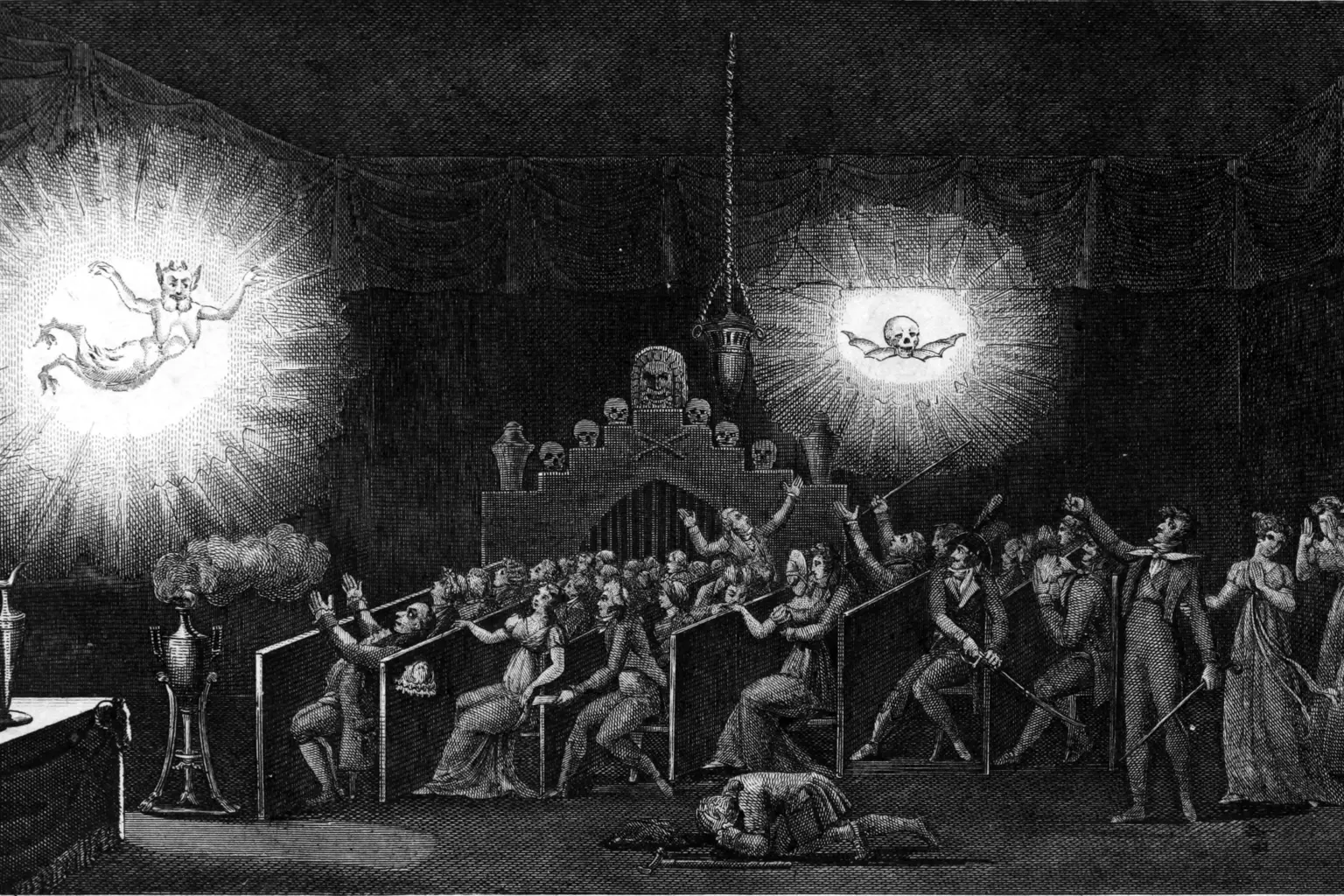
That combination helps explain why the same prop can feel ridiculous in daylight and effective in a dark hallway. The person has enough information to expect play, but not enough to predict the exact second when something will move. Long before the commercial haunted house, phantasmagoria shows were already arranging projected ghosts, darkness, and an audience that had deliberately come to be startled.
Heart monitors in a haunted house
The most enjoyment appeared near a middle level of fear.
In a 2020 field study, researchers followed 110 visitors, ages 12 to 57, through a commercial haunted-house attraction in Denmark. Participants wore heart-rate monitors, were recorded at several high-intensity moments, and reported how frightened and how entertained they felt.
Self-reported enjoyment followed an inverted-U pattern: very little fear and very high fear were associated with less enjoyment, while a middle range was associated with more. Small-scale changes in heart rate showed a similar curved relationship with enjoyment. The study supports a just-right range for this attraction and these visitors, rather than a universal dose of fear.
Choice and individual differences
The enjoyable range belongs to the person having the experience.
Two people can sit through the same scene and have very different evenings. Familiarity with horror, sensory sensitivity, expectations, age, past experiences, and the ability to stop can all change how the situation feels. The haunted-house results describe a group pattern; they do not identify the perfect scare for any one person.
A playful scare also depends on trust. Surprising someone who agreed to enter a haunted attraction differs from trapping a person in a frightening situation they did not choose. When the person wants to leave, the experiment in fun has already answered its question.
Notice the rise and fall
Map one small scare from beginning to recovery.
Choose a brief, age-appropriate spooky scene that everyone involved wants to watch. Before it begins, decide on a zero-to-five fear scale. Pause afterward and let each person rate the most intense moment, the enjoyment, and how long it took to feel settled again.
Compare the answers without choosing a correct reaction. One person may enjoy a two and dislike a four; another may find the scene too mild to be interesting. The differences are part of the psychology the haunted-house researchers were trying to measure.
SHARE THIS WITH THE KIDS
A few things to talk about together.
- Recreational fear happens in frightening experiences people choose for play or entertainment.
- A haunted-house study followed 110 visitors with heart-rate monitors and repeated self-reports.
- In that study, enjoyment was highest around a middle range of fear rather than at either extreme.
A FEW OF THE SOURCES BEHIND THIS PIECE
Read a little deeper
- Aarhus University: Playing With Fear, a field study in recreational horror (opens in a new tab)
- Andersen et al. (2020): study abstract and publication record (opens in a new tab)
- Aarhus University Recreational Fear Lab: publications (opens in a new tab)
- Association for Psychological Science: Haunted House Researchers Investigate Playing With Fear (opens in a new tab)
- Étienne-Gaspard Robertson: 1831 phantasmagoria frontispiece (opens in a new tab)