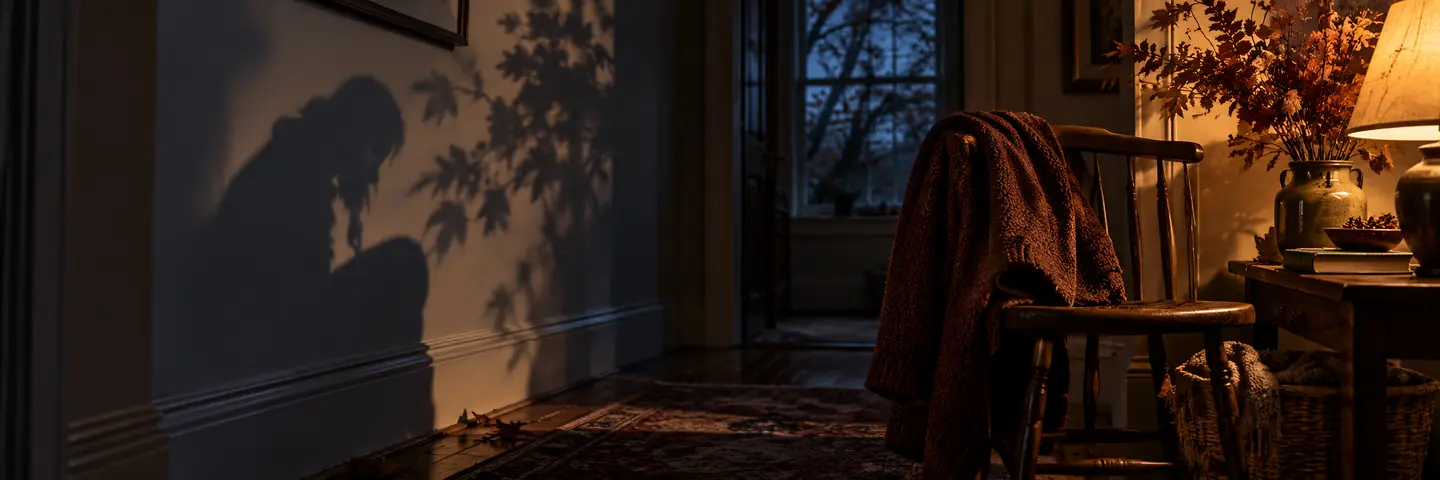
In daylight, you see a chair, a coat, and the shadow of a branch. At night, you may see one crouched shape and become extremely interested in the location of the nearest light switch.
The objects have not changed. The available visual information has. Your eyes and brain are trying to build a useful interpretation from a darker, noisier scene, while the body is more prepared to react to uncertain threat.
Night vision makes a trade
In low light, sensitivity matters more than fine color and detail.
The retina contains rods and cones. Cones support detailed color vision and work best in brighter light. Rods are much more sensitive and help us see when light is scarce, but the picture they support is not a full-color daytime view. As a room gets darker, edges soften, colors flatten, and small details that would identify an object can disappear.
That is why looking slightly beside a faint object can sometimes make it easier to detect. Rods are not concentrated in the center of the retina in the same way cones are. You may notice the shape without receiving enough information to decide immediately what the shape is.
The brain proposes an answer
Ambiguous shapes invite a fast best guess.
Perception depends on incoming information and on expectations built from past experience. A vertical shape with a smaller shape above it can fit the rough outline of a person. Moving leaves can make the outline change. If a room is familiar, the brain may resolve the puzzle quickly: coat, chair, plant. If the room is unfamiliar, or you have just heard a suspicious noise, the person-shaped explanation can win for a moment.
Seeing a meaningful form in an unclear pattern is common. Clouds become animals; outlets become faces; two branches and a trash bin become somebody standing by the fence. In darkness, there is simply less crisp information available to correct the first guess.
Uncertainty has a body response
Not knowing can keep the alarm switched on.
Laboratory studies of startle responses have found that darkness can heighten startle, and that unpredictable aversive events can produce more sustained anxiety than clearly signaled ones under some conditions. A shadow is not an electric shock and a hallway is not a laboratory, but the research helps explain a general pattern: uncertain context can keep the nervous system ready for something to happen.
That readiness changes attention. You listen harder, scan the edge of the room, and notice movement. The same small sound that would disappear into daytime background noise now joins the shadow as additional evidence for the wrong theory.
The jump arrives first
A startle can be quicker than an explanation.
Startle is a rapid defensive response to sudden stimulation. It can happen before you have fully identified what you saw or heard. Then the slower inspection catches up: the figure is laundry, the tapping is a branch, the glowing eyes belong to the cat who has once again chosen theater.
This sequence is useful when the threat is real because it favors quick action. It also produces false alarms. A false alarm feels foolish only after the room is legible again. In the moment, the body was responding to uncertainty with the information it had.
Add information
Light, distance, and a second look solve different parts of the puzzle.
Turning on a lamp restores edges and color. Moving closer changes the angle and reveals depth. Looking away and back can interrupt the fixed outline you first saw. Naming the objects out loud can help organize the scene: chair, blanket, plant, door.
None of this means ignoring an actual sign of danger. If something is genuinely out of place, use the light, leave the area, or get help. The point is narrower: many ordinary nighttime scares dissolve when the visual system receives the detail it was missing.
Try a harmless shadow test
Build the shape, then change one clue.
In a familiar room, drape a coat over a chair and place a lamp so the outline falls on the wall. Look at it from the doorway with the main light off, then turn the light on. Move the lamp lower, move the coat, or step to one side. Notice which detail makes the “figure” become furniture again.
The experiment is simple, but the lesson is good: perception is active. Your brain keeps testing a story about what is in front of you, and one small piece of better evidence can change the whole scene.
SHARE THIS WITH THE KIDS
A few things to talk about together.
- Rods are highly sensitive in low light, while cones support brighter, detailed color vision.
- Darkness removes some of the edges and color that normally help us identify an object.
- When a shape is ambiguous, expectations and context can influence the first interpretation.
- Startle is fast; the explanation for what startled you can arrive a moment later.
A FEW OF THE SOURCES BEHIND THIS PIECE
Read a little deeper
- Review of rods, cones, light, and visual signaling (opens in a new tab)
- Grillon et al. (1998), darkness and the startle response (opens in a new tab)
- Grillon et al. (2004), predictable and unpredictable aversive events (opens in a new tab)
- Andersen et al. (2020), fear and enjoyment in a haunted attraction (opens in a new tab)