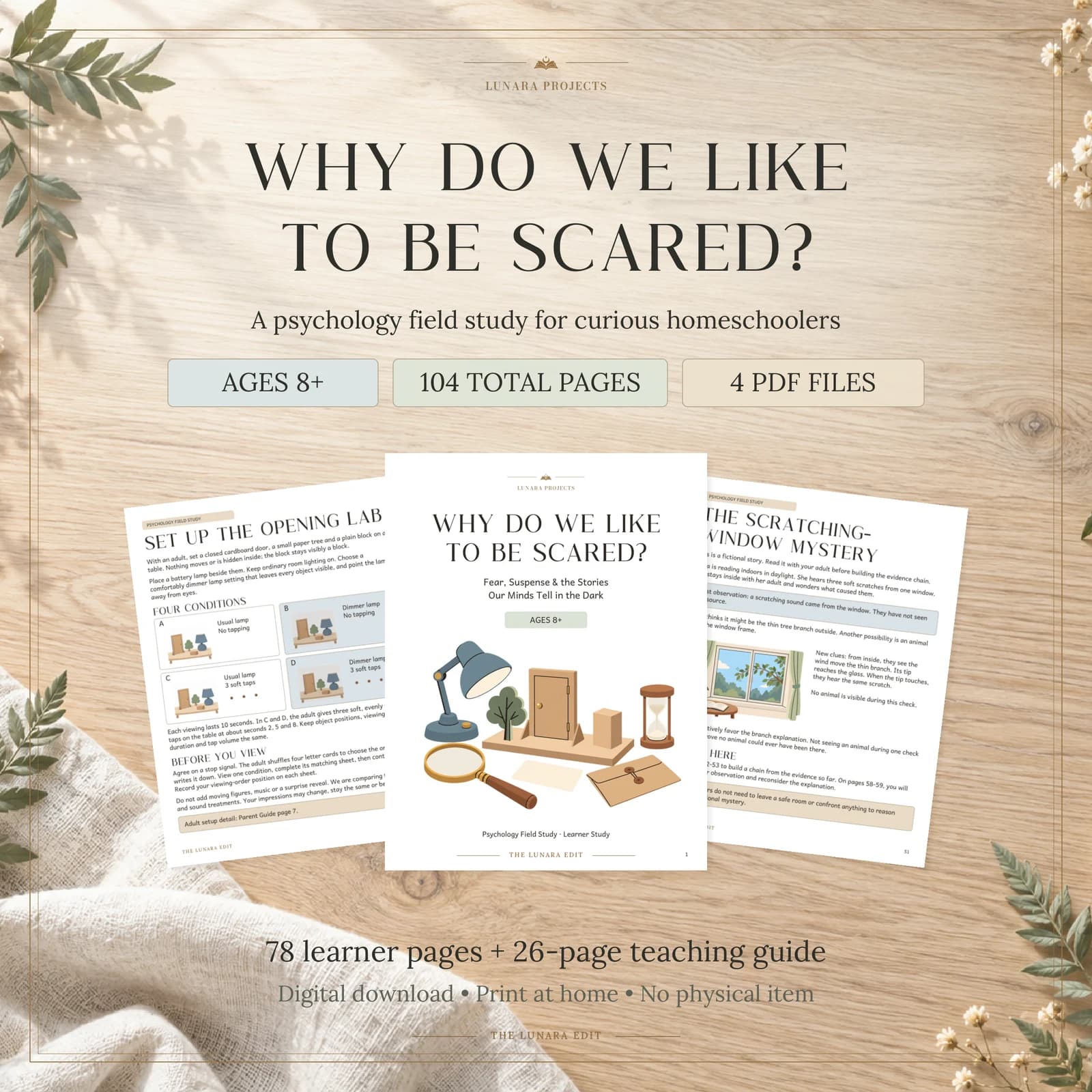
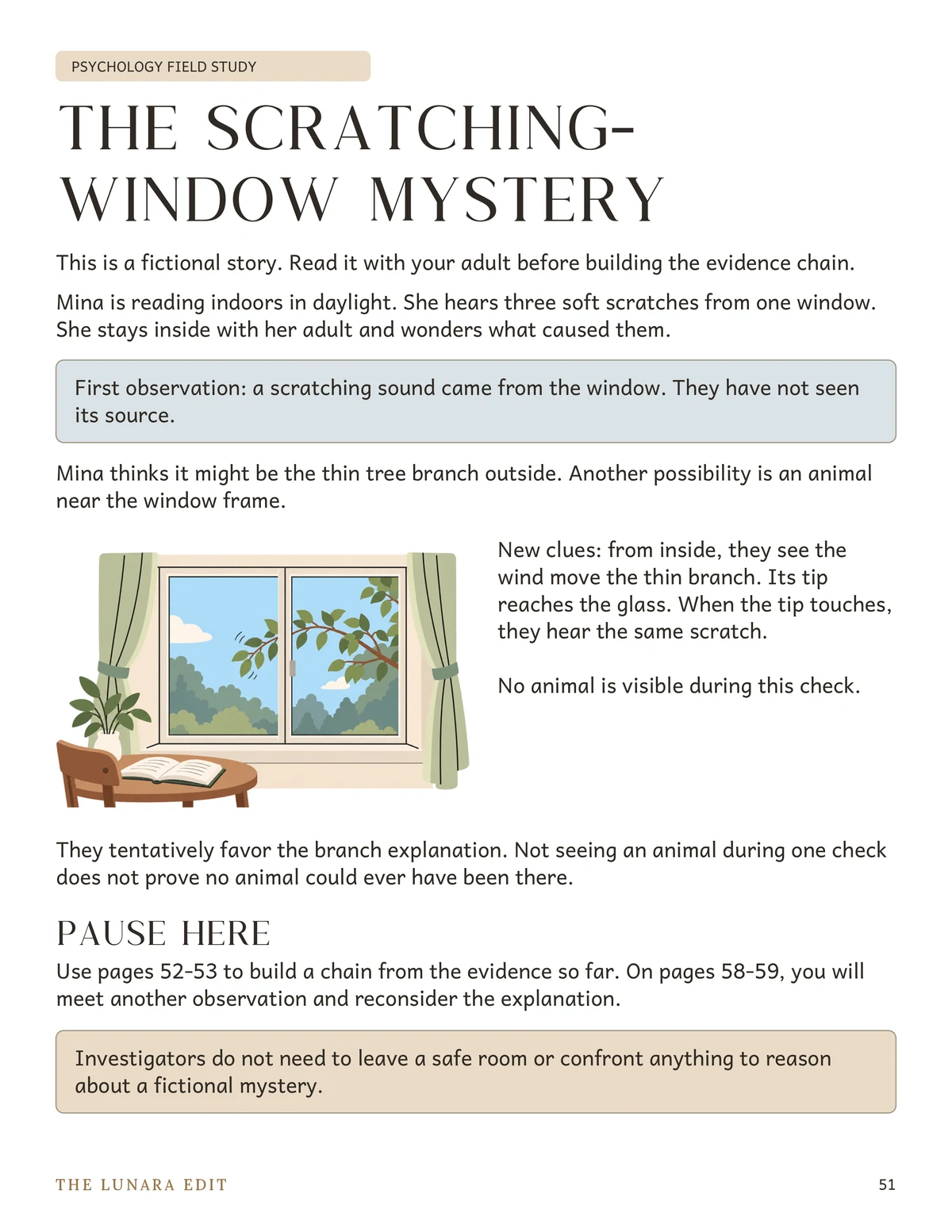
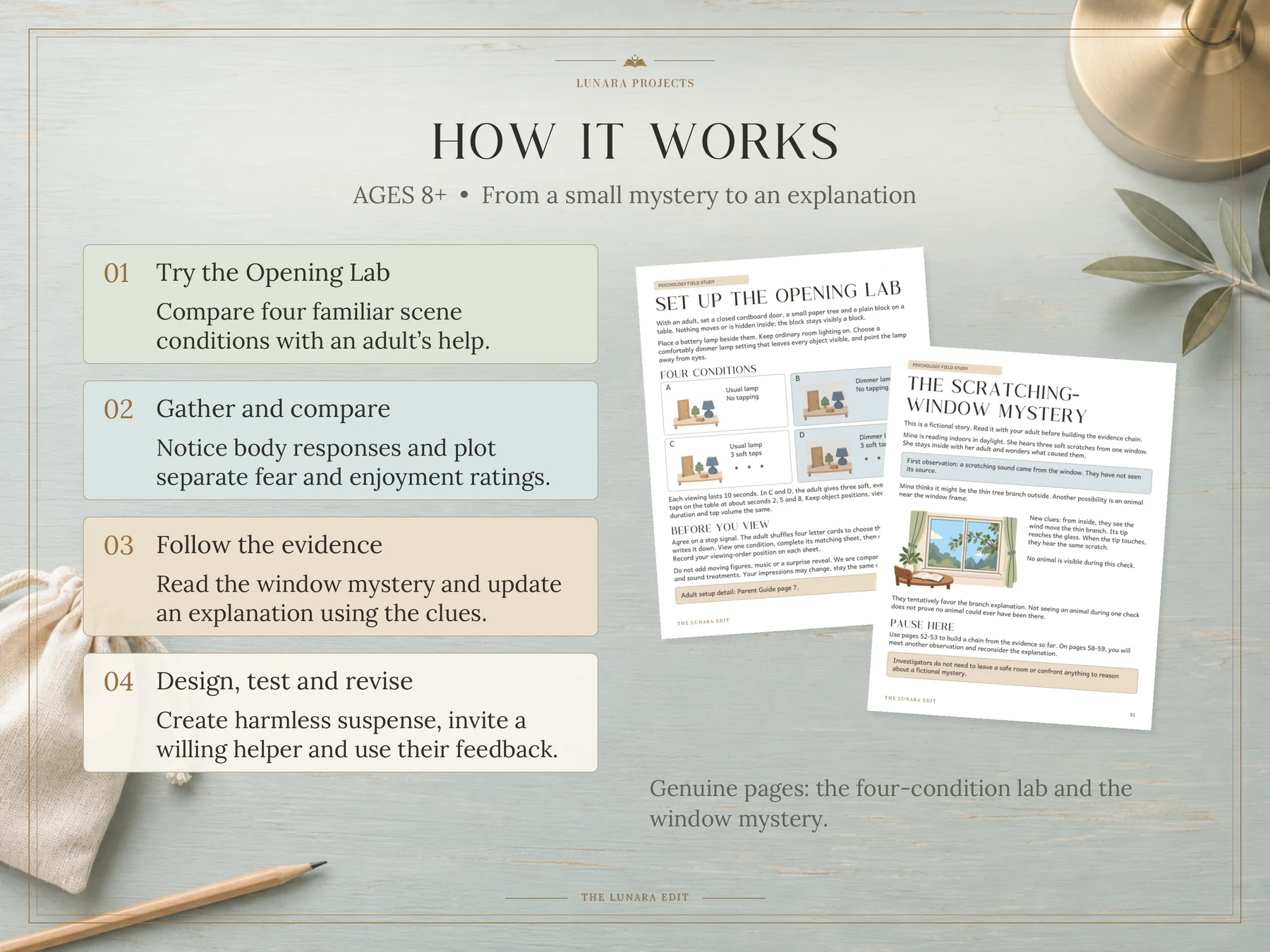
In the window mystery, a character hears scratching outside. Learners work through the clues to see which explanation fits, and what they still can’t be sure about.
Why Do We Like to Be Scared? uses fear and suspense as a way into questions about evidence, body responses and the stories people build from incomplete information. Learners compare observations, examine research, graph ratings and revise explanations, then design a harmless suspense experience and consider a helper’s feedback.
What your learner will do
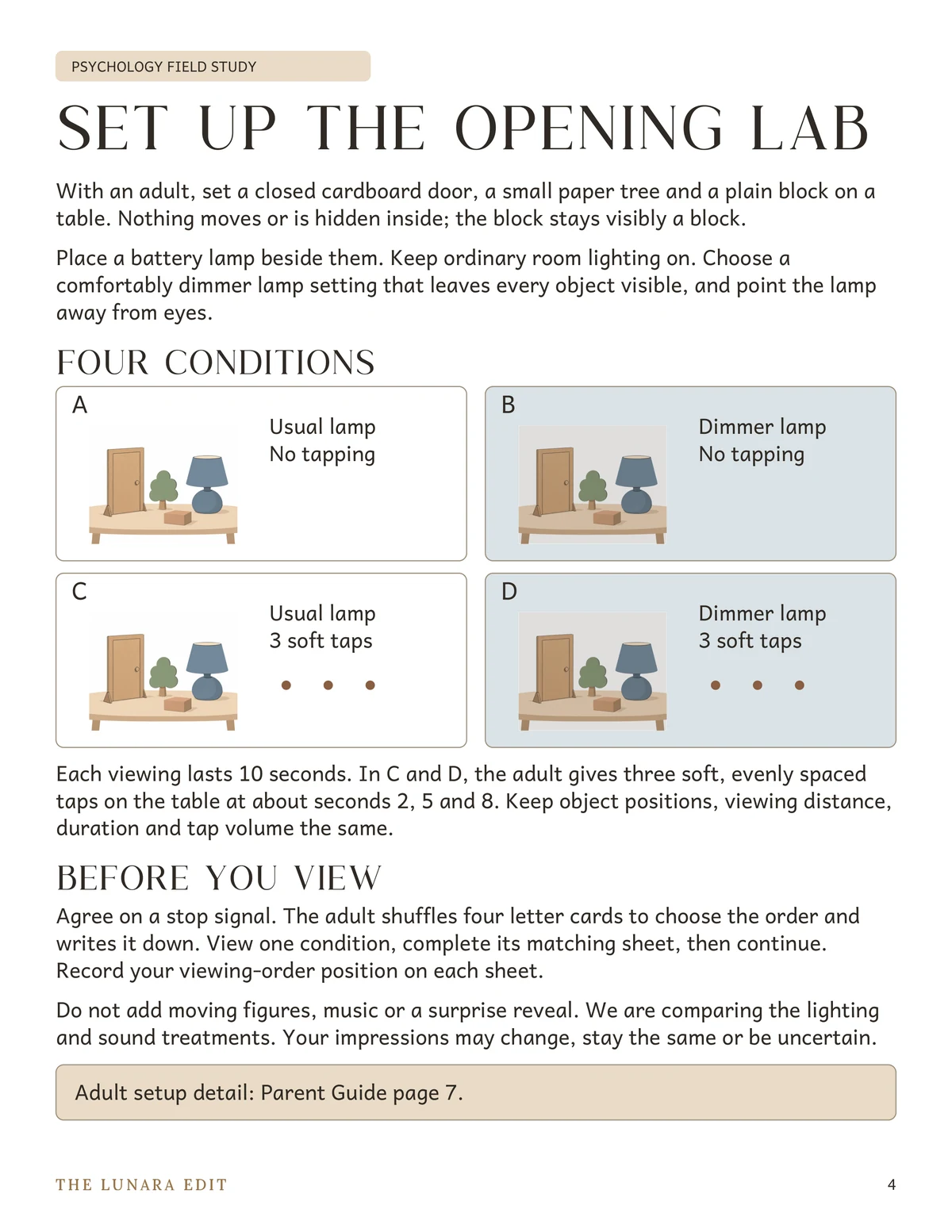
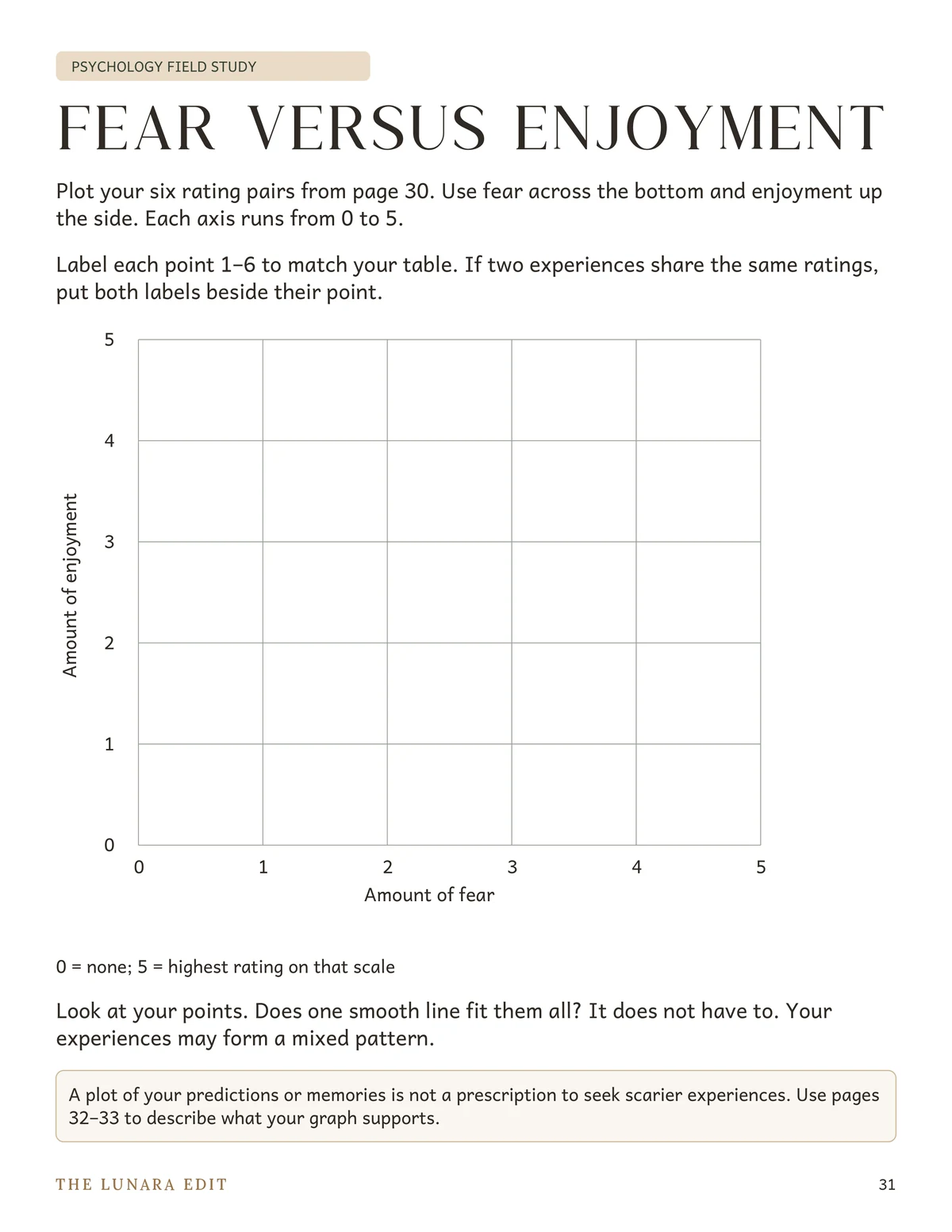
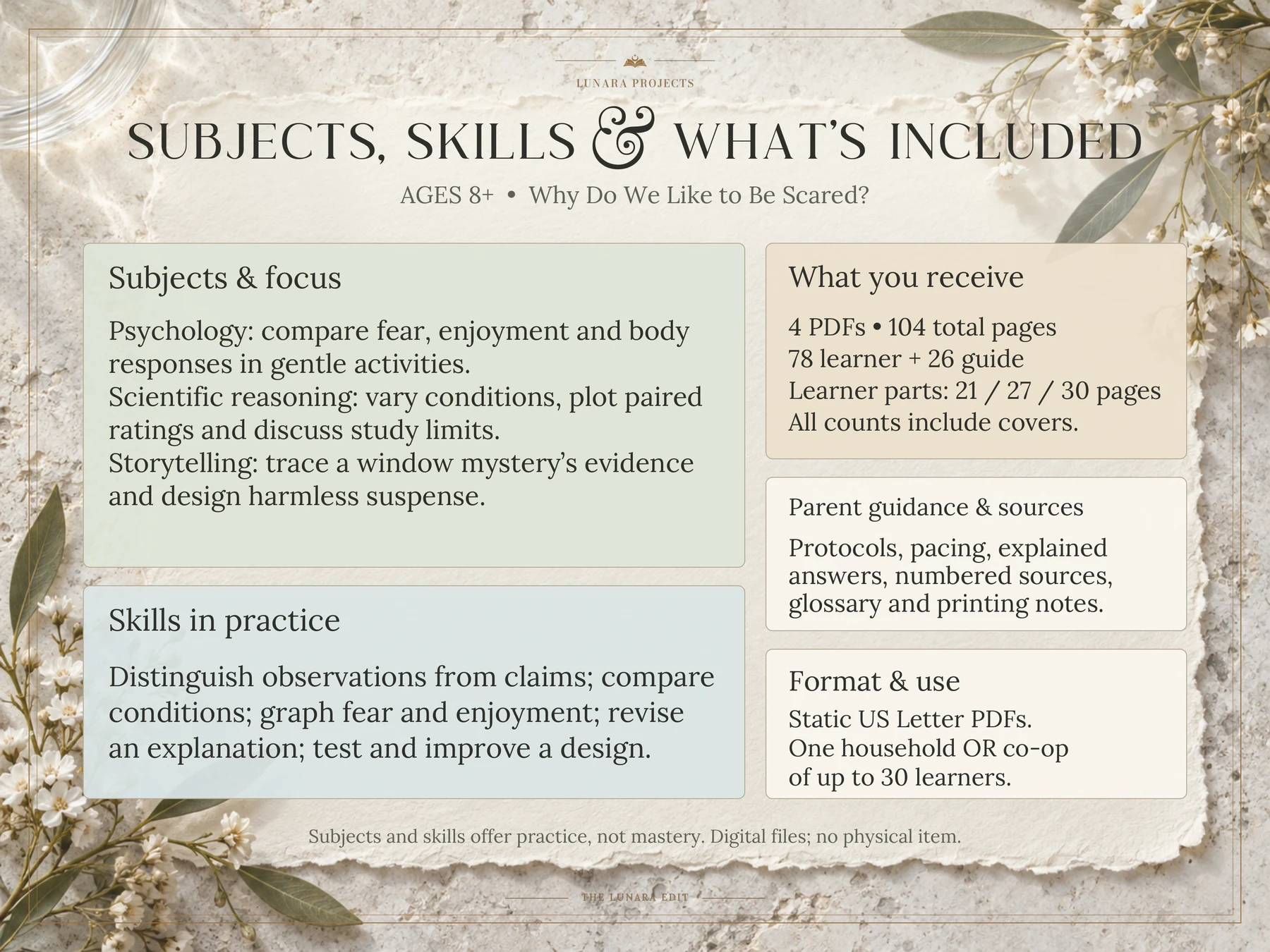
Compare four Opening Lab conditions; separate observation, interpretation and prediction; explore the Mystery Bag and body signals; plot fear and enjoyment ratings; examine variables, samples and study limits; distinguish what, when and if uncertainty; follow the window-story evidence; and plan, test and revise a gentle mystery.
How it fits your homeschool
- Readiness
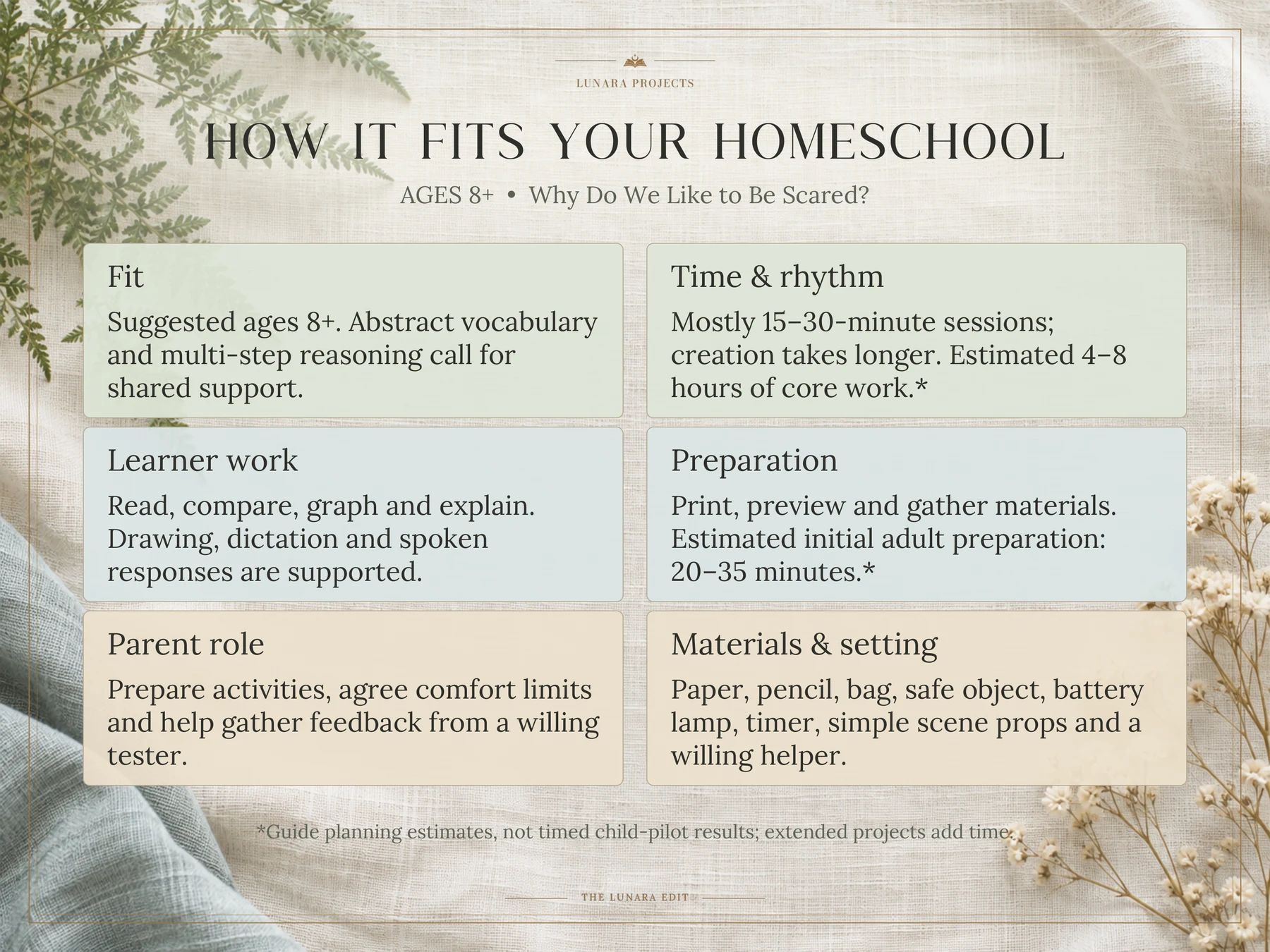
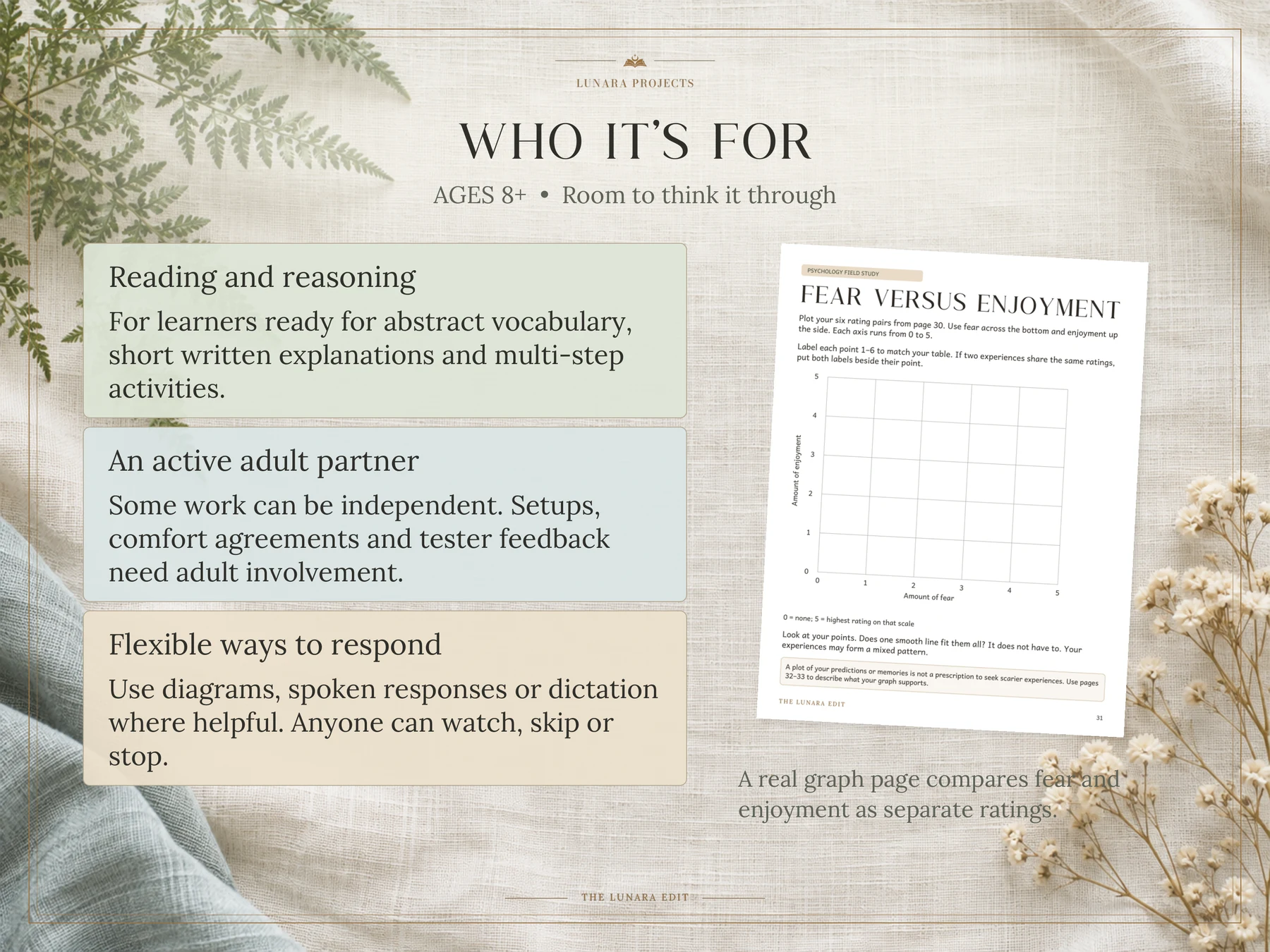
- Suggested ages 8+, with shared or intermittent support. Abstract vocabulary and multi-step reasoning make the sample pages a better guide to readiness than age alone. Read aloud, discuss, accept diagrams or take dictation as needed.
- Your role
- An adult actively helps with setups, the agreement about participation and feedback. Some reading and response work may be more independent. A willing family member or trusted adult helps with the final design test.
- Time & rhythm
- Mostly 15–30-minute sessions, with 30–45 minutes or another sitting for story and design work. Allow roughly 4–8 hours of core learner work across sessions, plus optional longer writing, projects and discussion. These are guide planning estimates, not measured completion times.
- Preparation
- The guide estimates 20–35 minutes for initial adult preparation, with later resets taking a few minutes. Preview the activities, print and order the pages, gather materials and arrange a willing helper for the final design test.
- Materials & setting
- Printed pages, pencil, optional notebook, cloth bag or pillowcase, a clean familiar safe object, cardboard door, paper tree, plain block, battery lamp, timer, four letter cards and a coin. No online activity or frightening media is required.
Look at the actual pages
Open a page to check the reading, illustrations and space for responses. These previews show the current edition while its final release is being prepared.
Subjects and skills
- Psychology: Body responses, attention, choice, uncertainty and research limits.
- Science reasoning: Variables, samples, comparisons and revising a claim when evidence changes.
- Language arts: Explaining evidence and planning, testing and revising a suspense story.
- Mathematics: Separate fear and enjoyment ratings and paired graphs.
- Media literacy: Sources, inference and unsupported additions to a story.
What comes with this edition
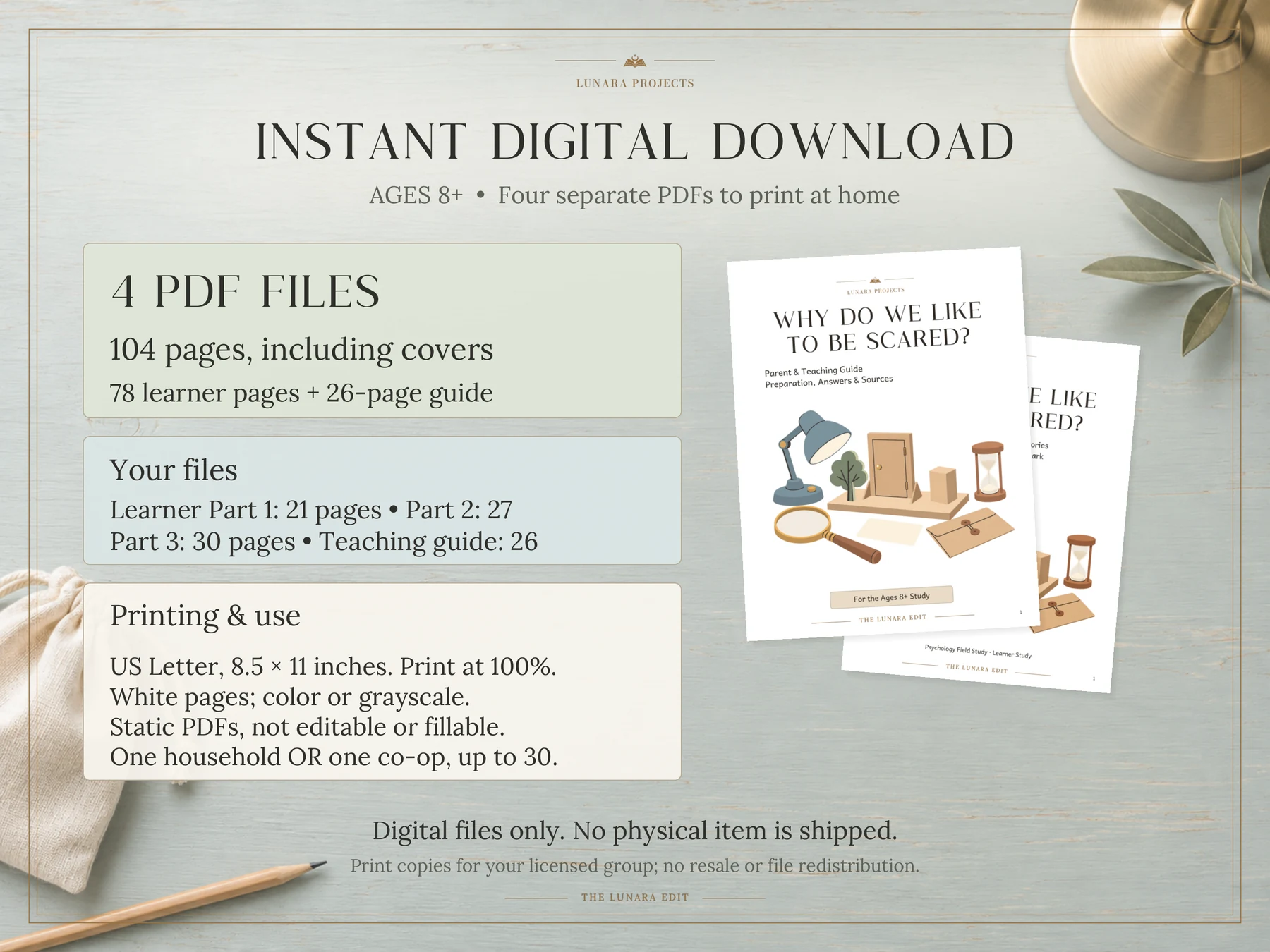
Three learner PDFs with 78 pages, plus a separate 26-page Parent & Teaching Guide: 104 pages in four PDFs, including covers. Each age edition is a separate purchase.
| File | Pages |
|---|---|
| Learner Part 1 | 21 |
| Learner Part 2 | 27 |
| Learner Part 3 | 30 |
| Parent & Teaching Guide | 26 |
The guide includes activity protocols, pacing, explained answers, research sources, a glossary and printing instructions.
More of what’s inside
Planning the study
Subjects and contents
How the activities work
Choosing for your learner
Files and printing
Printing and use
Static US Letter PDFs, 8.5 × 11 inches, with white main backgrounds and muted accents. Print the pages you need at actual size / 100%, in color or grayscale. The files are not editable or fillable. This is a digital resource; no physical item is shipped.
For one household or one co-op of up to 30 learners. Print and reprint for that group; do not resell, redistribute or publicly post the complete files. See the full printing license and purchase and refund information.
For another reading level, look through the ages 5–8 edition. The study guide article compares both.
Not available to purchase yet. You can browse all the previews above. For a question about the study, contact Kai.
Behind the resource
I’m Kai, the homeschooling parent behind The Lunara Edit. I direct the development and make the publication decisions. I use generative AI for drafting, revision, illustrations, and page design. Read how I create and review the resources.
Printing permissions
For one household or one co-op, pod, or learning group of up to 30 learners, unless the product’s own terms say otherwise. Reprint for those learners; keep complete digital files within the licensed household or group staff. The copying restrictions concern original human-authored writing and complete packets. We do not claim exclusive copyright over purely AI-generated imagery.
See the product license, safety guidance, and download support. For larger groups or a file problem, contact us.