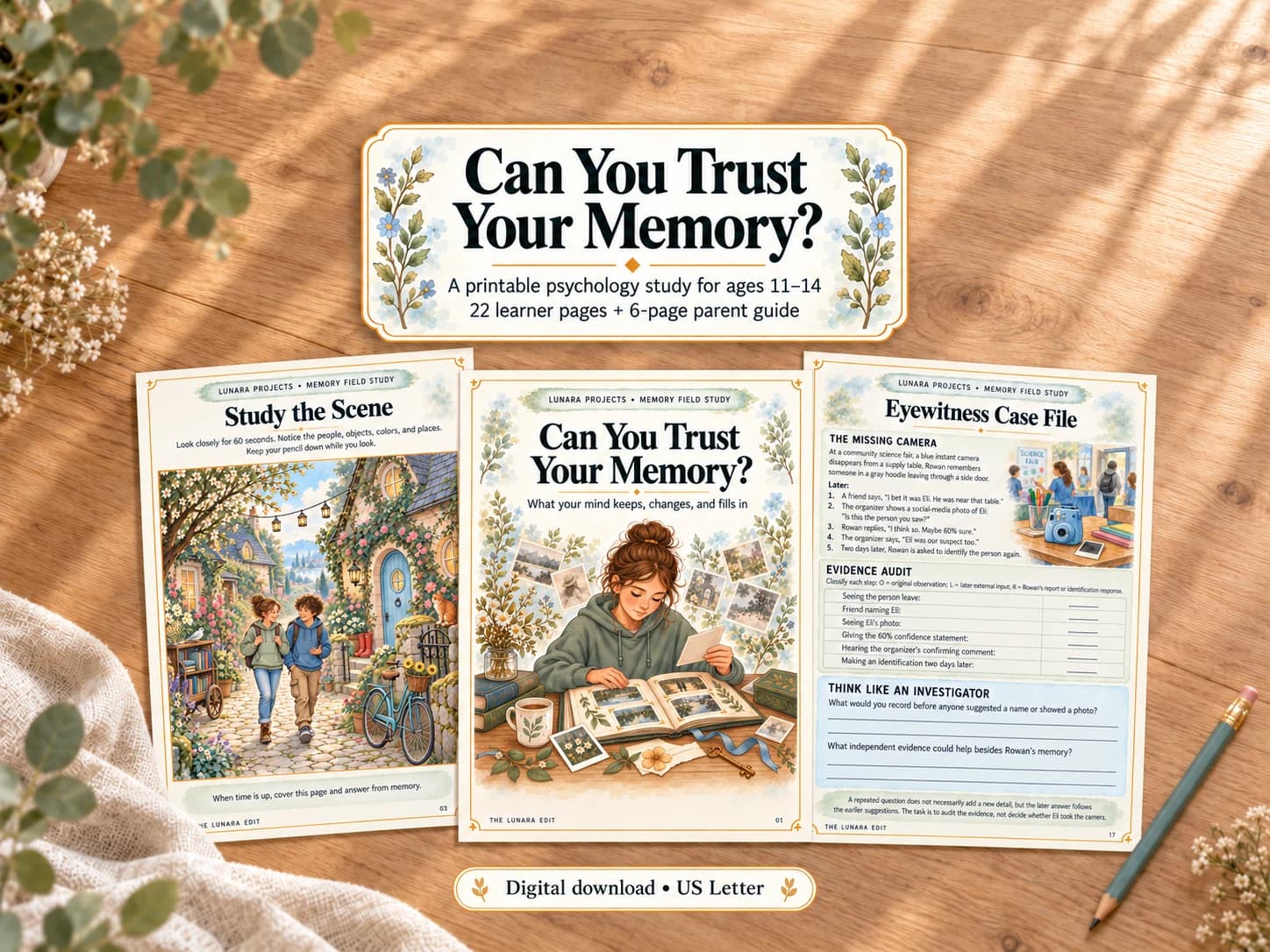
A learner can feel completely certain about a detail, check the original page, and discover that it was never there. That small surprise is where this study begins.
Memory does an extraordinary job without keeping a perfect recording of everything we see. We notice some details, connect them to what we already know, and later reconstruct an account from the information that remains. Usually that process serves us well. It also means a sensible guess can feel like a memory, a later question can introduce a new detail, and two people can remember the same event differently.
Can You Trust Your Memory? turns those ideas into activities learners can try for themselves. They record an answer before seeing the explanation, keep their first response visible, and compare it with the evidence. The packet never treats an error as a measure of intelligence or honesty. Each result is one learner’s data.
Begin with a scene before explaining the science
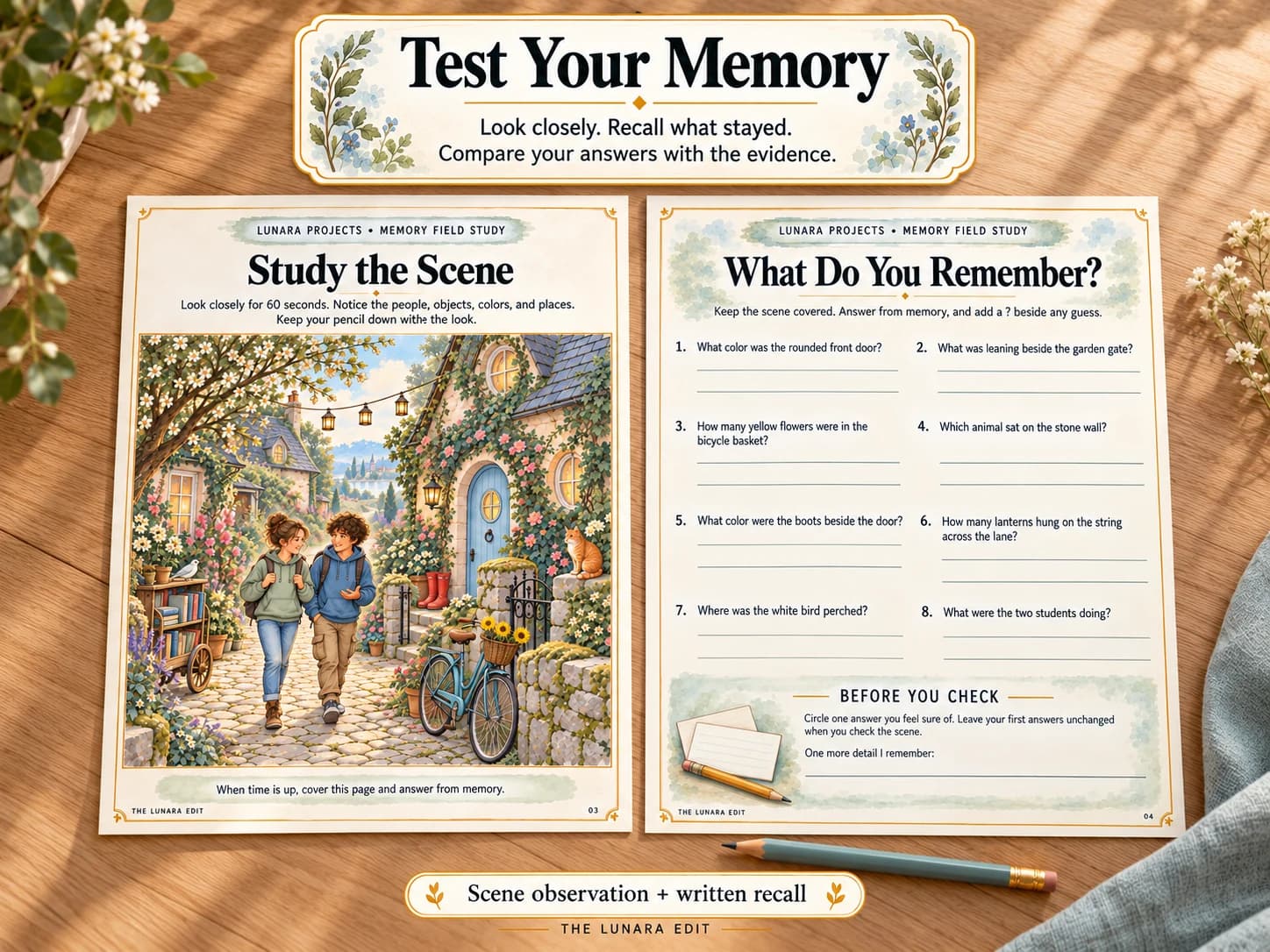
The first challenge asks learners to study an illustrated cottage lane for 60 seconds. Once the scene is covered, they answer specific questions from memory and mark whether each answer feels certain or more like a guess. Only then do they uncover the original and check.
Keeping that order matters. If the explanation comes first, a learner may start searching for the “right” effect. Beginning with an ordinary observation lets them meet their own memory as it works: some details stay vivid, some disappear, and some arrive because they fit the scene.
Later information can become part of the story
A short event about a spilled jar gives learners two differently worded questions. They underline what each question assumes, then separate the original event from the information introduced afterward. This opens the door to source monitoring: when I remember a detail, do I remember seeing it, reading it, imagining it, or hearing someone else mention it?
Research on eyewitness memory has shown why that distinction matters. Question wording can influence later reports, and witnesses who discuss an event may incorporate details supplied by another person. [2][3] Learners do not need a courtroom example to practice the skill. They can ask the same source question about a video, a family story, or a detail repeated in a comment thread.
The missing-camera case brings the pieces together
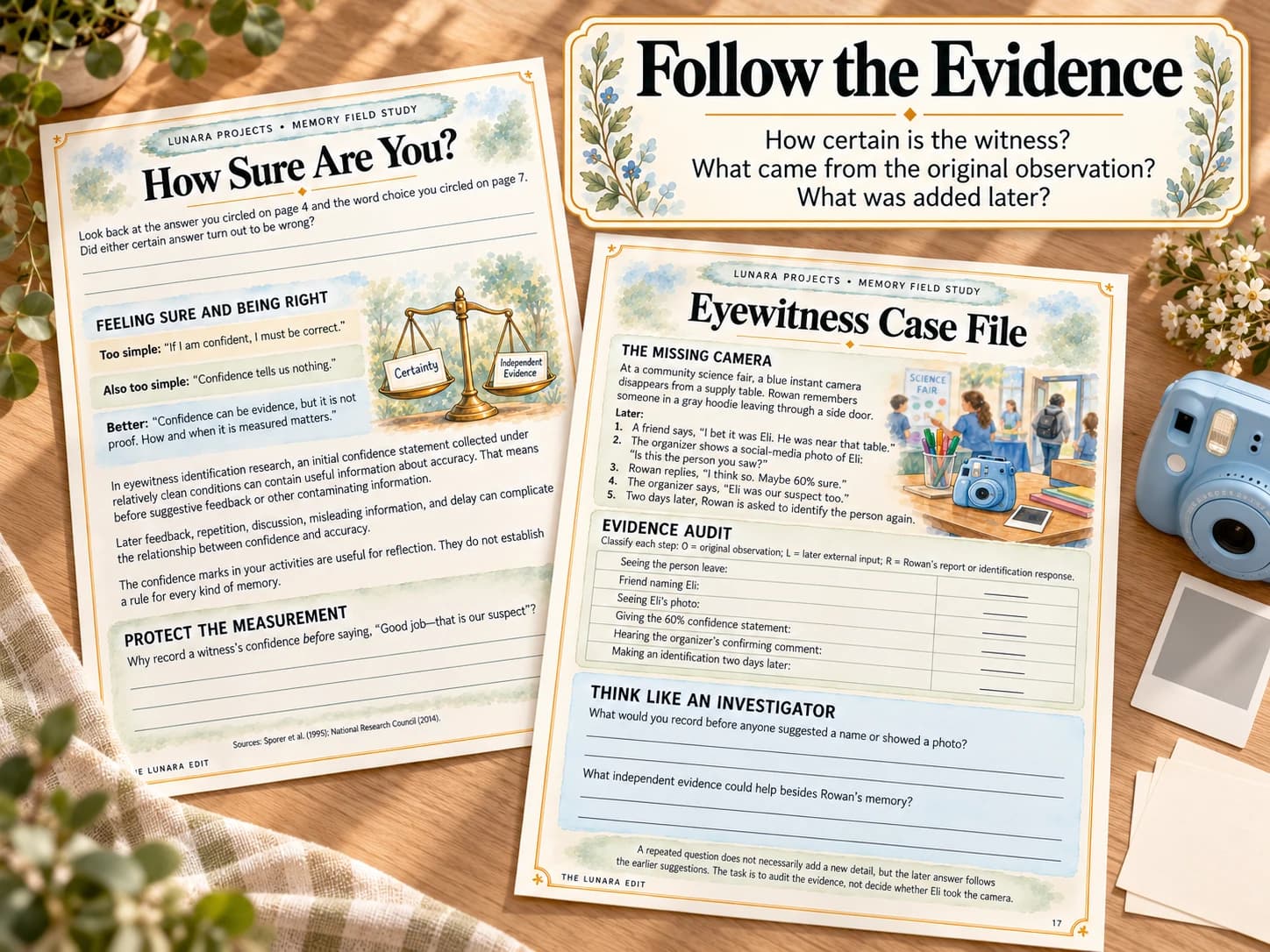
In the final investigation, a blue instant camera disappears from a table at a community science fair. A witness remembers a gray hoodie. Then a friend suggests a name, a photograph appears, and an organizer adds confirming feedback. Learners classify each step as an original observation, later external information, or the witness’s response.
The case leads into a practical Memory Detective Toolkit: record the first account, separate observation from inference, check where a detail came from, watch what a question adds, and look for independent evidence when accuracy matters. These habits echo the evidence-preservation procedures recommended in research reviews of eyewitness identification.[5]
What’s inside the printable study
The learner packet contains 22 illustrated pages, followed by a separate six-page parent guide with answer notes, activity guidance, and fuller source details. Most learners can work through the reading and writing independently, although an adult helps by keeping reveal pages covered and making room for discussion afterward.
- A detailed scene-observation and recall challenge
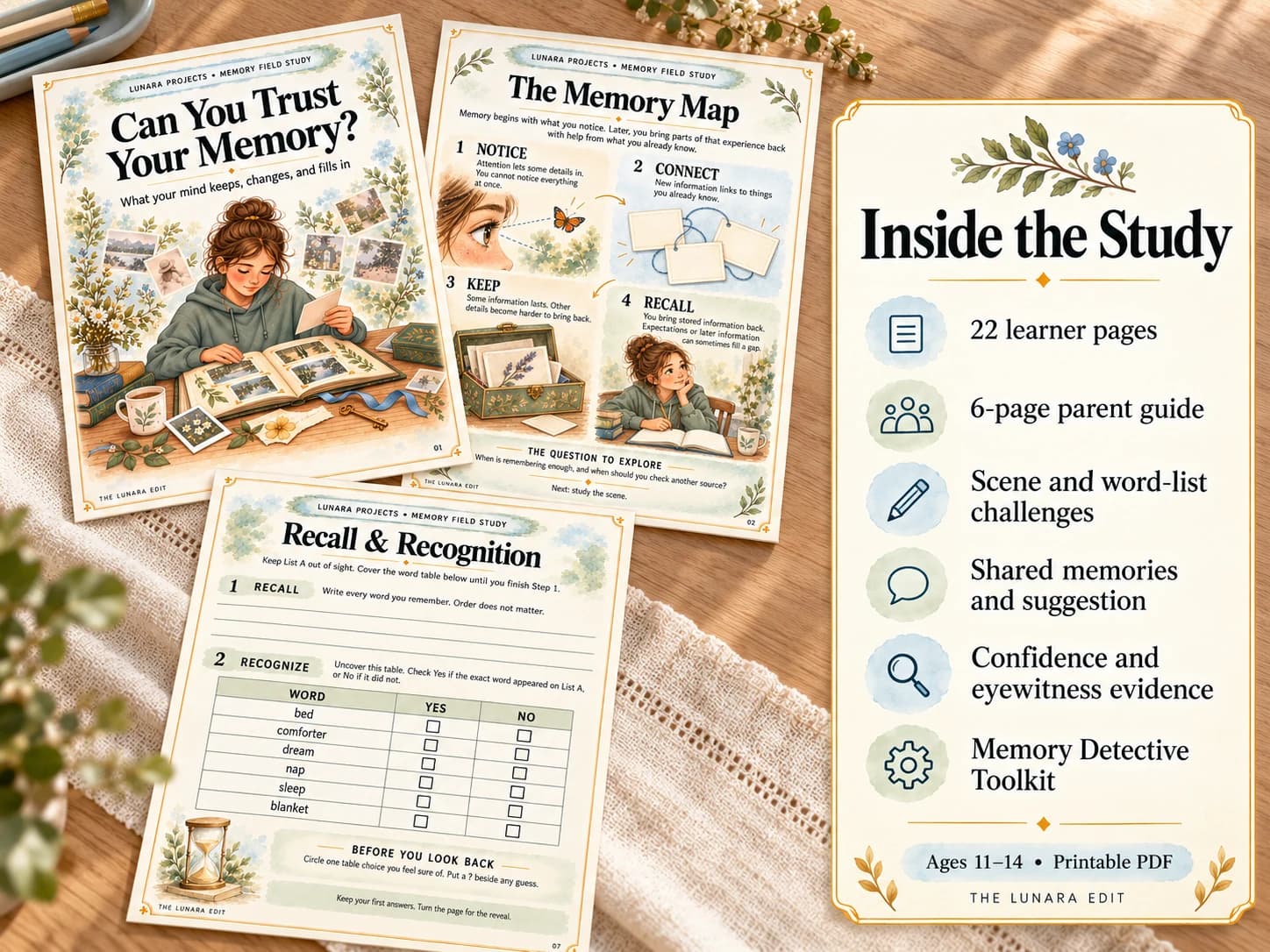
- A word-list activity with separate recall and recognition
- Short explanations of reconstructive memory, schemas, and source monitoring
- Leading-question and later-information activities
- A careful look at shared memories and the Mandela Effect
- Confidence and accuracy questions
- An eyewitness case, evidence audit, and Memory Detective Toolkit
- A no-peeking review, final reflection, sources, and parent notes
Allow about four to six hours across several sessions, depending on reading pace, writing, and discussion. The core study works offline once printed. A pencil is enough; a timer and scrap paper are optional.
A SIMPLE WAY TO USE IT
Keep the reveal pages covered and let the first answer stand
- Print the learner packet and keep the parent guide nearby for answer notes.
- Complete one challenge at a time without looking ahead to the reveal or explanation.
- Keep the original answer visible after checking the evidence; add corrections beside it.
- Ask what influenced the answer and how certain it felt before the page was uncovered.
- Finish by choosing one Memory Detective habit to use outside the packet.
The goal is careful comparison. A missed detail is useful data for the conversation.
Can You Trust Your Memory?
The instant download includes the 22-page learner PDF and a separate six-page parent guide, formatted for US Letter paper. Your purchase covers use within one household or a small homeschool co-op of up to 30 children.
See the complete printable on Etsy (opens in a new tab)Sources and further reading
- Roediger, H. L. III, & McDermott, K. B. (1995). Creating false memories: Remembering words not presented in lists. (opens in a new tab)
- Loftus, E. F., & Palmer, J. C. (1974). Reconstruction of automobile destruction: An example of the interaction between language and memory. (opens in a new tab)
- Gabbert, F., Memon, A., & Allan, K. (2003). Memory conformity: Can eyewitnesses influence each other’s memories for an event? (opens in a new tab)
- Prasad, D., & Bainbridge, W. A. (2022). The Visual Mandela Effect as evidence for shared and specific false memories across people. (opens in a new tab)
- National Research Council. (2014). Identifying the Culprit: Assessing Eyewitness Identification. (opens in a new tab)