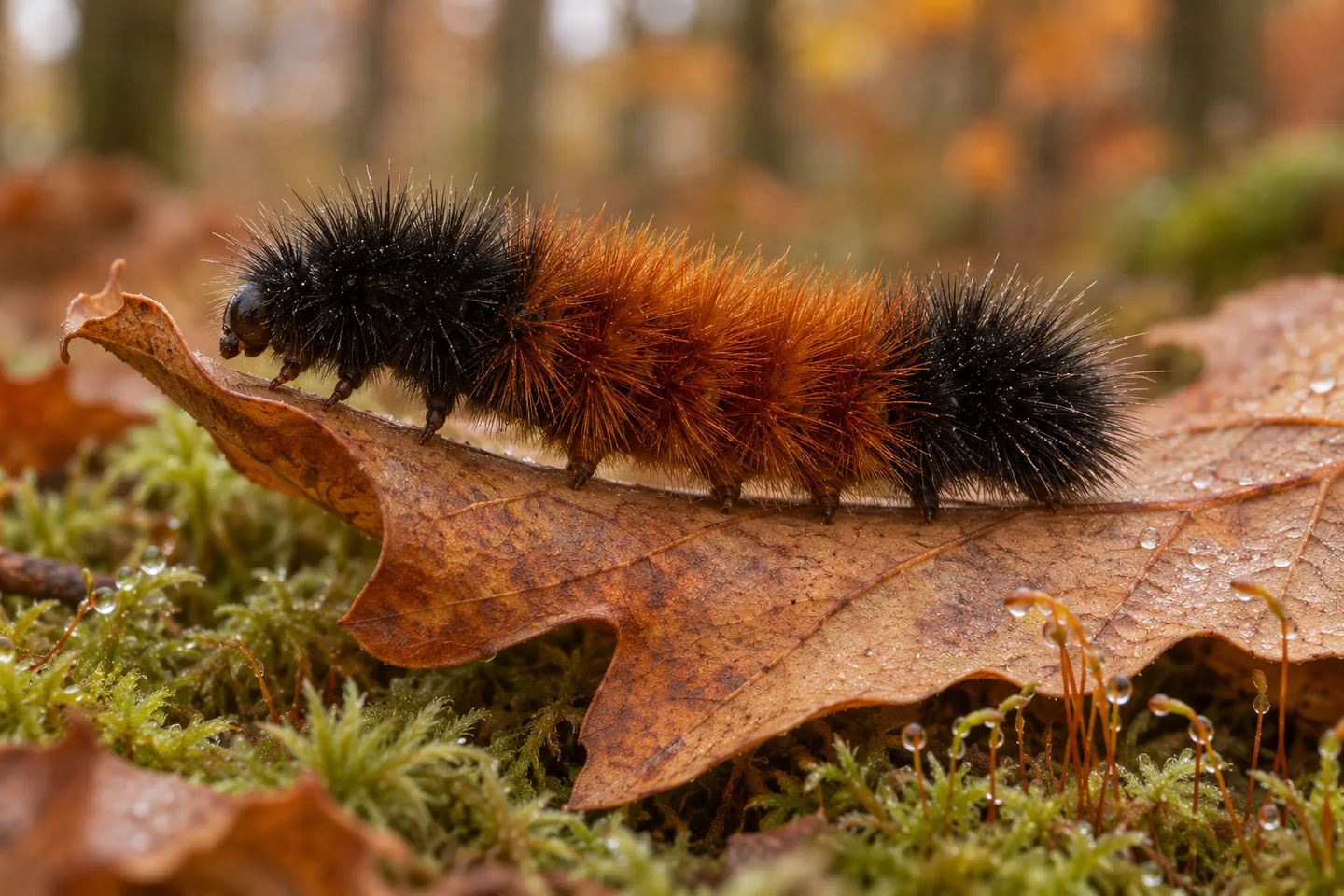
A woolly bear crossing the path looks busy enough without being responsible for the winter forecast. Its stiff little bristles catch the light, the rusty middle band comes into view, and somebody is likely to announce what all that black must mean for the snow.
The familiar story says a narrow reddish-brown band foretells a hard winter, while a wider band promises an easier one. It is a persistent piece of weather folklore, attached to a caterpillar many people really do notice in autumn. The markings, however, do not provide a reliable forecast of the winter ahead.

The familiar prediction
People have been reading its stripes for years.
The National Weather Service records several versions of woolly-bear lore. Some people read the width of the rusty middle band, while others look at how shaggy the caterpillar is or which direction it is traveling. Each version turns an autumn sighting into a prediction about the cold months ahead.
It’s easy to see why the story travels. A woolly bear is small enough to inspect on a walk, its pattern is easy to remember, and it appears just as people begin wondering what winter will bring. In some communities, that familiar little creature has inspired festivals with parades and races.
Sources for this section: National Weather Service, La Crosse (opens in a new tab)
The growing caterpillar
The pattern changes as the animal develops.
As a caterpillar grows, it sheds its outer skin in a process called molting. University of Missouri entomologist Bruce Barrett explains that the woolly bear’s markings change during this development. Feeding conditions and the timing of growth help shape the pattern you see on a particular autumn day.
The black-and-rust animal in the familiar story is the caterpillar of the Isabella tiger moth, Pyrrharctia isabella. People also use the name “woolly worm” for other bristly caterpillars, so two animals compared on a walk may turn out to be different species.
The National Weather Service and Illinois Extension explain that these markings don’t reliably predict the coming winter. Their changes belong to the caterpillar’s growth and development, which gives us something interesting to look for even after the old forecast has been set aside.
Sources for this section: University of Missouri Extension (opens in a new tab) · National Weather Service, La Crosse (opens in a new tab) · Illinois Extension (opens in a new tab)
Preparing for the cold
It is looking for cover.
If you see a woolly bear moving across a path in autumn, it may be searching for somewhere to spend winter. Leaf litter and other protected places provide shelter while it remains in its caterpillar stage through the cold months.
MU Extension describes glycerol, a compound that helps the animal tolerate cold. When warmer conditions return in spring, the caterpillar can spin a cocoon and eventually emerge as an Isabella tiger moth. The bristly crawler you noticed in autumn is one stage in that longer life.
A disturbed woolly bear may curl into a tight ball, making its bristles project outward. Those bristles can irritate some people’s skin, so leave it where it is and enjoy a close look or take a photograph.
Sources for this section: University of Missouri Extension (opens in a new tab) · National Weather Service, La Crosse (opens in a new tab)
On your next walk
See where your woolly bear is heading.
On your next walk, notice where you find one and what cover is nearby. You might photograph the band pattern and jot down the date, then compare sightings as autumn goes on. Leave the caterpillar’s leaf litter and shelter in place so it can get on with finding somewhere to spend the cold months.
SHARE THIS WITH THE KIDS
A few things to talk about together.
- A woolly bear’s bands do not reliably predict the next winter.
- The markings change during development, and “woolly worm” can refer to different species.
- The banded woolly bear spends winter as a caterpillar before becoming an Isabella tiger moth.
The records and research behind the story
Read a little deeper
- University of Missouri Extension · Bruce Barrett on development, shelter, bristles, and the Isabella tiger moth (2018) (opens in a new tab)
- National Weather Service, La Crosse · Versions of the folklore and identification differences (opens in a new tab)
- Illinois Extension · The band-reading legend and why it is not a winter forecast (2019) (opens in a new tab)