At the edge of a cottage garden, a rowan holds its bright berries against a gray sky. In older stories, that small tree had a job to do.
Rowan trees carry a long association with protection in British folklore. Their branches could become little crosses or loops, placed where people hoped trouble would stay outside. Museum collections preserve examples of those charms, along with accounts of where people hung or carried them.

Meet the rowan
The bright berries made the tree easy to notice.
European rowan, Sorbus aucuparia, is also called mountain ash. Its leaves are divided into paired leaflets along a central stalk, and clusters of red-orange fruits become conspicuous as the year turns toward autumn. The name mountain ash reflects a resemblance; rowan belongs to the rose family.
The Royal Horticultural Society includes rowan among trees with a long folklore history in the British Isles, describing its association with protection against enchantment. That gives a real, recognizable tree a place in stories about the uncertain world beyond a home or farm.
Small objects that survive
People made rowan wood into protection charms.
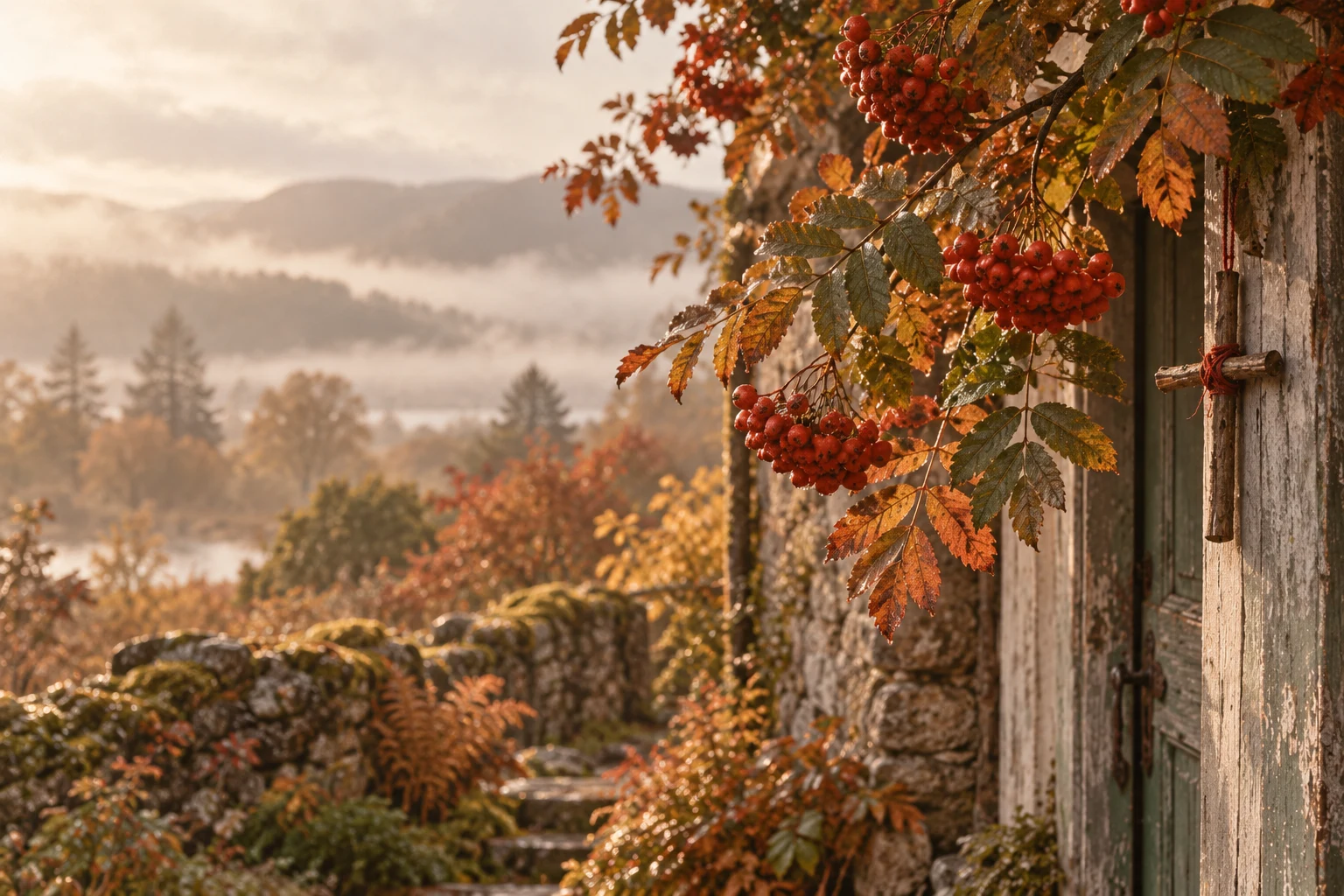
The Pitt Rivers Museum in Oxford holds delicate rowan crosses and loops acquired in the late nineteenth century. Its account describes charms hung at doors and above fireplaces, with some crosses bound in red thread. Versions could also be carried in pockets or attached to animals.
The recorded locations show how people used the charms in daily life: at an entrance, near a fireplace, on an animal, or carried with them. Comparing those uses helps us ask who or what a particular charm was meant to protect.
Details in the recorded beliefs
Red thread and the star on a berry appear in rowan folklore.
The museum links the rowan’s protective reputation in English folklore with the five-pointed shape at the base of its berries, and with the protective associations of the color red. Trees for Life also describes traditions involving red thread and rowan, alongside stories from Scotland and elsewhere. The repeated details help us recognize a family of related beliefs.
They do not make every account identical. A local practice recorded by a collector, a museum object, and a much older myth can each tell us something different. Keeping their dates and places in view lets the folklore remain rich without turning it into one rule that everyone supposedly followed.
Look at a museum example
Compare the charm with its recorded use.
Look at the rowan loops in the Pitt Rivers account. Notice how small and light they are, and imagine finding one above a fireplace. Ask who might have made it, who decided where to hang it, and whether its meaning would have been obvious to a visitor.
If a rowan grows near you, enjoy its leaves and berries where they are. You can draw the leaflets and fruit clusters without collecting them. If you want to make a decorative reminder of the story, use fallen twigs and thread, and describe it as your own modern response to the folklore.
SHARE THIS WITH THE KIDS
A few things to talk about together.
- European rowan is also called mountain ash and belongs to the rose family.
- Museum collections preserve small rowan crosses and loops used as protective charms.
- Red thread and the star-shaped marks on berries appear in accounts of rowan folklore.
A FEW OF THE SOURCES BEHIND THIS PIECE