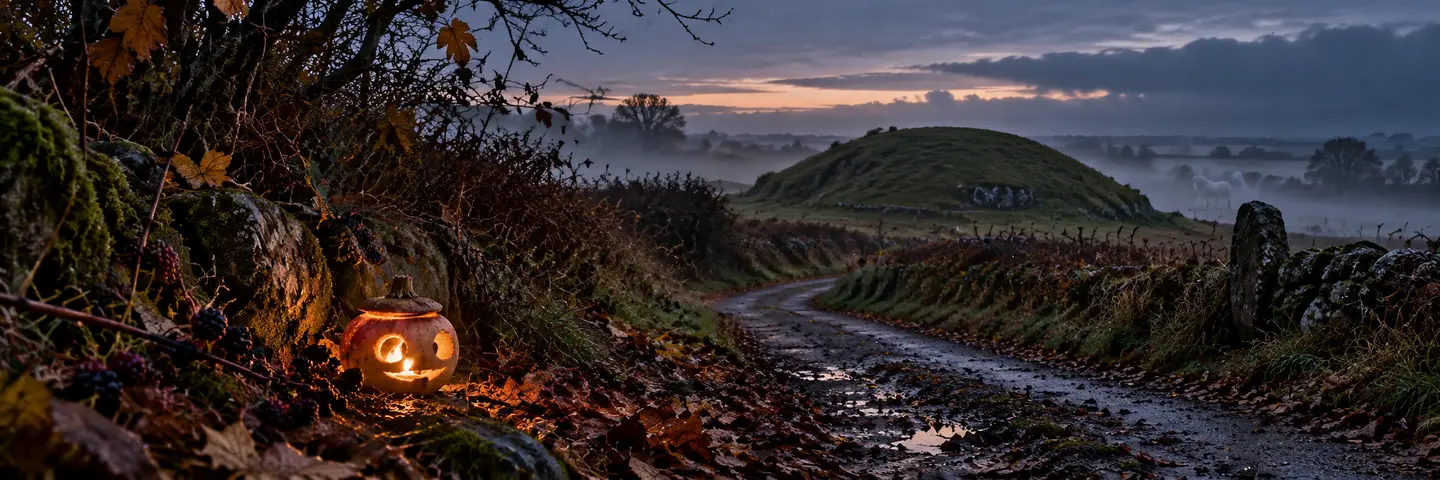
In Irish tradition, Halloween was not only a night for costumes and games. It was a night when familiar places could become uncertain: a road, a fairy mound, a lone tree, a patch of late blackberries.
Samhain falls on November 1, with festivities traditionally beginning the night before. It marked the start of winter in the Irish seasonal calendar. Medieval literature and later folklore collections both connect the time with the Otherworld, though they do not give us one tidy, unchanging set of beliefs.
When the ordinary world opened
Samhain stories let boundaries behave strangely.
Medieval Irish tales place journeys, revelations, and encounters with the supernatural at Samhain. InThe Adventure of Nera, a man enters the Otherworld and returns to the same moment from which he left. Another tale, Fíngen’s Night-Watch, imagines a woman of the sídhe telling a royal figure the hidden and wondrous events of Ireland each Samhain night.
Modern summaries often say “the veil was thin.” That phrase is a useful poetic shortcut, but it should not be treated as a quotation from one ancient Samhain rulebook. The older evidence is more varied and more interesting: stories about time shifting, knowledge becoming available, the dead returning, and beings from the Otherworld moving through human places.
The map changed after dark
Some places were better left alone.
The National Museum of Ireland records beliefs about avoiding fairy mounds, fairy trees, and forts on Halloween, along with warnings against traveling alone. These were not decorative backdrops. In tradition, a mound or old fort could be connected to the aos sí, the supernatural people of the mounds, and crossing the wrong place at the wrong time invited trouble.
The warnings made a familiar landscape legible in a different way. The path was still the path, but it also carried stories about who else might use it. Folklore did not need every listener to see a faery. It needed people to remember which tree, field, bend, or ruin deserved respect.
A shapeshifter on the road
The púca was not a sweet woodland mascot.
Irish stories describe the púca in several forms, including a dark horse or other animal. It could frighten, mislead, carry a traveler away, or occasionally offer information. The variety matters: folklore creatures are not game characters with a fixed list of powers. A local storyteller, place, and purpose can change what the púca does.
In the Schools’ Collection, gathered from Irish schoolchildren in the 1930s, Halloween customs include a warning not to eat blackberries after the night because the púca had spoiled them. Other entries tell of late travelers meeting a strange mount or being carried off course. These accounts are valuable evidence for traditions remembered in the twentieth century; they are not direct transcripts from pre-Christian Ireland.
Light, iron, and staying home
People answered uncertainty with small protections.
Museum accounts describe candles in windows, frightening masks, and carved turnip lanterns. People who had to travel might carry an iron or steel object. Families also left room for the returning dead within a night of food, divination games, mischief, and communal gathering.
It is tempting to arrange every custom into one clean origin story for modern Halloween. Traditions do not usually cooperate. Christian observance, local practice, older seasonal stories, immigration, commercial celebration, and family habit have overlapped for centuries. A turnip lantern can be part protection, part prank, and part excellent way to scare someone coming up the lane.
Read the place, not only the creature
Ask what the warning protected.
When a tradition says not to disturb a mound, linger beneath a certain tree, or pick the last berries, it is doing more than supplying a monster. It marks a limit: this place is not entirely yours; this season is changing; this food has reached its end; this road deserves care after dark.
The faery lore of Samhain survives because those warnings still make a familiar place feel charged. You do not have to flatten the stories into fact, or dismiss them as nonsense, to notice what they remember.
SHARE THIS WITH THE KIDS
A few things to talk about together.
- Samhain falls on November 1, with traditional festivities beginning the night before.
- Medieval Irish tales connect Samhain with journeys to the Otherworld, unusual knowledge, and altered time.
- Irish Halloween traditions warned people away from fairy mounds, trees, and forts and sometimes advised travelers to carry iron or steel.
- The Schools’ Collection preserves later folklore about the púca spoiling blackberries after Halloween.
A FEW OF THE SOURCES BEHIND THIS PIECE
Read a little deeper
- National Museum of Ireland, Halloween customs and beliefs (opens in a new tab)
- University College Cork, medieval stories at Samhain (opens in a new tab)
- University College Cork, The Adventure of Nera (opens in a new tab)
- Dúchas, the Schools’ Collection transcripts concerning the púca (opens in a new tab)
- Library of Congress, a caution about Samhain as “Celtic New Year” (opens in a new tab)