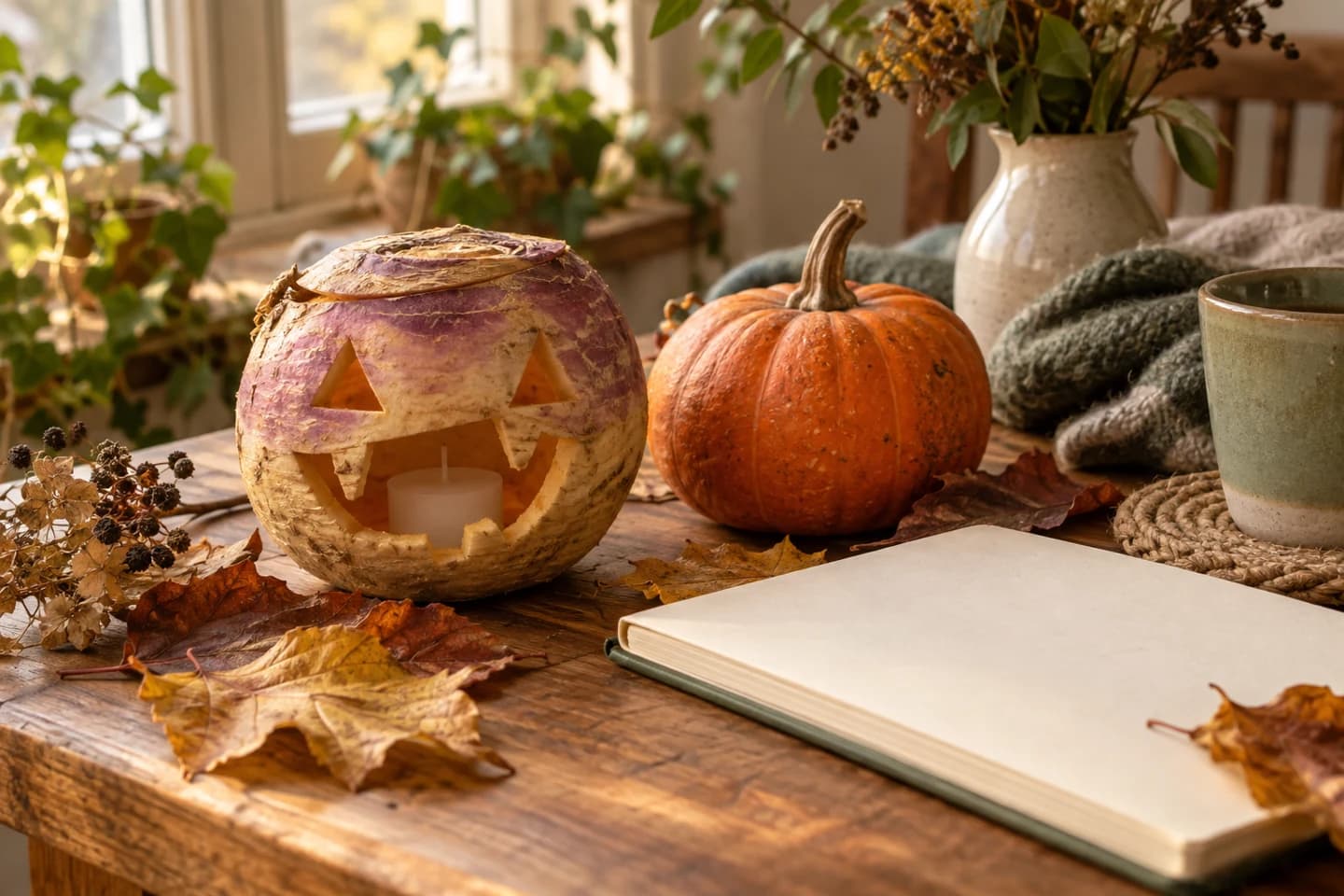
Contemporary illustrative scene; not a photograph of the museum object discussed below.
A carved lantern seems like a simple place to begin a Halloween lesson. Then a child asks who made the first one, whether people used pumpkins in Ireland, or what Samhain has to do with it.
Those questions open a useful history lesson: how do we know what happened?
For learners around ages 9–14, Samhain and Halloween offer a chance to explore seasonal customs, folklore, religious observances, and the evidence people use to connect them. A museum object, a traditional story, and a historian’s interpretation can all contribute. Each answers a different kind of question.
What is Samhain?
The National Museum of Ireland describes Samhain, on November 1, as the traditional beginning of winter, with celebrations taking place the evening before. Its account of Irish Halloween customs includes shared food, games, and beliefs about spirits returning to family homes.
That seasonal setting matters. Before asking where a particular Halloween custom originated, consider what a community might notice at a transition into winter: the harvest, stored food, longer nights, and changes in everyday work. These are useful questions to investigate rather than assumptions about what every family believed.
The museum also explains the name Halloween as the evening before the Feast of All Saints. Irish seasonal traditions and the Christian calendar belong in the discussion together; the name of a holiday does not, by itself, explain every custom associated with it.
Read the museum’s Hallowe’en and Samhain overview.
Start with a turnip and read its label
The National Museum of Ireland’s “ghost turnip” is a particularly good source for a family history lesson.
The museum received a turnip lantern in 1943 from a teacher near Fintown, County Donegal. She reported that this kind of lantern had been made locally around 1900. Museum artist Eileen Barnes then made and painted a plaster-cast model. The displayed object is that model.
There are already three different pieces of information to separate: a custom remembered around 1900, a lantern received in 1943, and a model made to represent it. None of those dates establishes when the custom first began.
The museum describes frightening carved turnip lanterns in Ireland and identifies pumpkin lanterns as an American development of the Irish tradition.
Open the ghost turnip collection entry and ask your learner:
- What is the object we are looking at?
- Which dates describe collecting or remembering?
- What would we need to discover before claiming this particular custom was thousands of years old?
Looking closely at a label is real historical work. A child who notices the difference between an original object and a model has already improved the accuracy of the story.
What a folktale can tell us
A story can preserve ideas about a season without providing a literal record of events.
University College Cork’s Department of Early and Medieval Irish discusses the Old Irish tale The Adventure of Nera. In the story, Nera visits the Otherworld and returns with summer plants, although his journey begins at Samhain. The account explores the tale’s unusual relationship between time, seasons, and the Otherworld.
For a learner, the first question might be: why would summer flowers be surprising in a story set at the beginning of winter?
A second question goes further: what does this story show us about the storyteller’s imagined world? That is different from asking whether the journey happened. A supernatural narrative is not a diary or a set of instructions for a festival.
You can use the university’s discussion as parent background without assigning the entire tale. Begin with the seasonal contrast, then invite the learner to explain why a story might place familiar things in an unfamiliar time.
Some familiar claims need a question mark
“Samhain was the Celtic New Year” often appears in short Halloween explanations. It is worth treating that sentence carefully.
Writing for the Library of Congress in 2013, folklorist Stephen Winick explained that the claim was less secure than older summaries suggested. He described it as a conjecture that arose in the late nineteenth century and became widely accepted during the twentieth.
That does not make Samhain unimportant. It means the connection between a seasonal festival and the beginning of a year needs evidence rather than repetition.
Read Winick’s discussion of Halloween scholarship, then try revising an overconfident sentence together:
“Samhain marked the traditional beginning of winter in Ireland. Whether it also marked the beginning of the ancient Celtic year is less certain.”
This is a useful writing habit. A qualified statement can tell the reader more than a dramatic one. Ask your learner which part is supported and which part needs further investigation.
Describe beliefs as beliefs
The National Museum of Ireland documents Irish Halloween customs involving guising, in which costumed visitors offered entertainment in return for treats. It also describes protective practices and beliefs concerning spirits.
These accounts are valuable evidence about traditions and the meanings people gave them. When discussing them, language helps: “Some people believed…” and “This account describes…” make the source of a statement clear.
Read the museum’s overview of Halloween customs. Choose one custom and discuss what people might have found frightening, reassuring, playful, or meaningful about it. Label your explanation as an interpretation unless the source provides the explanation itself.
The same approach works with family stories. You can ask who told a story, where they heard it, and whether other people remember a different version. Differences are interesting evidence to explore.
Samhain is also a living observance
Samhain is not only a subject in historical accounts. The Harvard Pluralism Project describes contemporary American Pagan observances that include remembering deceased loved ones and ancestors. Practices vary across communities.
When teaching this topic, distinguish a present-day religious observance from a claim about what happened centuries ago. Contemporary practice deserves respectful description, and it does not automatically prove an ancient custom.
A secular homeschool lesson can study these traditions without requiring religious participation. Ask what an account tells you about the people and community it describes; avoid treating one account as a description of everyone.
The Pluralism Project’s Cycles of Celebration provides background on contemporary Pagan seasonal observances.
A short Halloween history activity
Choose two of the sources above. Give your learner a page divided into three columns: claim, evidence, and question.
Start with these examples:
| Claim to investigate | Evidence to examine | Question to ask |
|---|---|---|
| Turnip lanterns were made near Fintown around 1900. | The museum’s account of a teacher’s report. | Does this establish when the tradition began? |
| A story connects Samhain with an imagined Otherworld. | The university’s discussion of Nera. | What can a fictional narrative reveal about ideas? |
| Samhain was definitely the ancient Celtic New Year. | The Library of Congress discussion of uncertainty. | How should the wording change to reflect the evidence? |
Then ask your learner to write three sentences: one supported statement, one clearly labeled interpretation, and one question that remains open.
For a learner who prefers talking, record the answers orally or write them together. The purpose is to practice making a claim that the evidence can support.
You can finish by comparing a custom in your own household with one in a source. Record similarities and differences without assuming that similar practices share the same origin.
Continue with The Night Between
If your learner wants a longer exploration, The Night Between is Lunara’s secular Halloween and Samhain unit study for ages 9–14.
The paid 16-page printable brings together history, folklore, fear, remembrance, and critical thinking, with student pages and parent guidance. It offers a way to continue the questions raised here: how stories change, how people explain unfamiliar experiences, and how seasonal traditions carry meaning.
For a science lesson alongside the history, try Lunara’s pumpkin nature study. A pumpkin can be both a seasonal symbol and an object to measure, observe, and investigate.