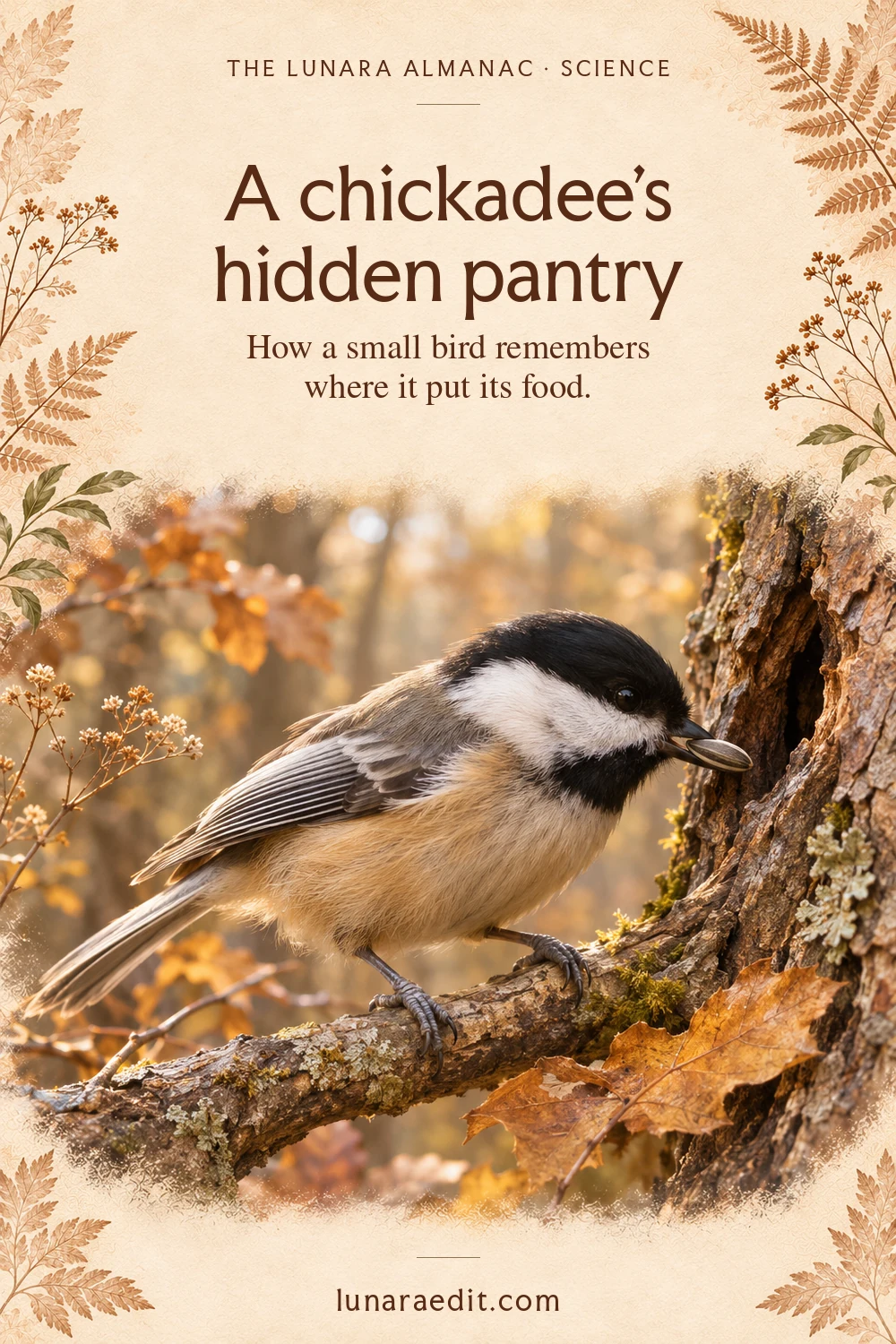
A chickadee takes a seed and leaves the feeder. A moment later it is back for another, which makes it look as though someone very small has decided to empty the whole thing.
Some of those trips may be feeding a future version of the bird. Black-capped chickadees hide food in scattered places and return to it later, using memory to keep track of their stores. Follow one departure and the feeder begins to look like the collection point for a pantry spread across the trees.

One seed at a time
The food goes into many small hiding places.
Food caching means putting food aside for later. A chickadee can tuck an item beneath bark or into a small crevice, then leave to find another. Cornell's Lab of Ornithology notes that a black-capped chickadee can remember thousands of these locations.
Scattering the food makes a demanding job for memory. Knowing which tree you visited is useful, but a tree has a great many cracks. A bird also returns to places it has already used, and a hiding place can be filled or emptied as the day continues.
Caching can happen throughout the year. Cornell describes it as especially noticeable in autumn, when plentiful food may leave a bird with enough to meet its immediate needs and still store some away. A busy feeder can reveal this work if you watch where the birds go after picking up a seed.
Following a single event
Researchers built a place where the hiding could be watched.
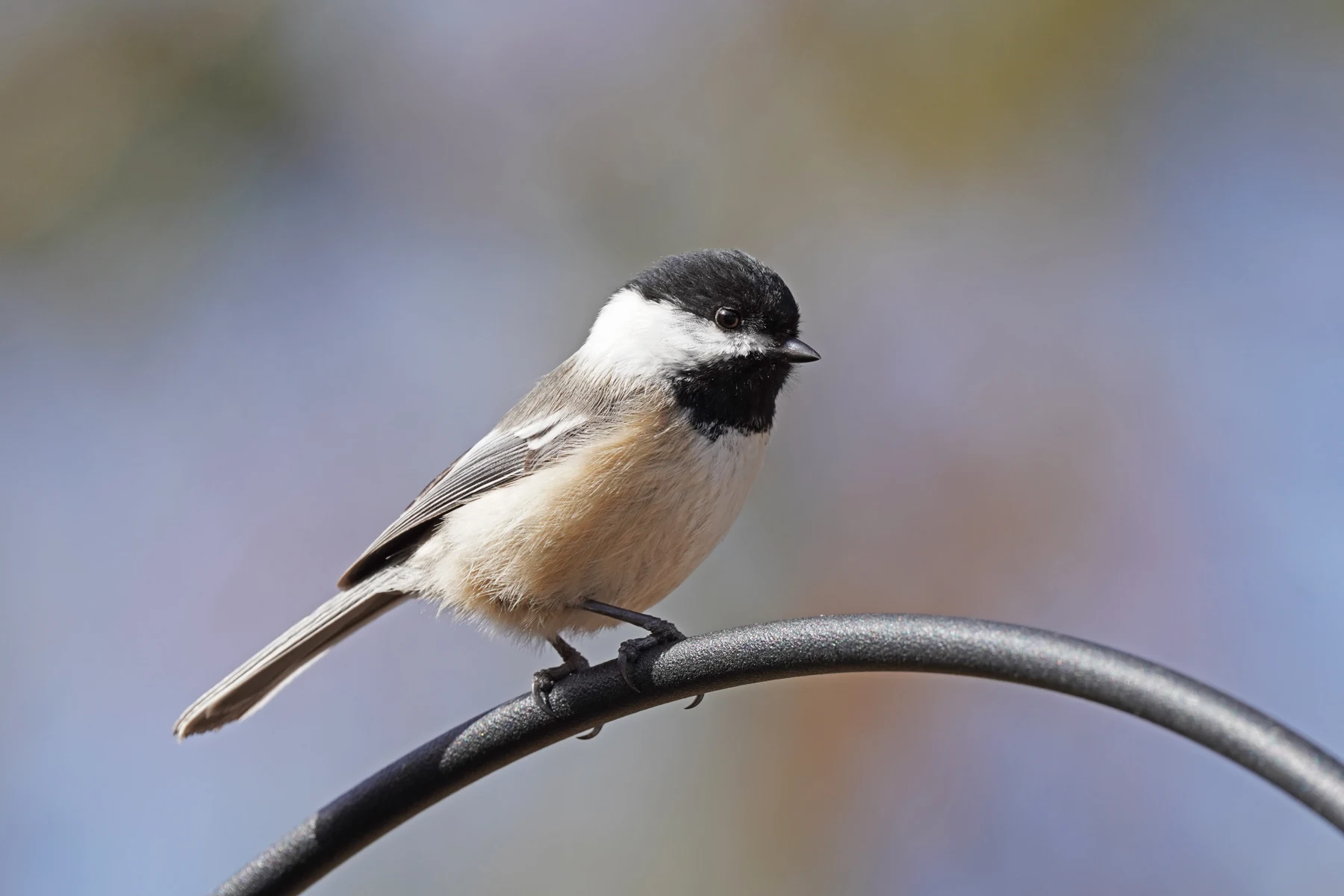
To connect the behavior with activity inside the brain, researchers at Columbia University used an indoor arena with many possible cache sites. Chickadees stored and retrieved sunflower seeds while the team recorded their movements and activity in the hippocampus, a brain structure important for memory.
The setup gave the researchers something unusually helpful: a clear moment when an event worth remembering occurred. They could identify a bird putting a seed away and compare that with its later return. They could also distinguish storing food from simply visiting a spot.
The laboratory version was deliberately easier to observe than a woodland. Cameras tracked the bird while the recordings captured patterns that would be almost impossible to connect with a specific hidden seed in a tree outside.
A distinctive pattern
The same brief pattern appeared again at retrieval.
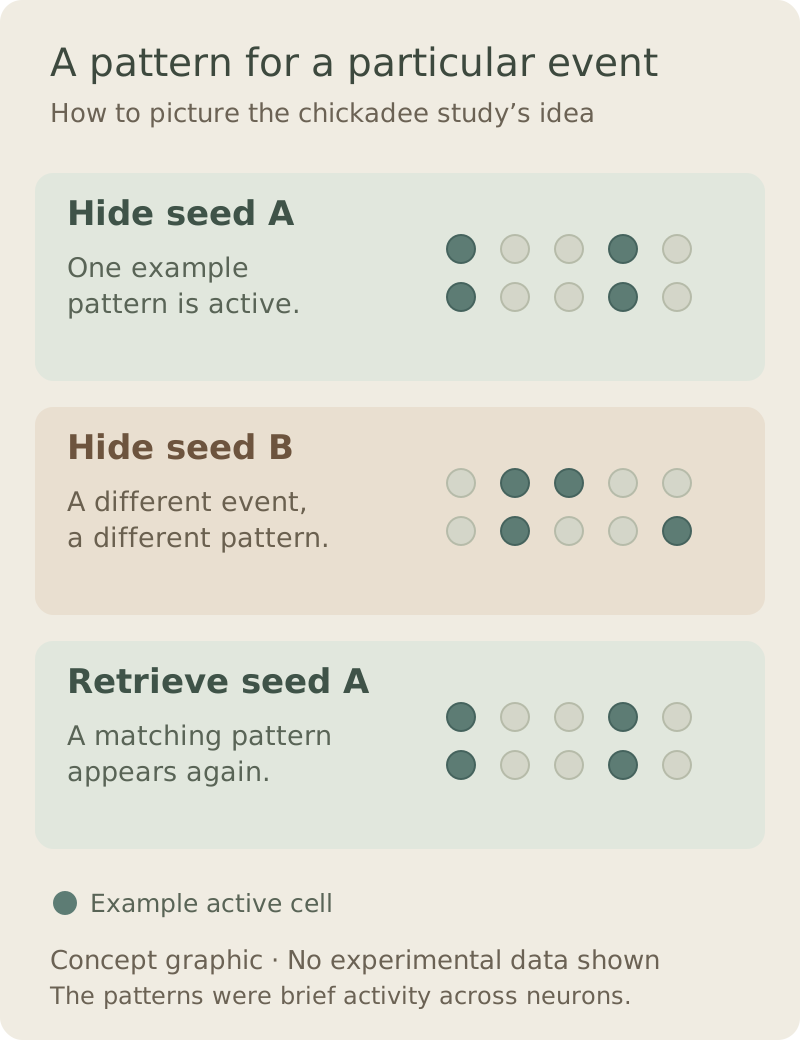
In the 2024 Cell study, the team found sparse, brief patterns of activity across hippocampal neurons during caching. A particular pattern could appear again when the bird retrieved the corresponding food. The researchers called these patterns barcodes because each could distinguish an individual caching event.
The barcode describes activity across brain cells. There are no printed stripes inside the bird’s head. Different groups can become active for different events, with a matching pattern appearing again during retrieval.
Columbia's account describes these patterns as lasting about a second on average. Something that brief would be easy to miss without knowing when the bird had stored or retrieved a seed. The timing of the behavior helped make the neural pattern visible.
More than a location
Two nearby hiding places could have different patterns.
The study also recorded the more familiar activity associated with place: where the bird was in its surroundings. The barcode patterns could differ sharply even between nearby caches with similar place-related activity. That distinction is why the work is interesting for researchers studying how a brain represents individual experiences.
The authors propose that reactivating these patterns could help an animal recall a particular event. They studied laboratory chickadees; whether a comparable mechanism supports human memories remains a research question.
At the next feeder visit
Follow the departure, as well as the arrival.
Watch from a comfortable distance and choose one bird taking a seed. Can you see where it lands next? It may eat there, disappear from view, or tuck the food away. Record what you can actually see, then watch another trip.
The brief pause at the feeder is only one part of the sequence. Somewhere beyond it, a crack in the bark may be becoming a place worth remembering.
SHARE THIS WITH THE KIDS
A few things to talk about together.
- Black-capped chickadees store food in many small caches and can remember thousands of hiding places.
- Researchers recorded distinct patterns of brain-cell activity when laboratory chickadees hid seeds.
- Patterns associated with particular caching events appeared again during retrieval.
The records and research behind the story
Read a little deeper
- Cornell Lab of Ornithology: Black-capped Chickadee (opens in a new tab)
- Cornell Lab: Where Is That Bird Going With That Seed? (opens in a new tab)
- Chettih, Mackevicius, Hale & Aronov (2024): Barcoding of episodic memories in the hippocampus of a food-caching bird (opens in a new tab)
- Columbia's Zuckerman Institute: the study, experiment and researchers (opens in a new tab)