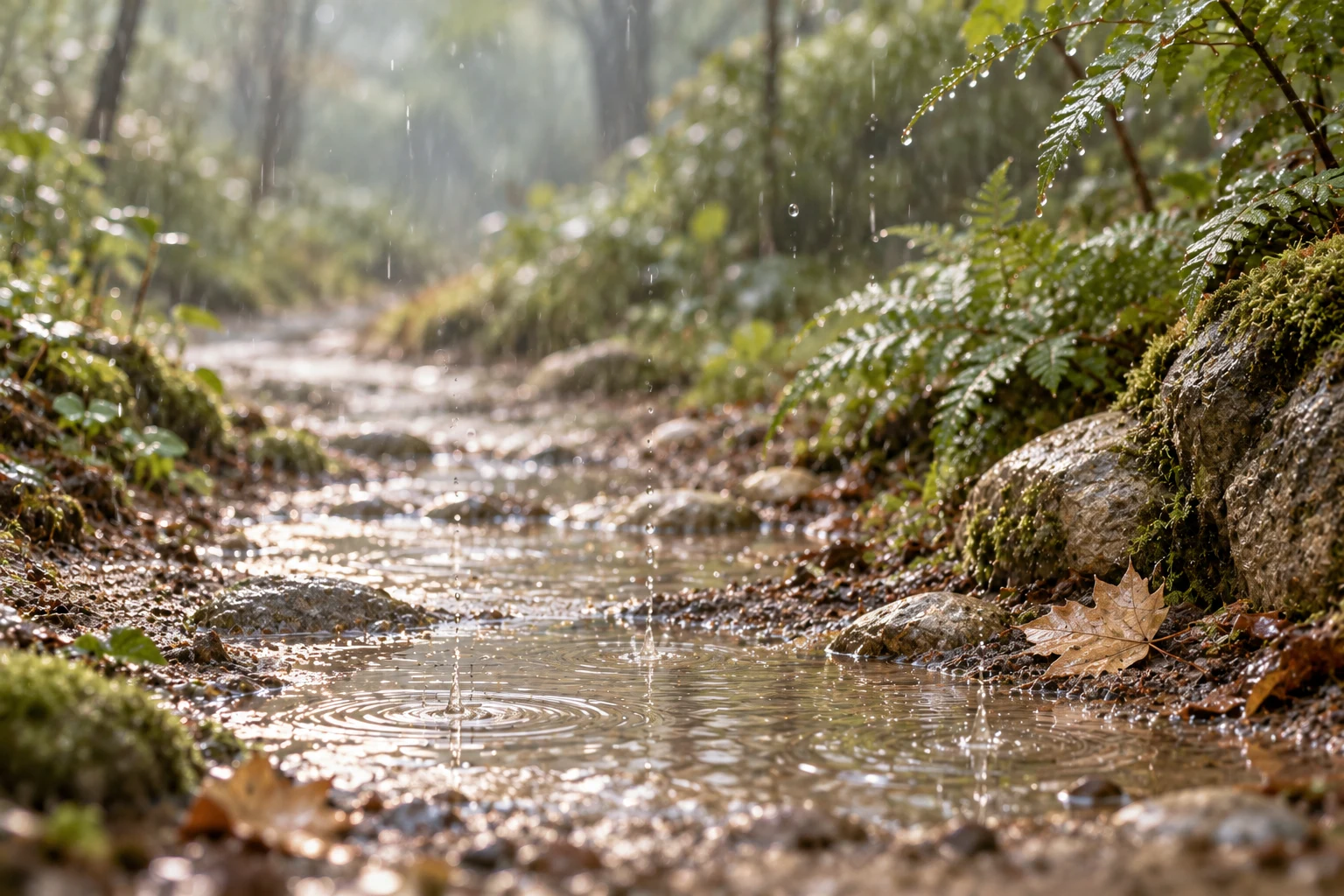
The rain has barely begun, and the air already smells different. You notice it before the path is properly wet.
The familiar scent is often called petrichor, especially when rain reaches dry ground. Compounds in and on the ground contribute to it, and the impact of falling drops can help carry material into the air. Following that process takes us from soil microbes to bubbles too small to notice in an ordinary splash.
A name for something familiar
Petrichor describes a scent released when rain meets the ground.
CSIRO credits its researchers Isabel Joy Bear and Richard Grenfell Thomas with creating the word petrichor in 1964. Their work investigated the characteristic odor associated with rain on dry earth. A name made it easier to discuss a shared observation that many people already recognized.
The scent can include several compounds, so petrichor is not the name of one molecule. The surface, recent weather, and material around it all help shape what you notice. A garden path, dry soil, and a wooded place need not smell exactly alike after the same shower.
Meet geosmin
Soil microbes make one important earthy-smelling compound.
Geosmin is a molecule produced by certain microorganisms, including soil bacteria such as Streptomyces. The American Chemical Society describes its earthy odor and its contribution to the scent associated with rain. It also contributes to the earthy flavor of beets, so the same compound may be familiar from both a garden after rain and something on your plate.
Humans can detect geosmin at very low concentrations. That means a small amount reaching the air can be noticeable. Smelling it does not tell you the exact composition of the soil, but it does connect a large sensory impression with chemistry taking place on a much smaller scale.
How the scent gets airborne
A falling drop can briefly trap a crowd of tiny bubbles.
In 2015, MIT researchers Young Soo Joung and Cullen Buie used high-speed imaging to study drops striking porous surfaces. The recordings showed small air bubbles becoming trapped at impact. As those bubbles rose and burst, they released much smaller droplets into the air. Suspended droplets or particles like these are called aerosols.
The experiments offered a mechanism by which rain could lift material from a surface, including aromatic compounds. The amount released depended on conditions such as the surface and impact speed; gentle and moderate rain could be more effective than heavy rain in the tested setups. A splash visible to your eye therefore has another, much finer spray that you may never see.
On a gentle rainy day
Notice the surface the rain reaches first.
From a sheltered doorway after a storm has safely passed, compare what you notice beside a garden bed and a paved path. Was the ground dry beforehand? Did the scent arrive with the first drops, or later? You can jot down a few observations and compare them with another shower.
Humidity, wind, plants, and different surfaces can change together, so this comparison will not isolate one cause. Record those conditions alongside the smell you notice, then look for similarities and differences between showers.
SHARE THIS WITH THE KIDS
A few things to talk about together.
- Petrichor names the scent associated with rain reaching dry ground.
- Some microorganisms make geosmin, an earthy-smelling molecule.
- Tiny bubbles in impacting drops can burst and release smaller droplets into the air.
A FEW OF THE SOURCES BEHIND THIS PIECE