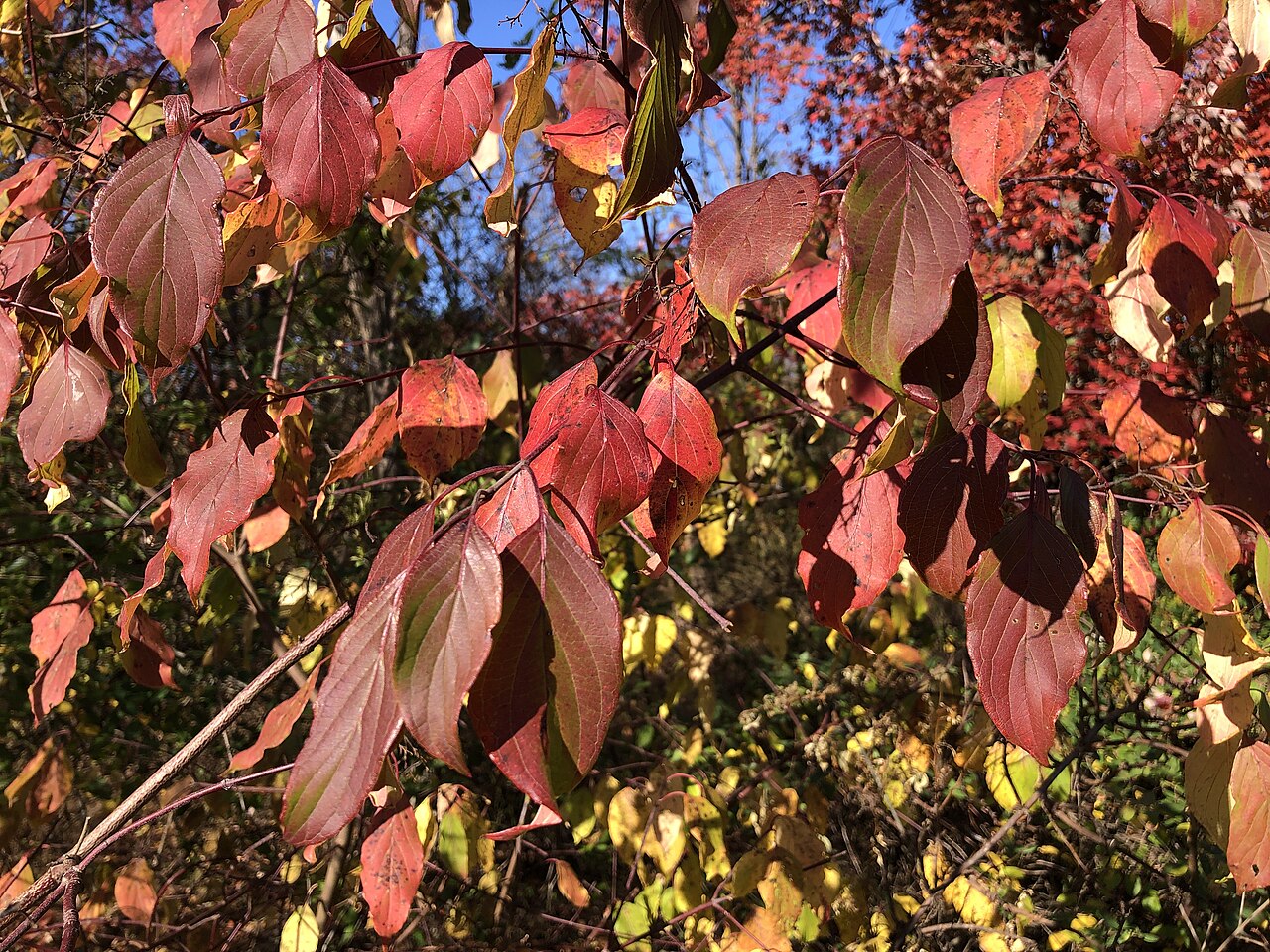
A yellow leaf and a red leaf can look like two versions of the same autumn change, but their colors have different chemical histories.
Yellow and orange pigments called carotenoids are already present in many green leaves. As green chlorophyll breaks down, those colors become easier to see. In many species, the reds come from anthocyanins made as autumn approaches. Making pigment uses resources, which leaves an interesting question: what might a plant gain by producing red color in a leaf it will soon shed?
Before the leaf falls
Aging leaves can return nutrients to the plant.
Autumn leaf aging, called senescence, is a period in which the plant can recover nutrients from its leaves. A leaf may be approaching the end of its life while still participating in that recovery.
One explanation for red pigments is that they help shield the remaining photosynthetic machinery from excessive light during this period. Researchers call this photoprotection: protection from damage caused by light.
Testing a light screen
Red-osier dogwood supplied an early test.

In a 2001 study, Taylor Feild, David Lee and N. Michele Holbrook examined how red and yellow aging leaves of red-osier dogwood responded to light. Red leaves absorbed more light across part of the visible spectrum and recovered better after a high-light stress treatment.
The researchers also tested blue and red light separately. Their results supported a screening role for anthocyanins: the pigments intercepted wavelengths that would otherwise reach the photosynthetic tissues.
The sunscreen comparison describes how the pigments screened incoming light. In this experiment, researchers tested visible wavelengths, extending the idea beyond protection from ultraviolet radiation.
From light to nutrient recovery
A 2003 experiment tested plants with and without red pigment.
William Hoch and colleagues compared ordinary plants with anthocyanin-deficient forms of three woody species. Their results supported the idea that the pigments could protect nutrient recovery under stressful light conditions.
Paper birch also performed well in the comparison, recovering nutrients without those red pigments. Other protective strategies can help plants recover nutrients before leaf fall.
Testing the wider explanation
Results across species complicate the picture.
Researchers also ask how the light-screening effect relates to the evolution of autumn redness across different tree species.
A 2021 comparison of 55 tree species found greater nitrogen-recovery efficiency in species with yellow autumn leaves. Anthocyanin presence was not associated with more efficient recovery, a result that challenged the proposed link between light protection and the evolution of red autumn leaves. The authors also acknowledged limitations of the comparison.
In a 2023 study of Norway maple, researchers compared green, red and yellow leaf sections. Under the conditions tested, the rate of damage to photosystem II, part of the machinery that captures light energy, did not differ significantly between red and yellow aging sections.
A different possible function
Red leaves may also affect insects choosing a host.
Another hypothesis concerns insects that select trees in autumn. If leaf color provides information about how suitable a tree is as a host, it could affect where those insects settle.
In a 2009 apple-tree study, Marco Archetti found fewer rosy apple aphids on varieties with red autumn leaves. Aphids tested the following spring also performed worse on trees whose leaves had been red in autumn. Those results supported the proposed signaling explanation for the apple varieties studied.
To test whether red leaves serve as a warning signal, researchers also have to account for insects' existing responses to color. Those preferences could influence host choice alongside any information the leaf color conveys about the tree. The apple findings concern the varieties studied and a possible role in insect behavior, while the light-screening experiments examine how pigment affects the leaf itself.
On an autumn walk
Compare the colors on one familiar tree.
Choose a tree you can revisit and record its location, the date and the colors you see. Photograph a branch from the same position on another day, noting whether the leaves have changed color or fallen.
If you compare two trees, identify them when you can and keep a separate record for each. Over several visits, your photographs will document differences in color and the timing of leaf fall. Nutrient recovery and light protection are measured through the kinds of experiments described above.
SHARE THIS WITH THE KIDS
A few things to talk about together.
- Yellow and orange carotenoids are already present in many green leaves.
- Many plants produce red anthocyanins as autumn approaches.
- Research tests several possible functions for red autumn leaves; results vary by species and experimental conditions.
A FEW OF THE SOURCES BEHIND THIS PIECE
Read a little deeper
- U.S. Forest Service: Why Leaves Change Color (opens in a new tab)
- Feild, Lee and Holbrook (2001): Anthocyanins in aging red-osier dogwood leaves (opens in a new tab)
- Hoch and colleagues (2003): Resorption protection and nutrient recovery (opens in a new tab)
- Pena-Novas and Archetti (2021): Testing the photoprotection hypothesis across 55 species (opens in a new tab)
- Mattila and Tyystjärvi (2023): Red pigments and photoprotection in Norway maple (opens in a new tab)
- Archetti (2009): Apple autumn colors and aphid host choice (opens in a new tab)
- Image license: Famartin's dogwood photograph is CC BY-SA 4.0 (opens in a new tab)