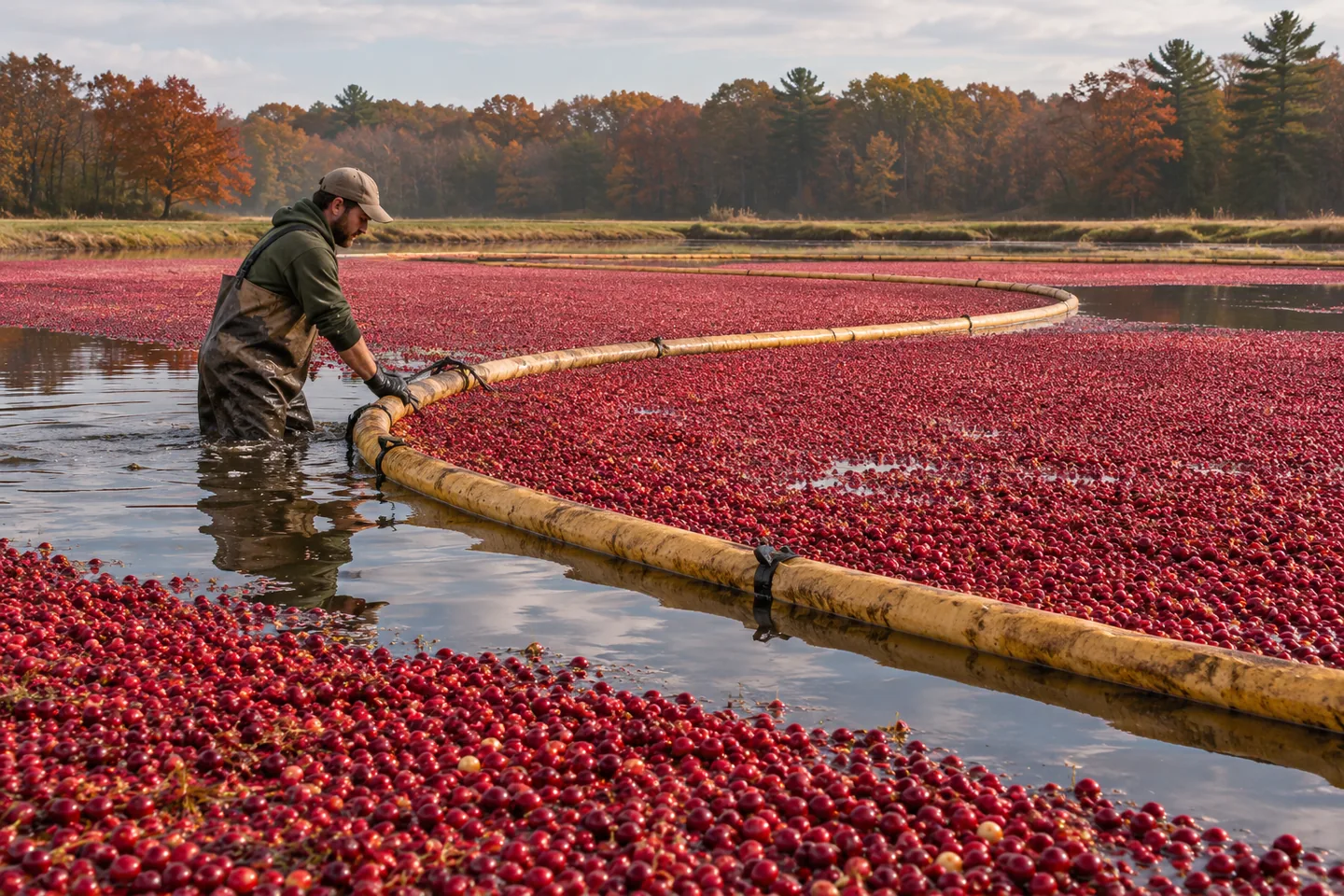
From the bank, the red surface looks almost solid. Then a narrow channel opens between the berries, a reflection appears, and the whole field begins to look more like water. During a wet cranberry harvest, thousands of loose fruits collect at the surface, ready to be gathered together.
For most of the growing year, the berries are much closer to the ground. Cranberries develop on low, woody vines rooted in soil, and growers bring water into the bed when it has a job to do. At harvest, that water makes use of something already inside the fruit: air.

Before the harvest
The berries begin close to the ground.
The American cranberry, Vaccinium macrocarpon, is a perennial plant, which means it grows back year after year. Its horizontal stems spread along the ground, while short upright shoots carry the leaves and flowers. Together they form a dense, low planting.
Commercial cranberry beds are often called bogs or marshes. The vines themselves grow best in acidic, well-drained soil, with their leaves and developing fruit above standing water. UMass Cranberry Station’s growing guide explains how important that drainage is to a healthy plant.
In spring, flowers open and are pollinated. Green fruit develops through summer, then takes on its familiar color in fall. By the time a grower is ready to flood a bed for harvesting, the berries have spent the season growing on their vines.
Sources for this section: US Cranberry Marketing Committee (opens in a new tab) · Cranberry Institute (opens in a new tab) · UMass Cranberry Station (opens in a new tab)
Why they rise
There is air inside a cranberry.
A cranberry contains four internal chambers that hold air. These spaces help give the berry enough buoyancy to float. When the bed is flooded and the fruit is loosened, the berries rise to the surface while the vines stay rooted below.
A specialized harvesting machine moves through the bed to dislodge the fruit. Growers then guide floating booms around the berries, gathering them into a smaller area so they can be removed and sent for processing. Those long curves across a harvest photograph are helping turn thousands of loose berries into a crop that can be collected.
Sources for this section: US Cranberry Marketing Committee (opens in a new tab) · Cranberry Institute (opens in a new tab)
Different destinations
Some cranberries are picked without a flood.
Cranberries headed for the fresh-fruit market are often gathered with a mechanical picker that combs them from the vines without flooding the bed. The berries are then cleaned and packaged. Most wet-harvested fruit goes into products such as juice and sauce, according to the Cranberry Institute.
So the bag of whole cranberries you bring home and the juice in your glass may have begun on the same kind of vine, then taken different routes through harvest.
Water has other jobs on a cranberry farm, too. Growers can flood the beds in winter to help protect the vines from harsh conditions. The red surface of an autumn harvest and the water over a winter bed belong to different stages of caring for the same plants.
Sources for this section: US Cranberry Marketing Committee (opens in a new tab) · Cranberry Institute (opens in a new tab) · UMass Cranberry Station (opens in a new tab)
At the kitchen table
Look inside one berry.
If you have fresh cranberries, ask an adult to cut one crosswise so you can look for the chambers inside. Then place a whole berry in a small bowl of water and watch where it settles. Seeing the inside beside the floating fruit makes the harvest easier to picture. The adult should handle the knife and supervise small fruit around young children.
SHARE THIS WITH THE KIDS
A few things to talk about together.
- Cranberries grow on low vines rooted in soil.
- Air-filled chambers help detached berries float during wet harvesting.
- Dry harvesting gathers fruit without flooding the bed.
The records and research behind the story
Read a little deeper
- US Cranberry Marketing Committee · Cultivation, four air chambers, and wet and dry harvesting (opens in a new tab)
- Cranberry Institute · Vine structure and the destinations of wet- and dry-harvested fruit (opens in a new tab)
- UMass Cranberry Station · How cranberry vines grow and why drainage matters (opens in a new tab)