
The vase is tall, golden brown, and carefully patterned. You might picture flowers in it, perhaps something with long stems and expensive taste. Its intended contents were celery.
During the nineteenth century, American households could serve celery upright in special glass vessels, putting the stalks where guests could admire them. A vegetable we now chop into soup was once costly enough to help announce the standing of the household serving it. It also left behind some remarkably beautiful dishes.

At the center of the table
The celery arrived standing up.
A celery vase did a straightforward job in a conspicuous way. Stalks stood vertically in cold water, with their leafy ends rising above the rim, much as stems rise from a flower vase. Guests could take the raw celery from a vessel that kept it visible throughout the meal.
The Museum of Fine Arts, Houston describes celery as an exotic and expensive vegetable in the nineteenth-century American setting. It places the celery glass among the increasingly specialized serving containers that appeared on dining tables. A dish could tell guests what it held before anyone offered it around.
There is something wonderfully specific about that. A household needed to obtain the desirable food, then own the appropriate object for presenting it. The celery and the vase arrived at the table together, each helping the other look impressive.
Look closely
Even an empty vase has plenty to tell us.
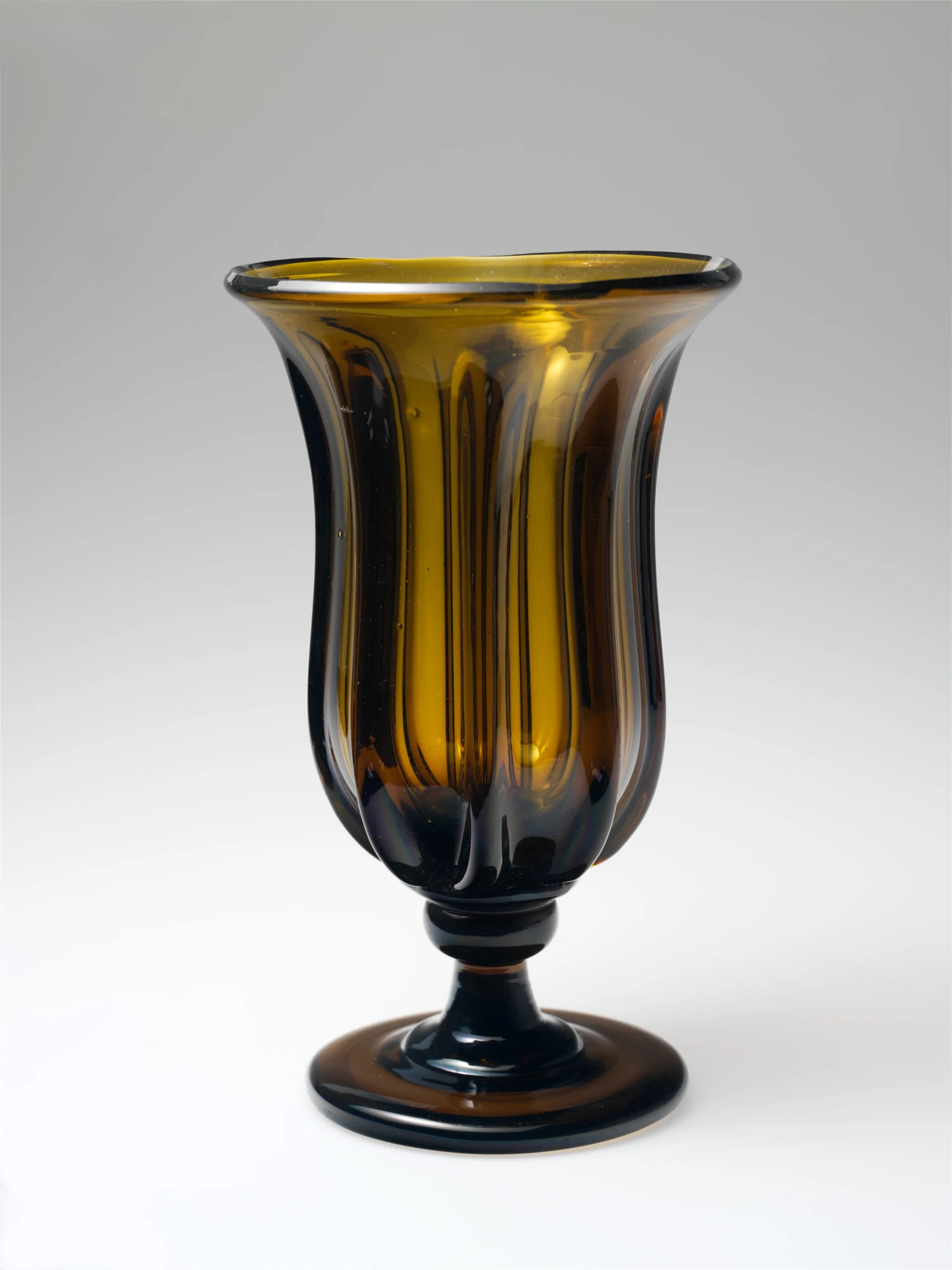
The Met's example shown here dates to 1845–70. It is American, made from blown, pattern-molded glass, and stands ten and a quarter inches high. That is a substantial object for a vegetable we often serve as a few sticks beside a dip.
Look at its changing shape: the broad opening, the narrowing body, and the foot that supports it. Light catches the repeated pattern and gives the amber glass a great deal of visual texture. Empty, it already looks ready for company.
The museum cautiously identifies where it may have been made, listing possibilities in Pennsylvania and Ohio. The object itself has survived more clearly than every detail of its origin. Its date, material, size, and purpose still let us picture a very particular way of serving food.
An impressive dinner
Good taste came with a shopping list.
The Henry Ford's collection describes celery vases as part of the way class-conscious Americans displayed social standing through unusual foods and specialized tableware. Its own example dates from 1830–70. Over time, the vase became a middle-class expectation, even as its original purpose was tied to an expensive vegetable.
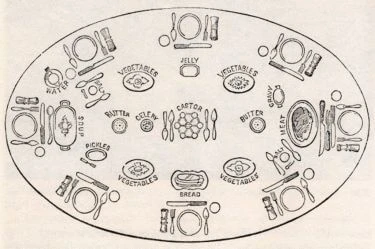
An illustrated table setting from the March 1859 issue of Godey's Lady's Book gives the object some company. The Corning Museum of Glass points out a celery vase alongside butter dishes, salt dishes, and a castor set used for condiments. The arrangement makes the abundance of serving equipment almost as noticeable as the meal.
This is a good place to linger over the picture. Which vessels can you identify immediately? Which ones would you need someone to explain? A table can seem perfectly ordinary to its diners while looking surprisingly elaborate to people a century and a half later.
From centerpiece to cupboard
The vegetable became easier to obtain.
According to The Henry Ford, changes in growing methods helped make celery more common, and its special dish lost some of its social importance. The costly food became familiar while the vessel that had displayed it remained behind in cupboards and collections.
That shift helps explain the little jolt of meeting a celery vase today. We still recognize the effort involved in setting out a special dish for guests. What has changed is which food seems special enough to deserve it.
Around your own table
Choose an object whose purpose somebody might have to guess.
A gravy boat, an egg cup, a butter mold, or a particular pair of serving tongs can carry its own small history. Look at the shape before naming the job. What does it hold, and what does its design make easier?
Then return to the celery vase and picture the green stalks above its rim. It may be the first time the vegetable has looked slightly underdressed in the refrigerator.
SHARE THIS WITH THE KIDS
A few things to talk about together.
- Nineteenth-century American diners sometimes served raw celery upright in special glass vases.
- Celery was expensive enough to become a sign of social standing.
- As growing methods made it more common, its specialized serving dish lost some of that significance.
The records and research behind the story
Read a little deeper
- The Metropolitan Museum of Art: American celery vase, 1845–70 (opens in a new tab)
- Museum of Fine Arts, Houston: how celery glasses were used (opens in a new tab)
- The Henry Ford: Celery Vase, 1830–1870 (opens in a new tab)
- Corning Museum of Glass: the 1859 illustrated table setting (opens in a new tab)