
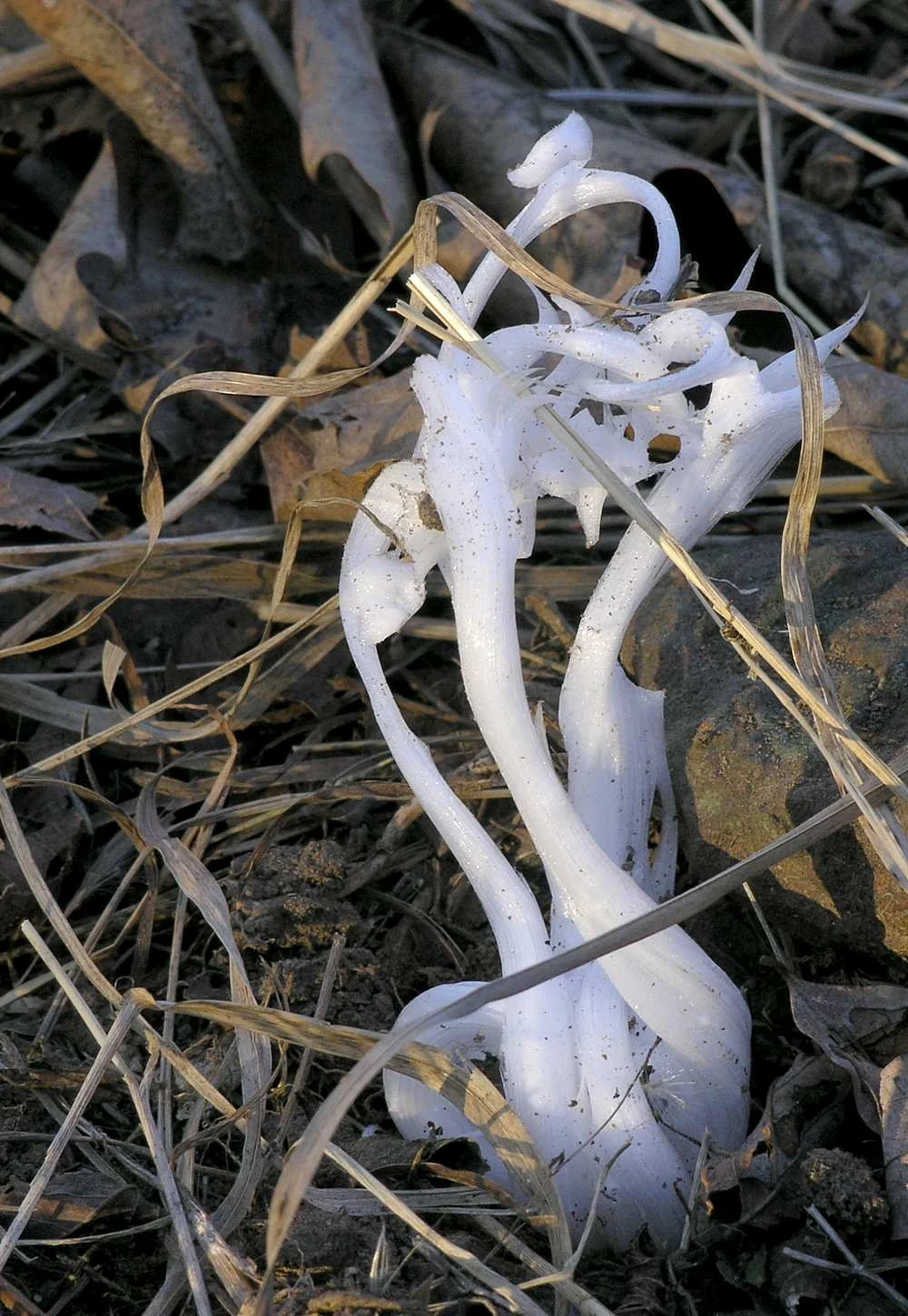
At the foot of a brown plant stem, something white has gathered among the leaves. It looks a little like a scrap of tissue that caught on the way past, until you crouch down and see the folds. They are thin, translucent, and made entirely of ice.
These are frost flowers: ribbons that emerge from the stems of certain plants when freezing air meets a supply of water from the ground. The plant may have finished flowering for the year, but a cold morning can give it this brief, improbable second display. In Missouri, late autumn is a good time to start looking.

At the stem
The ice keeps growing outward.
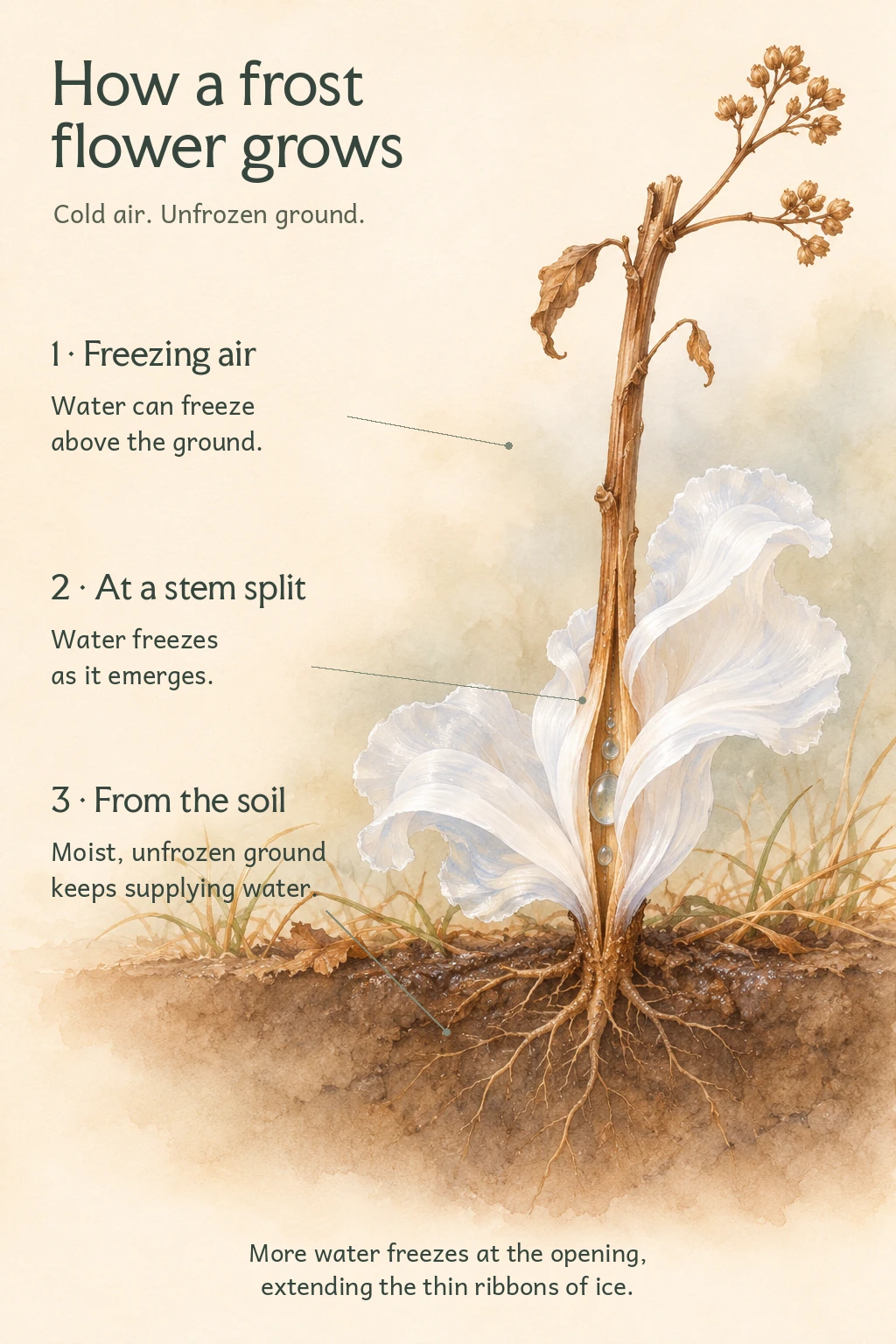
A frost flower needs a particular arrangement: air cold enough to freeze water, moist ground that has not yet frozen, and a suitable plant stem. The ground still supplies water while the air above it is already below freezing. That difference gives the ice somewhere to grow.
Water moves upward through the stem and reaches narrow splits along its sides. As it freezes at the opening, more water feeds the growing edge, pushing a thin sheet of ice farther outward. The sheet bends and folds as it develops, producing the ruffles that give frost flowers their name.
A long opening can produce a broad ribbon; a smaller opening can make a narrower curl. The National Weather Service describes layers roughly as thin as a credit card. Up close, the result can look like a tiny piece of folded fabric, with a stem running through its middle.
A few particular plants
A field full of stems will not become a field full of ice flowers.
Only some plants produce these formations. Missouri's Department of Conservation names dittany and white crownbeard among the local examples. University of Missouri horticulturist Michele Warmund also describes them on wingstem. Their ordinary growing places can include weedy edges, streamside ground, and places that have escaped the mower.
That makes a little familiarity useful. Finding the right plants while they are still recognizable gives you somewhere to return when the weather changes. You can photograph a patch and note its location, then look near the bases of the stems after an early freeze.
The regional details matter. White crownbeard is found in the southern half of Missouri, according to Warmund's account; another frost-flower plant may be the better lead where you live. A local native-plant guide can help you choose a promising patch.
Before the sun reaches them
The best part of the display is also why it is easy to miss.
These are fragile structures with a short morning ahead of them. As the air warms or sunlight reaches the ice, the folds can shrink, collapse, or disappear. By the time a path is busy with afternoon walkers, there may be very little left to notice.
Warmund suggests searching around dawn or shortly afterward during suitable weather. In Missouri, conditions can occur from October into early December. Moisture, temperature, plant species, and the particular spot all affect the result, so a cold night alone does not guarantee a display.
Their other names are nearly as appealing as the formations: rabbit ice, ice fringes, and ice ribbons. People were describing them long before a photograph could settle an argument about what they had seen. In 1833, the astronomer John Herschel wrote about wavy, ribbon-like ice appearing from splits in stems.
On a cold morning
Look low, and leave the curls where they formed.
Choose a safe, accessible patch you can visit without leaving the path or entering private land. Look at the ground around standing stems before reaching toward anything white. A photograph taken at stem height will usually show the folds better than one taken from above.
If someone is coming with you, ask them to notice where the ice begins. Is it attached to a leaf, lying on the soil, or emerging from a split in the stem? That small detail connects the beautiful thing in front of you to the water still moving beneath it.
SHARE THIS WITH THE KIDS
A few things to talk about together.
- Frost flowers are thin ribbons of ice that grow from splits in certain plant stems.
- They need freezing air and a supply of water from moist, unfrozen ground.
- Morning warmth and sunlight can melt the display before many people see it.
The records and research behind the story