Yesterday, the patch beside the log was leaves and moss. Today, it has acquired several small umbrellas.
Mushrooms are very good at making an entrance. After damp weather, they can appear in a lawn, along a path, or on a fallen branch with enough suddenness to look newly invented. The visible change is real, but the life behind it usually has a longer history.

Below the cap
Most of the fungus is somewhere you cannot see.
For many mushroom-forming fungi, the main body is a network of fine, branching threads called hyphae. Together, those threads form mycelium. They can grow through soil, fallen wood, or other material, drawing nutrients from their surroundings. What looks like a collection of separate mushrooms may be connected to growth hidden below the surface.
The mushroom is a reproductive structure, often called a fruiting body. It produces spores that can disperse and, under suitable conditions, begin new fungal growth. An apple is a useful comparison for the visible part: finding fruit tells you that a much larger living system has been at work. Fungi have their own biology, though, and belong to a separate kingdom from plants.
A change in the weather
Damp conditions can make the hidden growth visible.
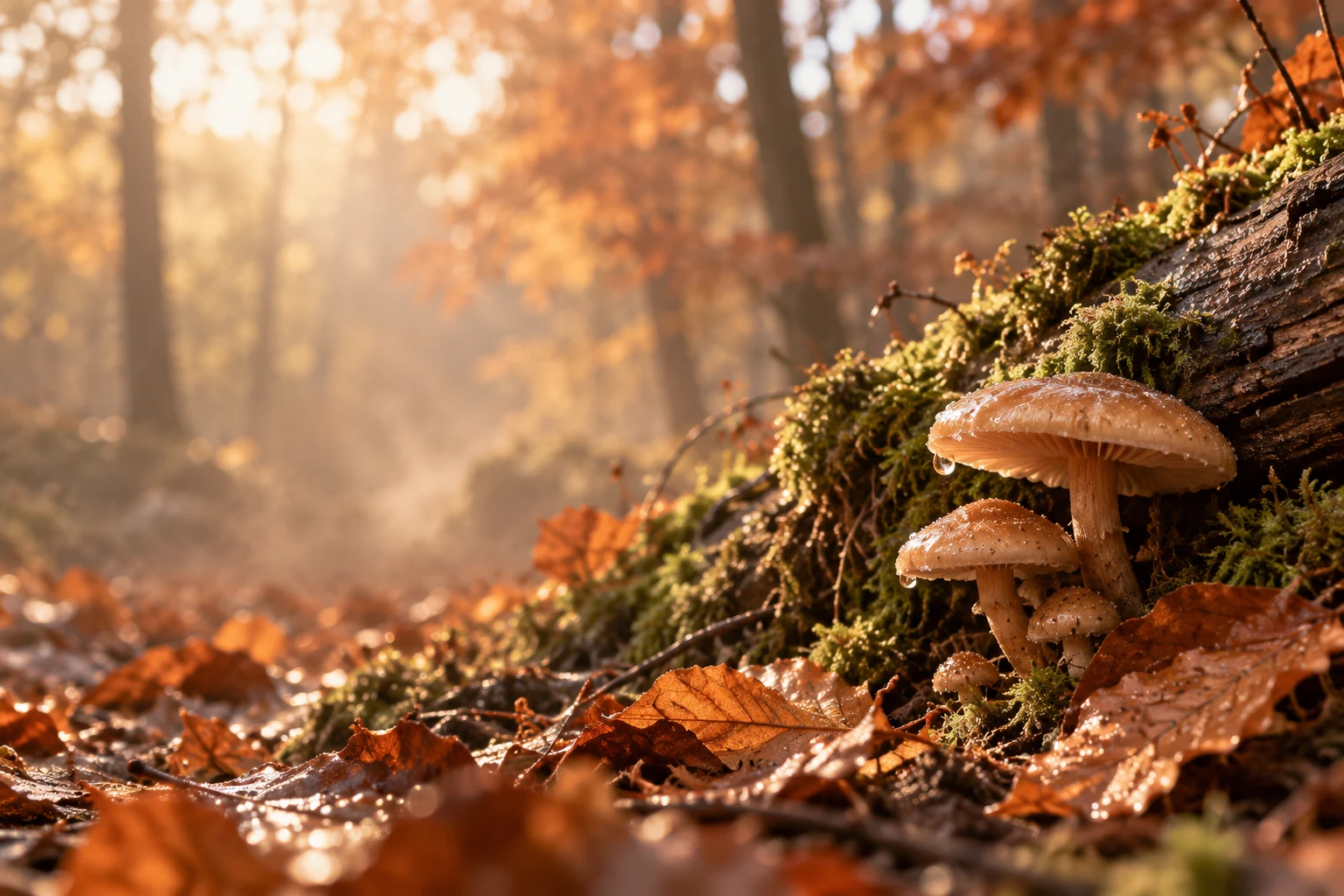
Water availability and suitable temperatures help many fungi produce fruiting bodies. Autumn often supplies that combination, along with plenty of fallen plant material. Different species respond to different conditions, so a shower does not summon every mushroom at once.
A fruiting body can develop quickly enough to surprise someone who walks past the same place each day. Rain is part of the opportunity; it does not mean the whole organism began growing that morning. The next dry spell may make the mushrooms shrink or disappear while mycelium remains in the substrate.
The work around the log
Fungi help change what a woodland can reuse.
Many fungi are decomposers. They release enzymes into their surroundings and absorb nutrients from the material those enzymes break down. A fallen branch can therefore be both the remains of a tree and a place where another organism is actively feeding. This process helps return nutrients to the wider ecosystem.
Other fungi form partnerships with plant roots, exchanging resources with the plant. Some are parasites. A mushroom beside a tree does not, by itself, tell you which relationship is happening. The setting is a clue to record, rather than a complete identification.
On the next damp morning
Visit one small patch twice.
Choose a log or a corner of the yard you can revisit without disturbing it. Notice where the mushrooms emerge, whether their caps are open or closed, and what surrounds them. Take a photograph from the same position on another day, then compare the changes.
You might find that the most interesting question is about timing: what became visible after the weather changed, and what might still be growing when the mushrooms are gone? A familiar bit of ground can hold a great deal more life than its surface first suggests.
SHARE THIS WITH THE KIDS
A few things to talk about together.
- The branching threads of many fungi form a network called mycelium.
- A mushroom is a fruiting body that produces spores.
- Many fungi help break down fallen plant material and recycle nutrients.
A FEW OF THE SOURCES BEHIND THIS PIECE