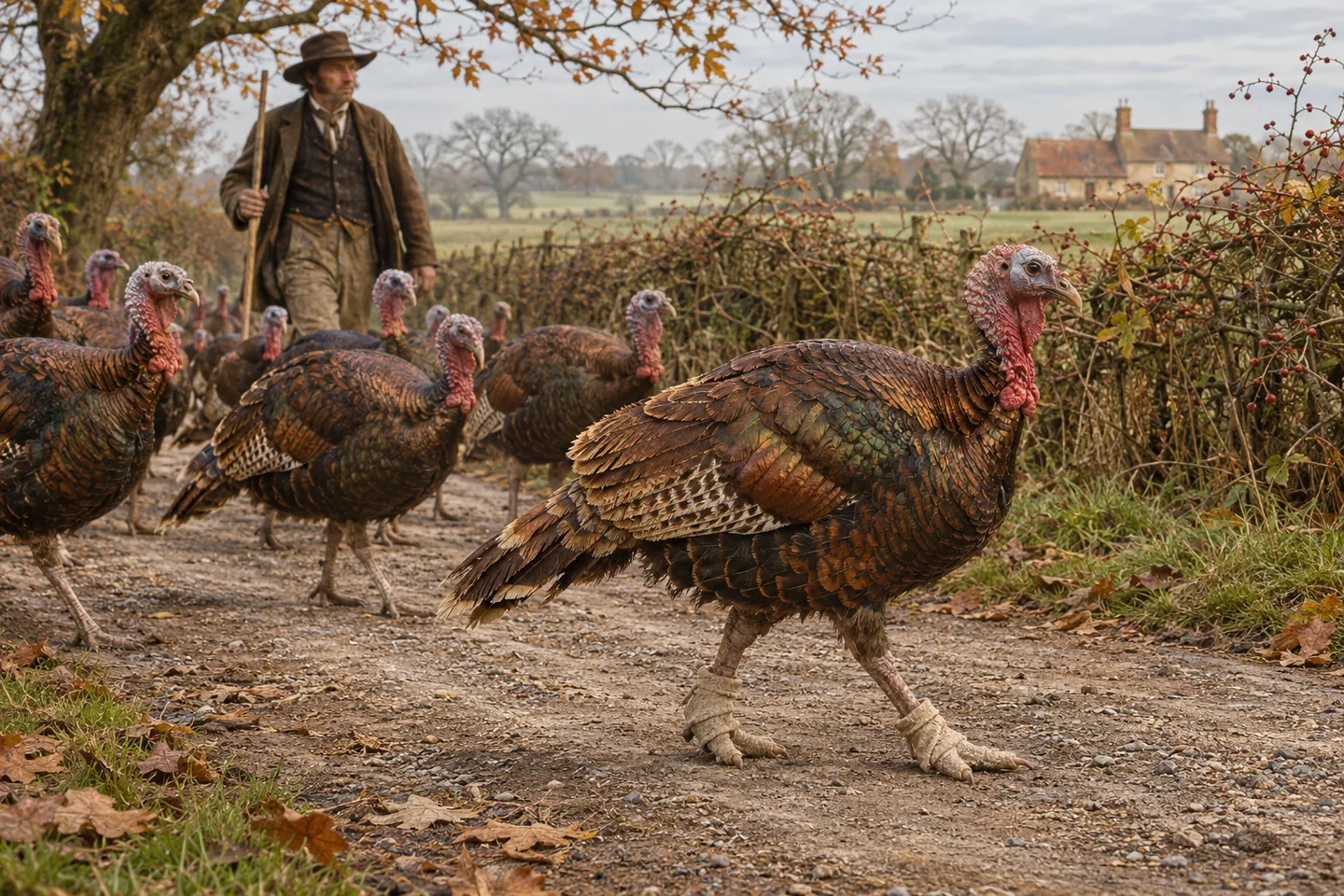
The turkey at the front of the flock has a long way to go, and dinner is at the other end of it. Before poultry could routinely travel in refrigerated vehicles, one solution to getting fresh birds to a distant city was to let them do much of the walking themselves.
Large groups of turkeys were driven toward London from farming areas such as Norfolk and Suffolk. Keeping them moving meant looking after feet that had a great deal of road ahead of them. Later accounts describe pitch and small cloth coverings used to protect those feet along the way.

The older record
Daniel Defoe counted the trade in droves.
In his account of a 1722 tour through eastern England, Daniel Defoe describes Suffolk and adjoining Norfolk as important sources of turkeys for London and the surrounding counties. The volume containing his account was first published in 1724.
Defoe repeats a local report that three hundred droves crossed Stratford Bridge on the River Stour in a season, with hundreds of birds in individual groups. He uses those reported figures to estimate the scale of the trade, giving us an impression of just how much poultry was traveling toward the city.
Imagine managing one of those groups along a road: keeping the birds together and headed in the right direction, with all those feet covering the distance between a farm and a market. Getting dinner into London could begin with a very slow walk.
Sources for this section: Daniel Defoe (opens in a new tab)
Protecting the feet
Those feet had a long road ahead.
Folklorist Stephen Winick’s American Folklife Center essay on Christmas turkeys draws on later accounts by Margaret Visser and historian Judith Flanders. They describe protecting the feet of birds driven long distances with pitch, sacking, or little boots.
Rough cloth or a protective coating helped reduce wear against the road. The coverings are an easily remembered detail, but they also help us picture the work involved in delivering live poultry. A bird had to reach the market in a condition that made the journey worthwhile.
Sources for this section: Daniel Defoe (opens in a new tab) · Stephen Winick (opens in a new tab)
Changing transport
Carts and coaches changed the journey.
Defoe also describes purpose-built carts with stacked stages for carrying poultry. Farmers and carriers were already using several ways to move live birds, and a cart could spare a flock part of the walk.
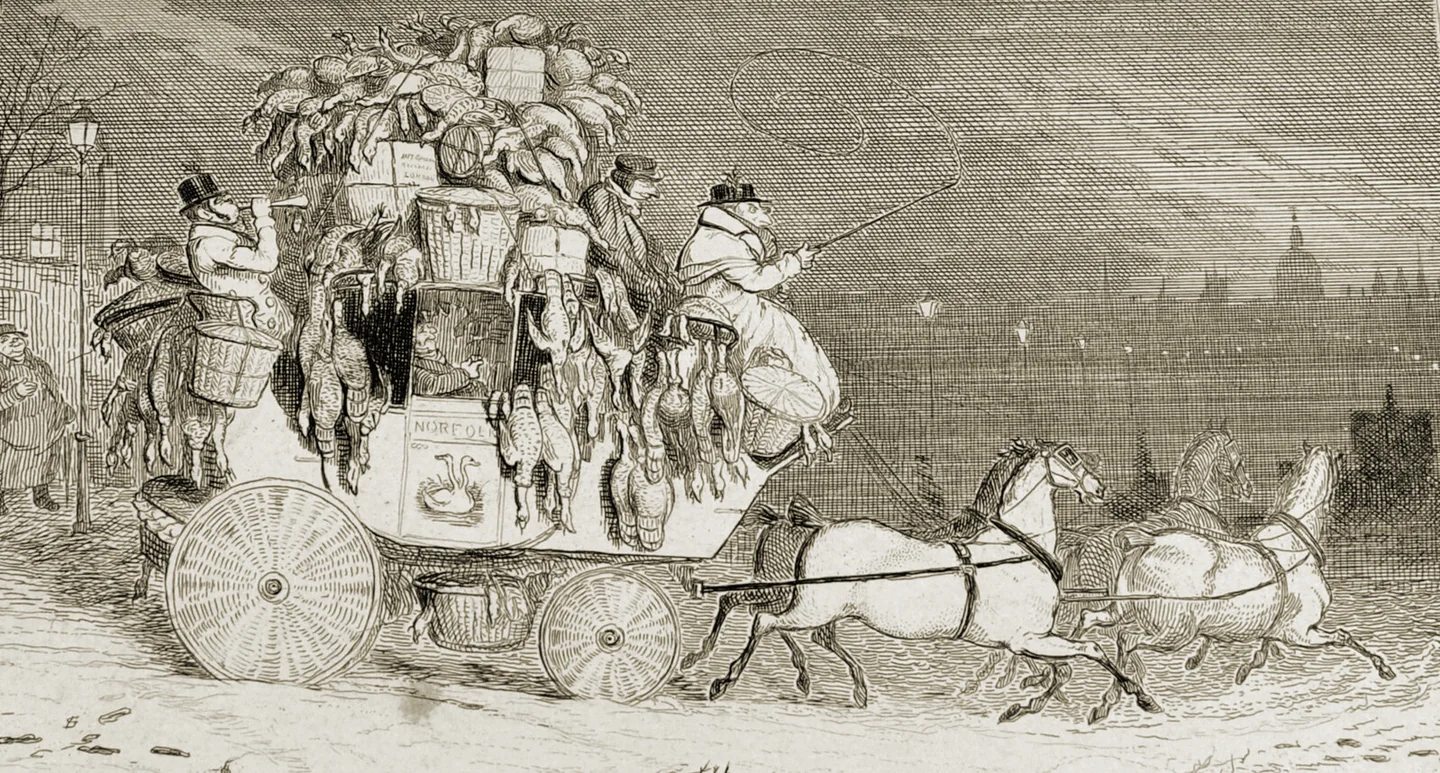
Colder winter weather opened another possibility. As Winick explains, it became more practicable to carry slaughtered poultry for the Christmas market. Robert Seymour’s nineteenth-century illustration of the Norfolk coach shows birds and hampers crowded around the vehicle, all heading toward their destination together.
Each method brought its own costs and demands: time on the road, feeding live birds, paying for labor and freight, and keeping meat in a usable condition. Railway transport would change the journey again. For the turkeys traveling on foot, a little protection against the road was one practical part of getting there.
Sources for this section: Daniel Defoe (opens in a new tab) · Stephen Winick (opens in a new tab) · University of St Andrews Collections (opens in a new tab)
Look at the coach
See how much the coach could carry.
Spend a moment with Seymour’s illustration and follow the birds and containers around the coach. There seems to be poultry fitted into every available corner. Set it beside the walking flock at the top of the page, and the work of bringing a Christmas dinner into the city becomes rather easier to imagine.
SHARE THIS WITH THE KIDS
A few things to talk about together.
- Large turkey droves supplied London from eastern England.
- Later accounts describe protective pitch or cloth coverings for birds’ feet.
- Defoe also described poultry carts, and winter coaches carried slaughtered birds.
The records and research behind the story
Read a little deeper
- Daniel Defoe · Account of the 1722 eastern counties tour, first published in 1724; Project Gutenberg’s 1891 edition transcription (opens in a new tab)
- Stephen Winick · American Folklife Center: turkey transport, foot protection, and the Christmas market (2021) (opens in a new tab)
- University of St Andrews Collections · Robert Seymour’s 1836 Book of Christmas illustrations (opens in a new tab)