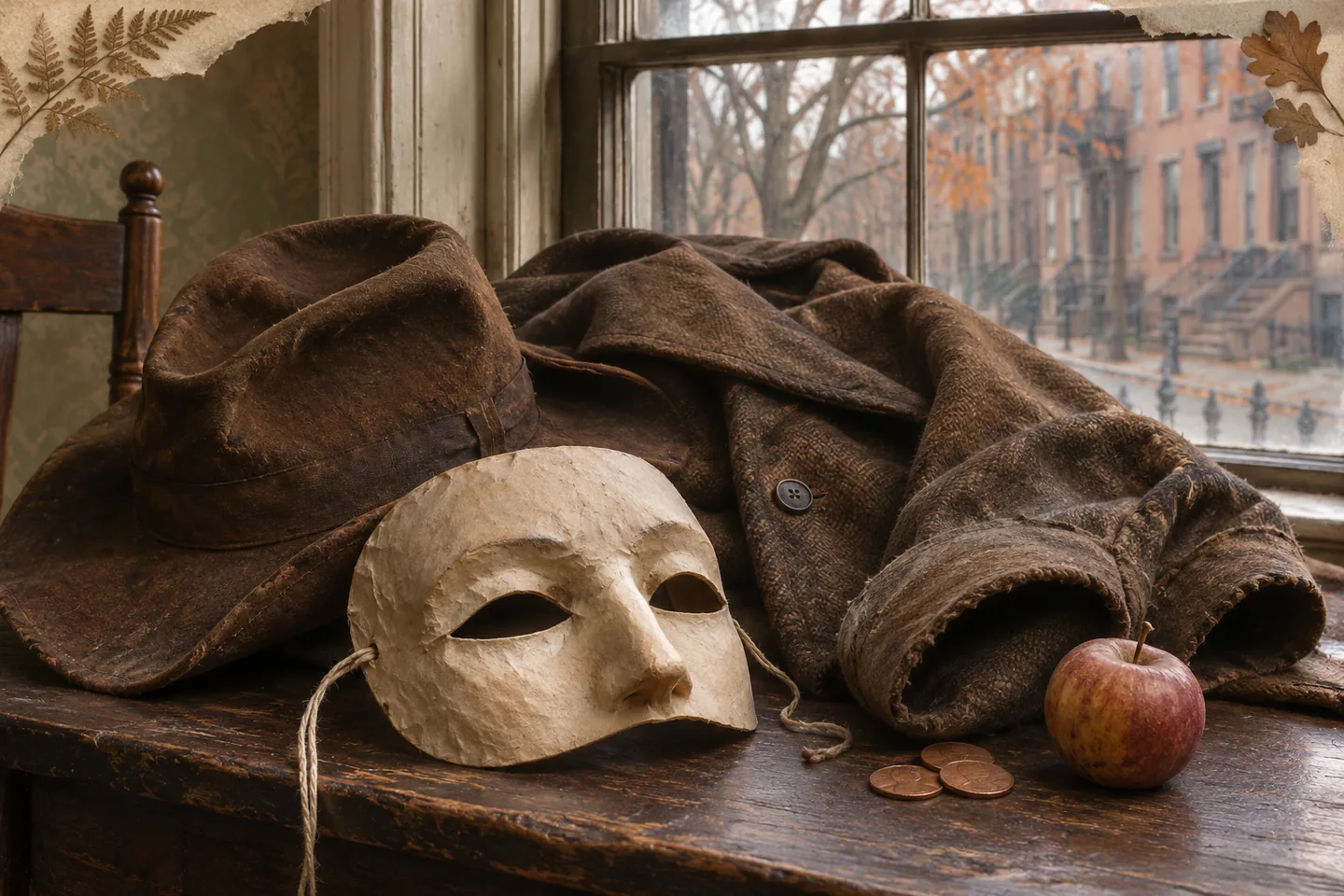
The coat hangs past the child’s hands. The hat seems to belong to someone considerably larger. A face has acquired a mustache, a mask, or both, and the little group is ready to go out asking for pennies. In a collection of early New York photographs, this is what Thanksgiving looks like.
Around the turn of the twentieth century, children took part in a custom called Thanksgiving masking, often remembered as Ragamuffin Day. They dressed up and visited neighbors or approached people in the street for small gifts. The familiar turkey dinner could share its holiday with a noisy expedition through the neighborhood.

Around the neighborhood
Children had their own plans for the day.
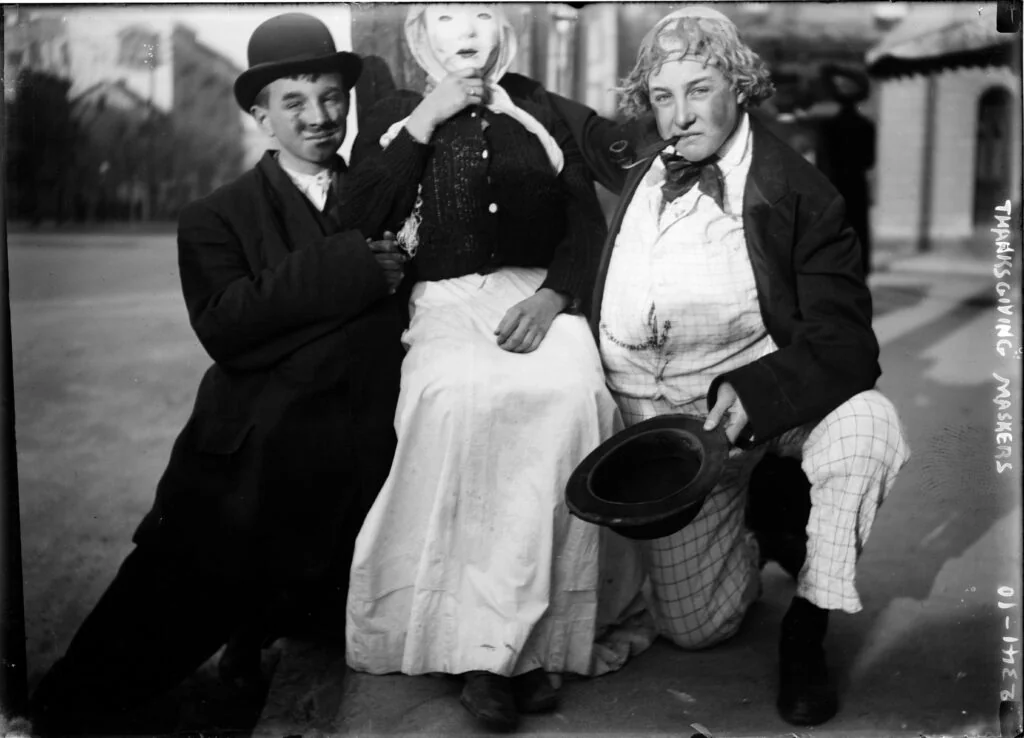
The Library of Congress’s Bain News Service pictures preserve the outfits especially well. Children pose in clothes that bunch, trail, and fold around them. Some wear theatrical faces; others rely on a hat and a borrowed garment. In the three-child portrait below, a false mustache, a pale mask, and an adult-looking pipe turn the clothing into a performance.
Period newspaper accounts describe children asking for money and treats, while other photographs show groups gathering for a scramble for pennies. The New York Genealogical and Biographical Society records the question “Anything for Thanksgiving?” The exchange was recognizable enough for people to prepare small change before going out.
The same expedition could feel rather different from the other side of the door. Tom Bober’s Library of Congress essay brings together newspaper complaints about noise, flour-filled sacks, and crowds. While children were making a holiday of the neighborhood, some adults were wishing the neighborhood would quiet down.
Sources for this section: Stephen Winick (opens in a new tab) · Tom Bober (opens in a new tab) · New York Genealogical and Biographical Society (opens in a new tab)
The calendar
The costumes belonged to November.
These pictures can feel like Halloween photographs filed under the wrong heading. Thanksgiving masking was already established before modern American trick-or-treating became widespread, as folklorist Stephen Winick explains in his American Folklife Center account.
Winick explores folklorist Tad Tuleja’s argument that Thanksgiving masking helped shape the later Halloween custom. He also traces possible connections with older European traditions of dressing up, visiting neighbors, and asking for food or money. The history brings several customs into view, with their exact relationships still open to discussion.
For the children in these New York photographs, disguises and neighborhood treats belonged to November. An oversized coat and a handful of pennies were as much a part of the day as the dinner waiting at home.
Sources for this section: Stephen Winick (opens in a new tab)
As the custom changed
Dressing up could bring hurt as well as fun.
Some costumes used racist caricatures or mocked people living in poverty. Children might enjoy the disguise while taking part in a custom that made other people’s identities or hardships into entertainment.
The photographs preserve the borrowed coats, oversized hats, and children pausing for the camera. Newspaper accounts add the bustle around them: the search for treats, the scramble for pennies, and the neighbors complaining about noise and flour-filled sacks. Together, they bring us a little closer to the holiday as people encountered it on the street.
By the middle of the twentieth century, Thanksgiving masking had largely faded as Halloween visiting became more familiar. Some neighborhoods kept it going longer, according to the New York Genealogical and Biographical Society. A tradition that once sent groups of children out into the street gradually became something to explain in the caption of an old photograph.
Sources for this section: Stephen Winick (opens in a new tab) · Tom Bober (opens in a new tab) · New York Genealogical and Biographical Society (opens in a new tab)
Look a little closer
Have another look at the sleeves and hats.
In the Bain photograph, the borrowed clothes almost seem to swallow their wearers. Look at where the sleeves end, how the hats sit, and the expressions beneath the disguises. Those small details make it easier to imagine the children getting ready to head out into the neighborhood.
SHARE THIS WITH THE KIDS
A few things to talk about together.
- Thanksgiving masking was established before modern American trick-or-treating became widespread.
- In New York, children dressed up and asked for pennies, fruit, or candy.
- Bain News Service photographs preserve the oversized clothes and disguises.
The records and research behind the story
Read a little deeper
- Stephen Winick · American Folklife Center: Thanksgiving masking and its possible antecedents (2020) (opens in a new tab)
- Tom Bober · Library of Congress: photographs, newspapers, and differing accounts (2015) (opens in a new tab)
- New York Genealogical and Biographical Society · Ragamuffin Day (2016) (opens in a new tab)