The witch is riding a pumpkin through a gold sky. Turn the card over, and someone has written that they will come by on Thursday.
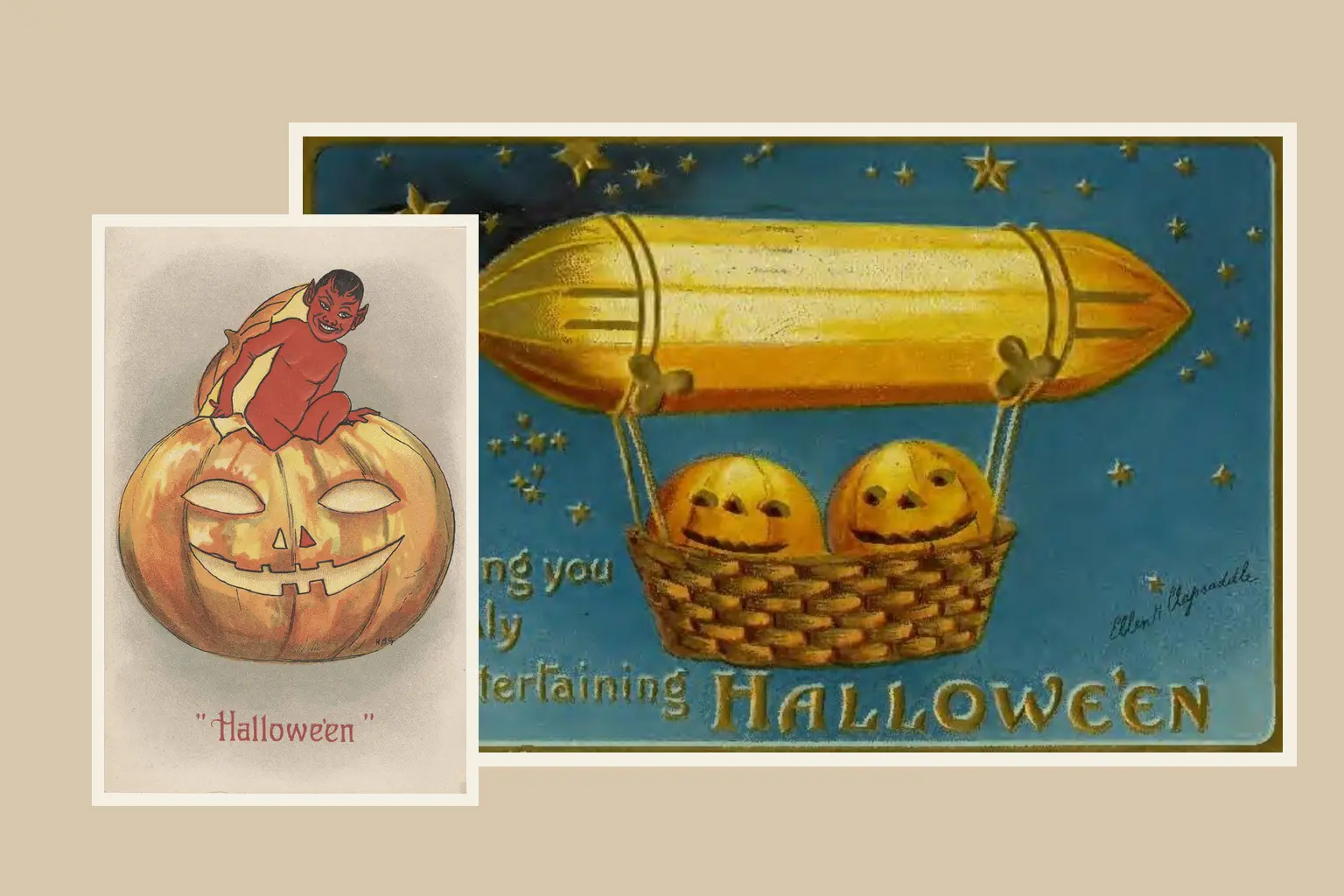
In the early twentieth century, Halloween postcards placed holiday greetings, party customs, and strange little illustrations into the ordinary mail. People sent them, saved them, and pasted them into albums. Surviving cards show how a seasonal celebration looked when a small printed image could travel farther than most of the people buying it.

A new little canvas
Postcards became a fast and collectible form of communication.
.jpg)
Postcard production expanded rapidly around the turn of the twentieth century. In the United States, an 1898 act allowed private companies to print cards labeled “Private Mailing Card,” and a 1901 postal order allowed the shorter wording “Post Card.” Regulations changed again as the familiar divided back developed.
The Museum of Fine Arts, Boston, describes a worldwide postcard craze in which billions of cards were mailed or placed in albums. The image side could carry art, advertising, a joke, a city view, or a holiday greeting. The other side made room for the machinery of the mail and, eventually, a short message.
A holiday takes a printed form
Halloween cards gathered regional customs into a shared set of pictures.

The Henry Ford’s postcard collection connects early Halloween cards with harvest celebrations, fortune-telling, matchmaking, jack-o’-lanterns, and the growing influence of print media. By the early 1900s, sending and collecting Halloween greetings had become a popular American activity.
The pictures could be eerie, comic, or unexpectedly sweet. Black cats arch their backs. Owls stare from crescent moons. Children bob for apples. Witches drive impossible vehicles. A Smithsonian collection card from about 1910–1911 sends “Sir Goblin” into the sky on a flying machine with goblins riding bats around him.
What the back adds
A dramatic picture often carried a very ordinary message.
A postcard was both designed object and quick correspondence. The published image could present a theatrical Halloween world, while the handwriting recorded a visit, a greeting, a family update, or simply a name. Looking at both sides keeps the card connected to the person who used it.
Collections also remind us that dates are not always exact. The New York Public Library dates one “Hallowe’en greetings” card broadly between 1907 and 1940. Its catalog record identifies an embossed color postcard with masks, candles, and costumes, while leaving the artist and exact year unresolved. An archive can preserve an object without solving every question attached to it.
Look closely at two cards
Build an evidence list before inventing the story.
Choose two postcards from the museum collections below. List the symbols, colors, printed greeting, materials, and catalog date for each one. Then compare the backs if they are available: who sent the card, where did it go, and what did the writer actually say?
After the evidence list is complete, imagine the rest. You might design a card for one of the recipients or write the message you expected to find. Keep the documented details and your invented additions in separate columns so the archive remains visible inside the story.
SHARE THIS WITH THE KIDS
A few things to talk about together.
- Sending and collecting Halloween postcards was popular in the United States by the early 1900s.
- Postcards were mailed and also saved in albums during the worldwide postcard craze.
- Museum records may preserve a card even when its exact date or artist remains unknown.
A FEW OF THE SOURCES BEHIND THIS PIECE
Read a little deeper
- The Henry Ford: Hallowe’en Postcards (opens in a new tab)
- Smithsonian Institution Archives: Postcard History (opens in a new tab)
- Museum of Fine Arts, Boston: The Postcard Age (opens in a new tab)
- National Museum of American History: Sir Goblin Halloween postcard (opens in a new tab)
- New York Public Library: Hallowe’en greetings postcard (opens in a new tab)
- Enoch Pratt Free Library / Digital Maryland: H. B. Griggs Halloween postcard, 1908 (opens in a new tab)
- Ellen Clapsaddle: Halloween dirigible postcard, 1908–1909 (opens in a new tab)