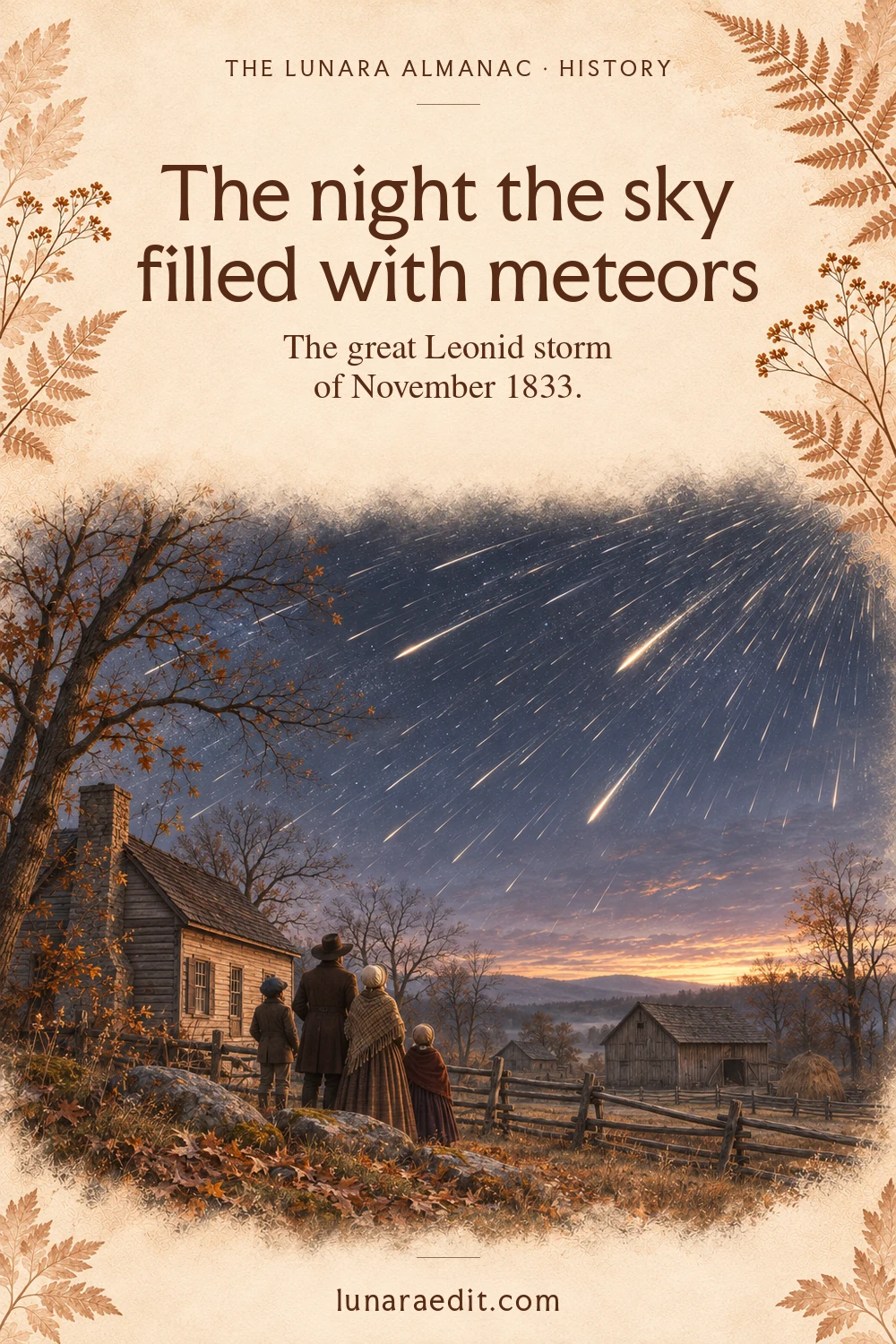
Denison Olmsted was asleep when a neighbor woke him to see the sky. Above New Haven, Connecticut, meteors were crossing the darkness in extraordinary numbers. It was the morning of November 13, 1833, and plenty of other people had been called out of bed.
Across eastern North America, the Leonid meteor storm turned a familiar kind of fleeting light into a spectacle people would describe for decades. Some observers read the display through religious ideas about signs in the heavens. Others began trying to record what they could see. Olmsted, a Yale professor, wanted more observations than one person beneath one patch of sky could possibly collect.

A sky that would not sit still
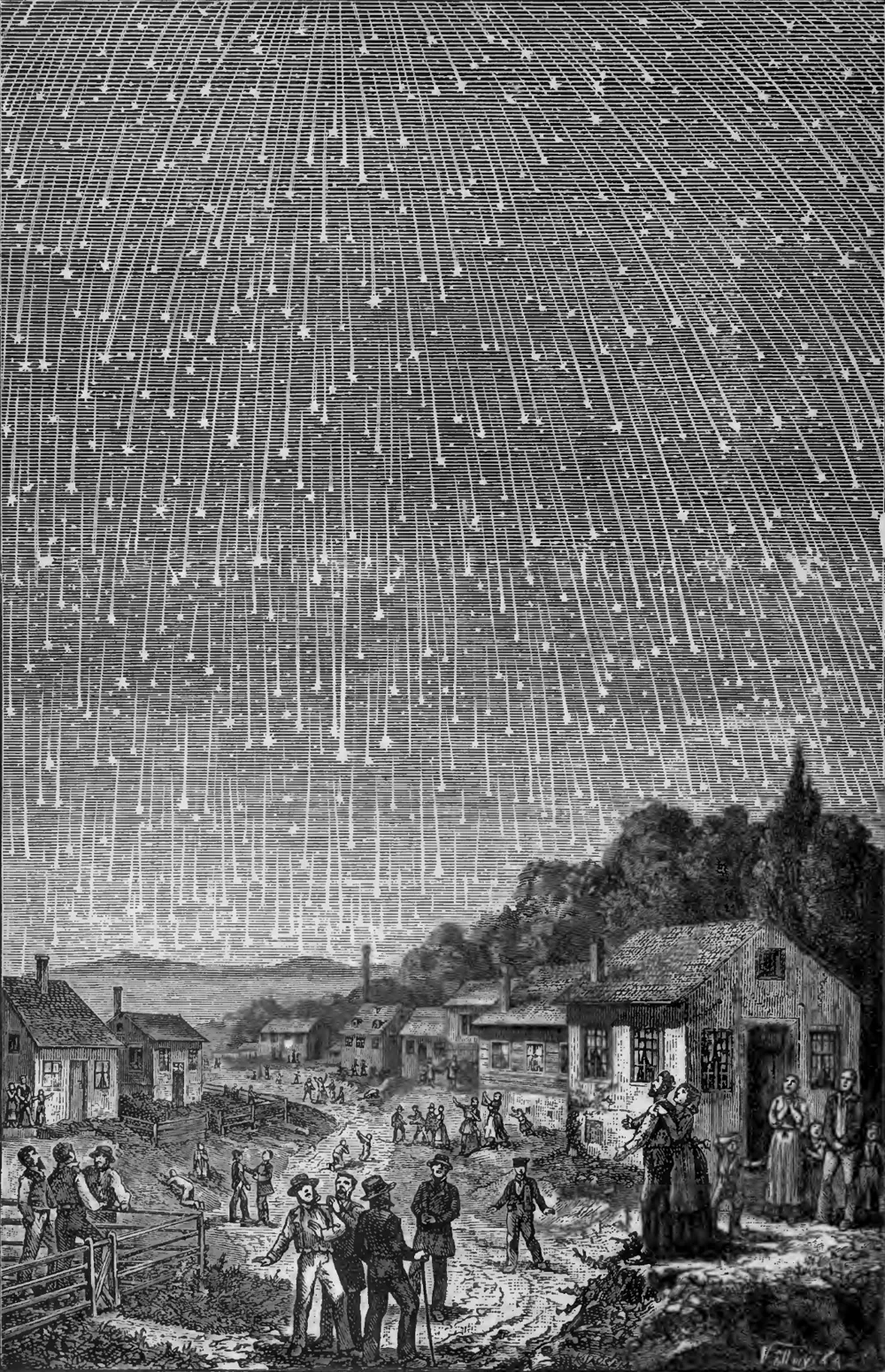
The picture gathers a whole spectacle into one view.
The engraving shown here gives the scene an almost impossible density. Bright tracks stretch across a dark sky while the people below look upward. Let your eye move from the watchers to the light, and it is easy to understand why this became such an enduring image of the event.
It was made much later. The American Astronomical Society dates the image's first appearance to 1888, more than fifty years after the storm. Adolf Vollmy's engraving drew on a painting by Karl Jauslin, associated with an eyewitness account. It belongs to the story of how people remembered and pictured 1833.
A moving display poses a problem for a still picture. Showing many trails together can suggest the experience of a busy sky, while also making one instant look more crowded than it was. The engraving is most useful when we know what it is: a dramatic later depiction to place beside the written accounts.
Tiny material, bright trails
Earth was passing through a comet's debris.
The Leonids come from material associated with comet 55P/Tempel–Tuttle. As a comet travels around the Sun, it leaves particles behind. When Earth encounters this material, particles entering our atmosphere at high speed produce the bright streaks we call meteors.
The stars themselves remain in place. The apparent point from which the Leonid trails spread lies in the direction of Leo, which gives the shower its name. The particles do not begin their journey at that constellation; the pattern comes from the direction in which we encounter the stream.
Earth meets Leonid material each November, but the amount and arrangement of debris it encounters vary. An ordinary annual shower and an exceptional storm can therefore belong to the same family while offering very different evenings to the people watching.
Notes from many places
Olmsted asked newspaper readers what they had seen.
After watching from New Haven, Olmsted sent a report to a local newspaper and invited readers to contribute observations. Other papers picked it up, and accounts reached him from across the eastern half of North America, according to the American Meteor Society's history.
This gave him a way to compare views separated by far more ground than he could cover himself. A person's location, the time they watched, and the apparent directions of the trails could become parts of a larger account. The same display that had brought people to windows and doorways was giving researchers a reason to gather their notes.
The work continued beyond that morning. In 1837, Olmsted recruited Yale students and an amateur observer to help monitor the Leonids over several nights. Watching for a return required patient shifts, including evenings that could not promise anything like the spectacle of 1833.
The shower that still comes back
A November sky does not need to repeat 1833 to be worth watching.
NASA describes meteor storms as much rarer than the annual shower. The parent comet's roughly 33-year orbit helps shape the history of Leonid outbursts, but it does not give every viewer a spectacular display on a simple repeating timetable.
For an ordinary observing night, location, darkness, the Moon, and weather all matter. Check a current forecast from NASA or the American Meteor Society before choosing a night. The engraving can stay magnificent on the page while the sky outside offers something slower: a stretch of watching, then perhaps one bright line.
Look at the engraving together
Follow one trail backward.
Choose several meteor tracks in the picture and imagine extending them backward. Where do they seem to gather? Compare that visual pattern with the idea of a radiant: the direction from which a shower's meteors appear to arrive.
Then look at the people near the bottom of the image. What would you want to write down if somebody woke you for an unfamiliar sight in the sky? Olmsted's neighbors had a spectacular morning; the notes that followed helped make it possible to study.
SHARE THIS WITH THE KIDS
A few things to talk about together.
- The great Leonid meteor storm was seen before dawn on November 13, 1833.
- Leonid meteors come from debris associated with comet 55P/Tempel–Tuttle.
- Denison Olmsted collected observations through newspaper appeals after the storm.
The records and research behind the story
Read a little deeper
- American Meteor Society: Olmsted and the early years of meteor observations (opens in a new tab)
- NASA: the Leonids and their parent comet (opens in a new tab)
- NASA Astronomy Picture of the Day: The Great Meteor Storm of 1833 (opens in a new tab)
- American Astronomical Society: the 1833 storm and its later illustrations (opens in a new tab)