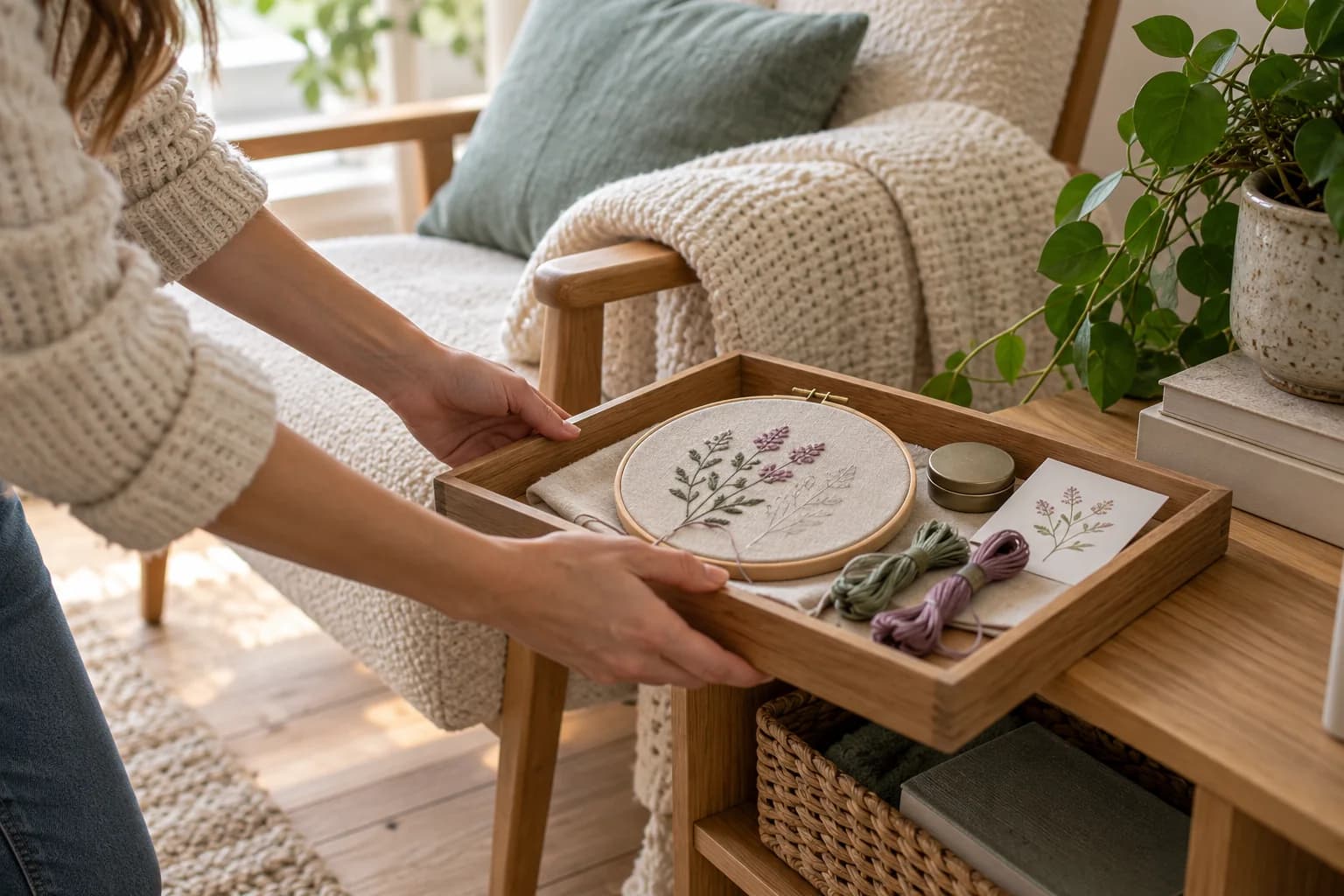
You finally have a little time for the embroidery, sketchbook, or half-built miniature, but first you have to remember where everything went. The instructions are in one room, the good pencil is in another, and the table needs clearing again before dinner.
Keep the current project together
Choose one thing you want to return to and give it a container that fits the space where you actually use it. A shallow tray works for a sketchbook and a few pencils. A small lidded box may suit embroidery, while a rigid board can hold a puzzle or an arrangement of paper pieces.
Start with something you already have. Check that it fits the work without bending it, that you can lift it comfortably, and that it has somewhere to go when the table needs to be a table again.
If you have several hobbies, pick the one you are doing now. The larger supply collection can stay elsewhere; this little space only needs to hold enough to make the next session possible.
Keep the next few supplies within reach
A project tray can fill up surprisingly quickly if it has to hold every color of thread you own. Keep the colors you are using, the current instructions, and the tool you keep reaching for. Put the extras back with the rest of the supplies.
For a sketchbook, that might be one pencil, an eraser, and the reference image you chose. For embroidery, keep the hoop, the next thread colors, and a secure needle holder. Store sharp tools, small parts, solvents, and other materials where children and pets cannot reach them, following the material’s storage directions.
If you often borrow an everyday item, decide whether it can stay with the project for a while. A pencil that keeps returning to the kitchen drawer makes the next beginning a little more complicated.
Leave yourself a useful note before stopping
Write down the next action while you still remember it: “finish the three leaves beside the stem,” “test this color on scrap paper,” or “find the photo of the back wall.” A page number or a quick photo may be enough for a project with a clear pattern.
The note can also hold a question you have not solved. “Check whether this piece goes behind the window” gives you something specific to investigate when you return. Keep the instructions with the project so you can check your place.
For a hobby with drying time or a careful stopping point, plan around that part. A clear spot where wet paint can dry safely may be more useful than a portable box.
Make putting it away a short job
Before settling in, look at where the project will go afterward. Could the tray slide onto a shelf? Could the sketchbook and pencils go into a bag beside your chair? Try the whole movement once, including carrying it through the room.
If putting it away takes ten minutes of sorting, remove some of what is in the container. You can keep a small envelope for the pieces you are using or a closed tin for tiny supplies, without dividing everything into a new system of boxes.
Choose a home that suits the materials. Something delicate may need a protected shelf; something heavy should not have to be lifted over your head. Keep walkways clear and the things that need to stay upright on a steady surface.
Try the arrangement before adding anything
Use the project space a couple of times and notice what sends you hunting. Add that missing item, change the container if it keeps catching on the work, or move it closer to the place you like to sit.
You may find that you want a longer stretch for this particular hobby. Keep the project ready for that stretch, and choose something else when you only have a few minutes. The useful arrangement is the one you can put down and return to without having to unpack the entire hobby each time.
For another small project using things already on your shelves, try making linen book covers.