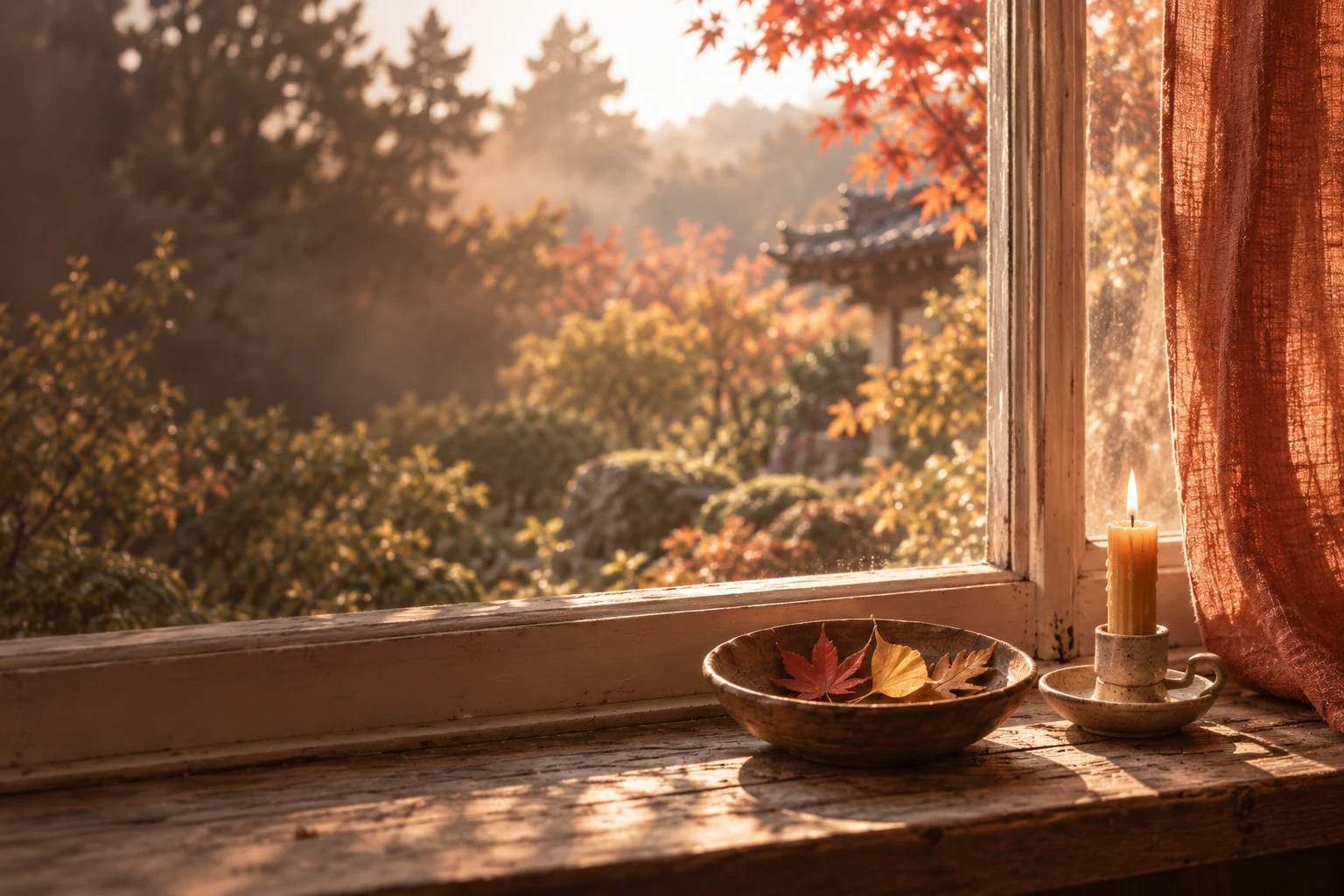
A candle takes a few seconds to light. Somehow, those few seconds can feel like the point when the evening begins.
The action is small enough to look unnecessary from the outside. You could eat dinner without it, finish the workday without a walk, or greet the first cool morning without opening the window. Yet repeated actions sometimes become the part of a day or season that people most want to keep.

What the action means
Rituals combine repeated actions with personal or shared meaning.
Ritual researchers often describe actions that follow a recognizable pattern and carry symbolic meaning. A routine might get the dishes washed. A ritual might be the moment everyone pauses before the meal, or the particular way a family says goodbye. The same action can be practical and meaningful at once.
In their 2018 review, Nicholas Hobson and colleagues organized research on rituals around emotion, performance, and social connection. They considered both the physical pattern of an action and the meaning people give it. That combination helps explain why copying someone else’s exact steps may not produce the same experience: the steps arrive without the history attached to them.
A closer look at the evidence
Familiar rituals have sometimes helped people recover after stress.
A 2020 study by Martin Lang, Jan Krátký, and Dimitris Xygalatas involved 75 Marathi Hindu women in Mauritius. After a task designed to raise anxiety about public speaking, participants either performed their customary ritual at a local temple or rested for a similar period. Those in the ritual group reported less anxiety afterward, and a heart-rate-variability measure also differed in the direction the researchers expected.
The setting matters. The ritual group was in a familiar temple, while the comparison group rested in a different space. The study cannot fully separate the action from the place, the participants’ beliefs, or the comfort of familiarity. It offers evidence about a particular practice in a particular community, and leaves useful questions about how those ingredients work together.
In an ordinary home
A small repeated action can mark a transition you otherwise miss.
One reasonable way to apply that broader idea is to choose an action that makes a change in the day perceptible. Put the work headphones away, open a window for a moment, or step onto the porch before starting dinner. These are suggestions to try, rather than an established recipe from the study.
The meaning can be very plain: work has ended; we are together now; this is the first evening cool enough for a blanket. You do not have to manufacture significance for every moment. A ritual earns its place when the action and its meaning feel worth returning to.
Something to try this week
Choose a moment that already belongs to your day.
Think of a transition you often rush through: the end of lessons, the start of dinner, or the first few minutes after the children are asleep. Give it one small action you like. Try it a few times and notice whether it changes how the transition feels.
You can keep it, adjust it, or let it go. The useful question is whether the action helps you recognize something that matters, without asking more of you than it gives back.
SHARE THIS WITH THE KIDS
A few things to talk about together.
- Rituals combine patterned actions with the meanings people give them.
- A ritual can be shared with other people or belong to one person.
- Researchers study the action, its setting, and people’s expectations together.
A FEW OF THE SOURCES BEHIND THIS PIECE
Read a little deeper
- Hobson et al. (2018): The Psychology of Rituals (opens in a new tab)
- Lang, Krátký, and Xygalatas (2020): Ritual behavior and anxiety in Mauritius (opens in a new tab)
- Masaryk University: summary of the Mauritius study (opens in a new tab)
- The full Mauritius study, including discussion of context and limitations (opens in a new tab)