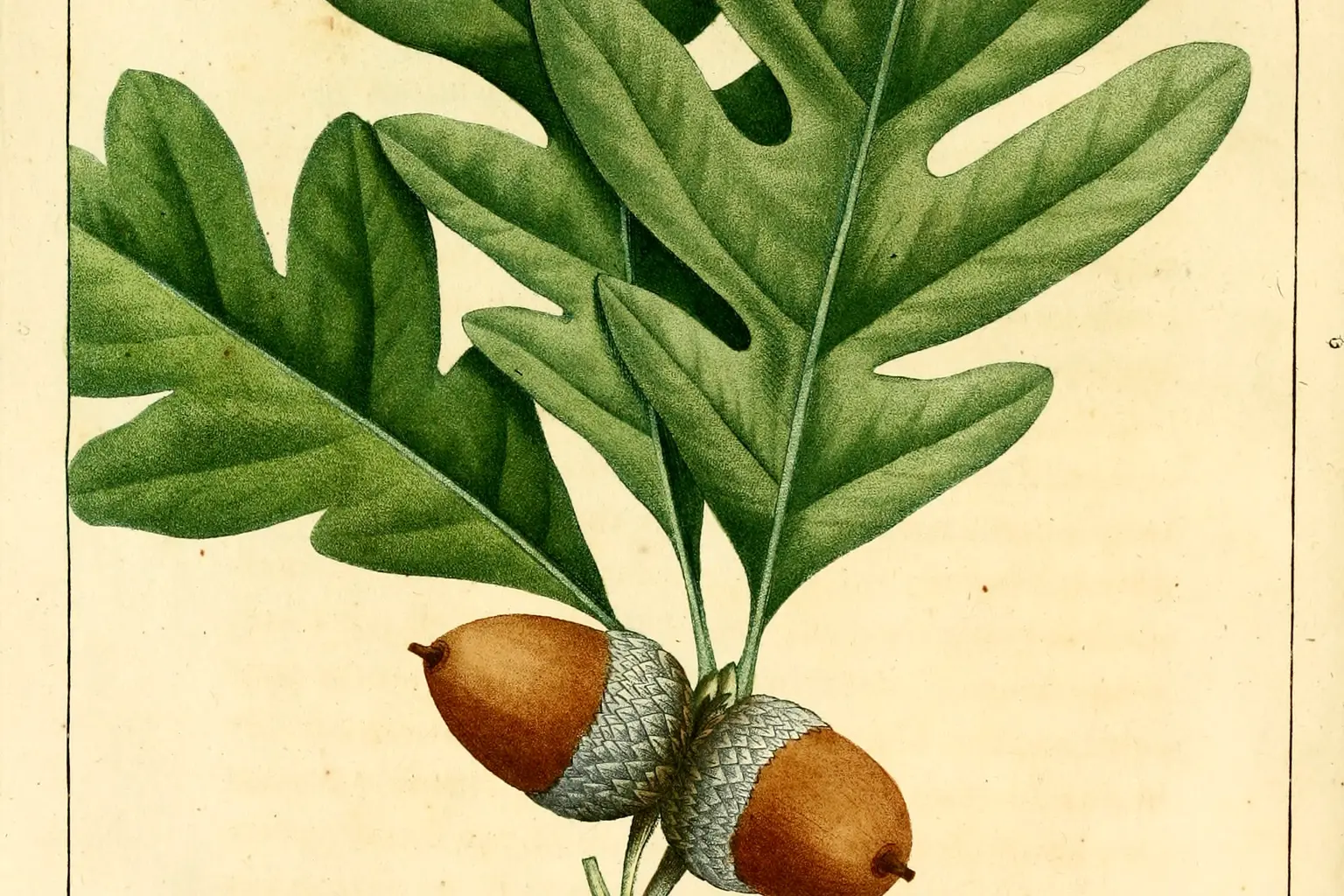
The first acorn hits the roof. Then another. By morning, the yard sounds as if someone has emptied a wooden bead box across it.
Oak trees do not produce the same crop every year. A heavy crop is called a mast crop, and years with unusually abundant seeds are often called mast years. The change reaches well beyond the tree: acorns feed insects, birds, and mammals, and the number left uneaten helps shape the next generation of oaks.
A crop with a name
Foresters call acorns hard mast.

Mast is the fruit and seed produced by trees and shrubs and eaten by wildlife. Acorns, hickory nuts, walnuts, and similar foods are hard mast. In Missouri woodlands, acorns are an especially important food for deer, squirrels, turkeys, and other animals.
The crop changes sharply from year to year. University of Missouri Extension reports that many oak species produce a good acorn crop, on average, only once every three or four years. Species, individual trees, spring weather, crown size, and growing conditions all contribute, so one oak can be generous while another nearby produces very little.
A shared pulse of seeds
Masting describes abundance and synchrony together.
Ecologists use masting for intermittent seed crops that become synchronized across many plants in a population. That coordination matters. A single productive tree may feed every visitor that finds it; a neighborhood of productive trees can put far more acorns on the ground than local consumers can immediately eat.
One explanation is called predator satiation. Lean years may keep some seed-eating populations low, while a very large crop can leave a greater number of seeds after animals and insects have eaten their fill. This is a well-studied hypothesis, and its success varies among species, places, and seed predators.
The consumers answer back
A bumper crop does not overwhelm every acorn eater.
A 17-year study of northern red, white, and chestnut oaks examined acorn weevils, insects whose larvae develop inside acorns. The weevils gathered at seed-rich trees and reproduced quickly when more acorns were available. In two of the three oak species, masting did not help the seeds escape insect predation; in northern red oak, the result depended on how synchronized the trees were.
A U.S. Forest Service study in central hardwood forest found weevil damage as well as acorn removal by vertebrates. Squirrels mattered, but they were part of a larger group of consumers. The familiar idea that oaks simply flood the forest with more food than animals can eat captures one possible effect, while the studies show why ecologists keep measuring what actually happens.
Try a small acorn survey
Count the ground beneath two oaks.
Use four sticks to mark a square about one foot on each side beneath an oak. Count the acorns inside it without collecting them, then repeat the count under another oak or at a different distance from the same trunk. Note empty caps, holes, or cracked shells separately.
Your squares offer a sample, and fallen leaves can hide part of the crop. Compare the counts, identify the trees if you can, and return after a few days. A changing count may reflect more acorns falling, animals carrying them away, or both.
SHARE THIS WITH THE KIDS
A few things to talk about together.
- Acorns and other nuts eaten by wildlife are called hard mast.
- Many oak species have large year-to-year changes in acorn production.
- Masting can involve many trees producing an unusually large seed crop at the same time.
A FEW OF THE SOURCES BEHIND THIS PIECE
Read a little deeper
- University of Missouri Extension: Managing Oaks for Acorn Production to Benefit Wildlife in Missouri (opens in a new tab)
- U.S. Forest Service: Oak mast production and animal impacts on acorn survival (opens in a new tab)
- Bogdziewicz et al. (2018): North American oaks, masting, and acorn weevils (opens in a new tab)
- Missouri Department of Conservation: Missouri oaks (opens in a new tab)
- The North American Sylva: Pierre-Joseph Redouté’s 1812 white oak plate (opens in a new tab)