A child joins a game because their friends are playing. Perhaps the game looks fun. Perhaps a friend explained the rules and made it feel less confusing. Or perhaps the child worries that saying no will mean being left out. More than one reason may be present.
The choice alone does not tell us which explanation fits. A useful conversation begins with curiosity about what helped the child decide.
When other people offer information
Other people can help us notice things we missed. Imagine arriving at a workshop and following someone who points to the organizer’s updated room notice. You are using information that you can check.
Psychologists distinguish informational influence, which concerns the information others provide, from normative influence, which concerns expectations and the social consequences surrounding agreement. The APA’s account of group pressure (opens in a new tab) describes persuasion, appeals to group norms and approval or disapproval among the ways a group can influence a response.
When belonging affects the choice
Now imagine a learner who dislikes a game but says they love it because they expect friends to mock their taste. The concern is about what disagreement might cost socially. The APA’s description of normative influence (opens in a new tab) connects conformity to group norms with social rewards and negative consequences.
A learner may also believe that friends spotted a real clue while feeling awkward about being the only person who disagrees. Information and social expectations can appear together. Asking “What helped you choose?” leaves room for a fuller answer.
Begin with a judgment of your own
Why We Follow the Crowd begins with three line comparisons. The learner records an answer and how certain it feels before seeing any group feedback. The next page introduces three different, explicitly fictional groups: one mostly wrong, one unanimously wrong and one unanimously correct.
The learner looks again, records a later answer, then compares the two sets of responses. A ruler comes afterward. The first answers stay visible, including when nothing changed.
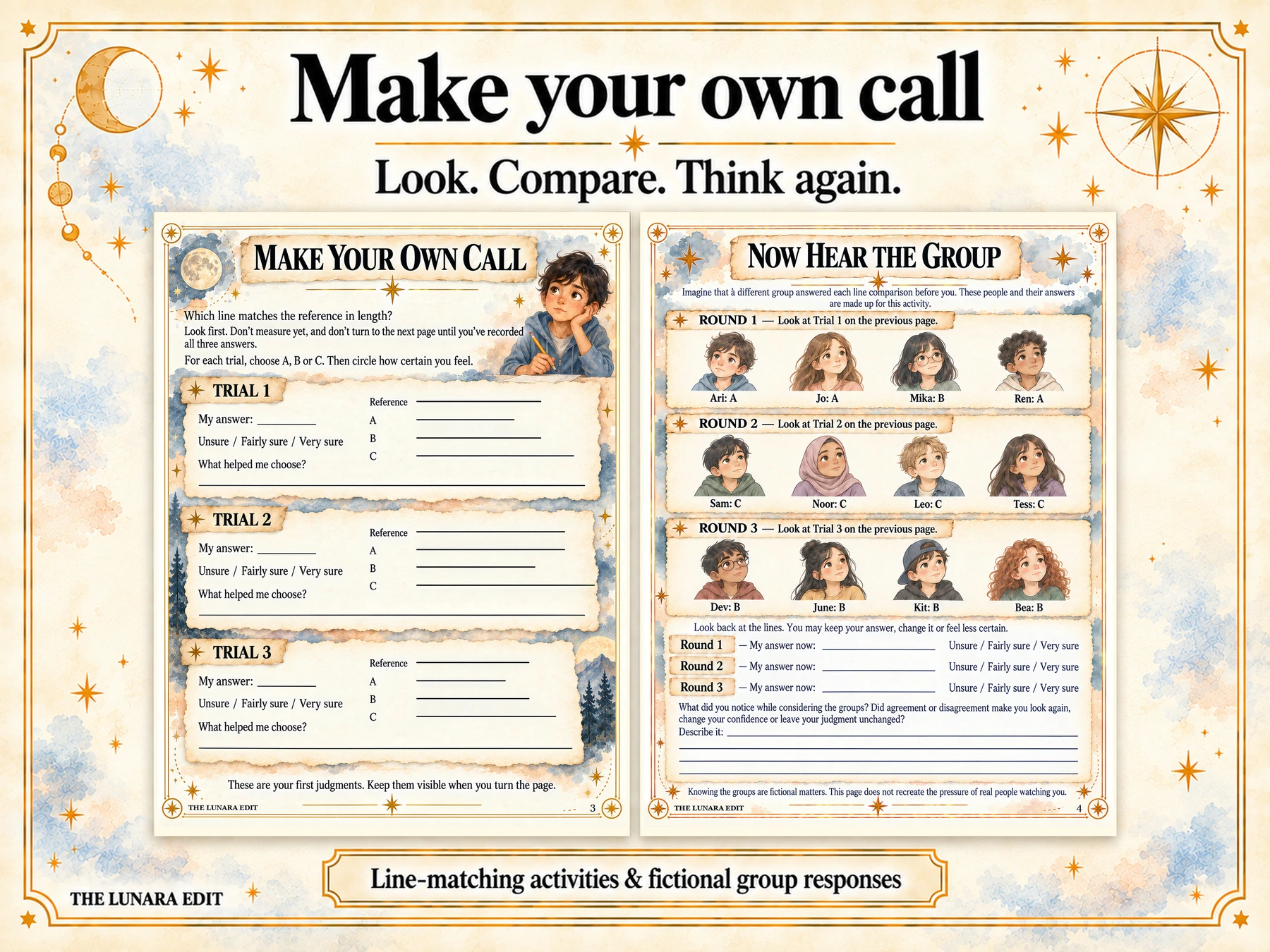
This is a reflection exercise. Different line sets and fictional groups cannot establish an effect of unanimity or dissent, and a printed crowd cannot recreate live social pressure. Keeping or changing an answer does not give the learner a conformity score.
What the research helps us ask
Line-judgment experiments give researchers a concrete task for studying social influence. In a 2023 replication of an Asch-style task by Franzen and Mader (opens in a new tab), participants compared line lengths after hearing other group members’ answers. Those answers sometimes influenced their judgments; the researchers also examined changes in setting and incentives.
Findings from that task invite questions about evidence and the social situation. They do not establish why every child agrees with friends. The study pages keep the research separate from the authored fictional activities.
Try a preference decision and a factual check
A fictional club is choosing a name. Most members prefer “The Garden Readers,” while one learner prefers “The Lantern Readers.” Everyone agreed beforehand to choose by a vote. Can the learner accept the shared choice while keeping their own preference? What would make that process fair?
Then change the question. The club needs to know whether a shelf is 90 or 100 centimeters wide. Most members guess 100. A vote records their guesses; measuring the shelf can check its width.
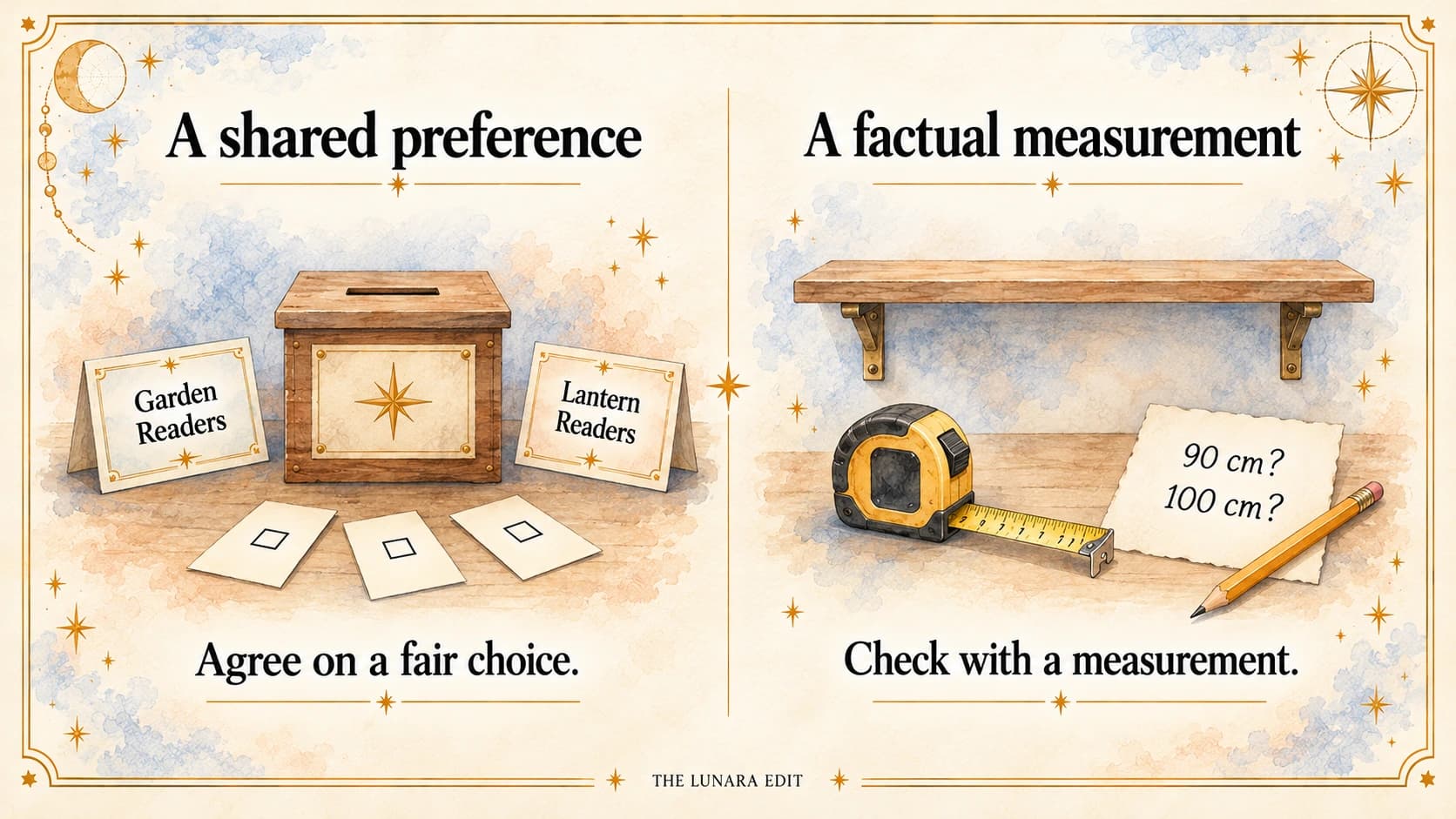
Ask what kind of decision you are making, then choose what would help. You can discuss these examples without buying the printable or sharing a personal experience.
Three questions to keep nearby
- What reasons does the group have?
- What could I check?
- Do I feel free to disagree or revise my answer?
How the study fits your homeschool day
The core work combines short readings, comparisons and written reasons. A learner comfortable with those tasks can complete much of it independently. You can read aloud, discuss a prompt, take dictation or use a labeled sketch when that fits better.
- Learner work
- Mostly independent: reading, comparing evidence, explaining answers and creating a decision guide.
- Parent involvement
- Light involvement. Allow about 10–20 minutes for orientation and discussion. Help preserve the opening sequence, then use the guide to discuss and check explanations. Extra reading or writing support adds time.
- Expected time
- Provisionally 2–3 hours across several sessions, including core written responses. Optional extension and discussion add time. Learner and adult timing have not been measured.
- Preparation
- Print and order the pages, skim the parent guide and gather a pencil. Introduce a ruler after the first judgments and fictional-group responses have been recorded.
- Materials and setting
- Printed pages, pencil and a ruler later; colored pencils are optional. The core study works offline and needs no phone, internet or second learner.
- Parent preview
- Fictional examples discuss belonging, peer pressure and excluding someone from group credits. Historical research deception is explained; learners are not asked to pressure real people.
Subjects and focuses
- Psychology: social influence, informational and normative influence, and public answers versus private beliefs.
- English Language Arts: informational reading, explanatory writing and reasons supported by evidence.
- Media Literacy: source checking, popularity and the difference between repeated claims and independent checks.
- Supporting Mathematics: fractions and denominators when counting people and responses.
The practical outputs include recorded judgments, explanations of fictional cases, a proposed group-decision process and a personal decision guide.
What the download includes
Four printable US Letter PDFs contain 32 total pages, including covers. Learner numbering continues across three parts; the parent guide has its own numbering.
- Part 1 · Make Your Own Call: 7 pages.
- Part 2 · Inside the Research: 7 pages.
- Part 3 · Thinking with a Group: 10 pages.
- Parent Guide and Sources: 8 pages, with answer guidance, discussion support and six research references.
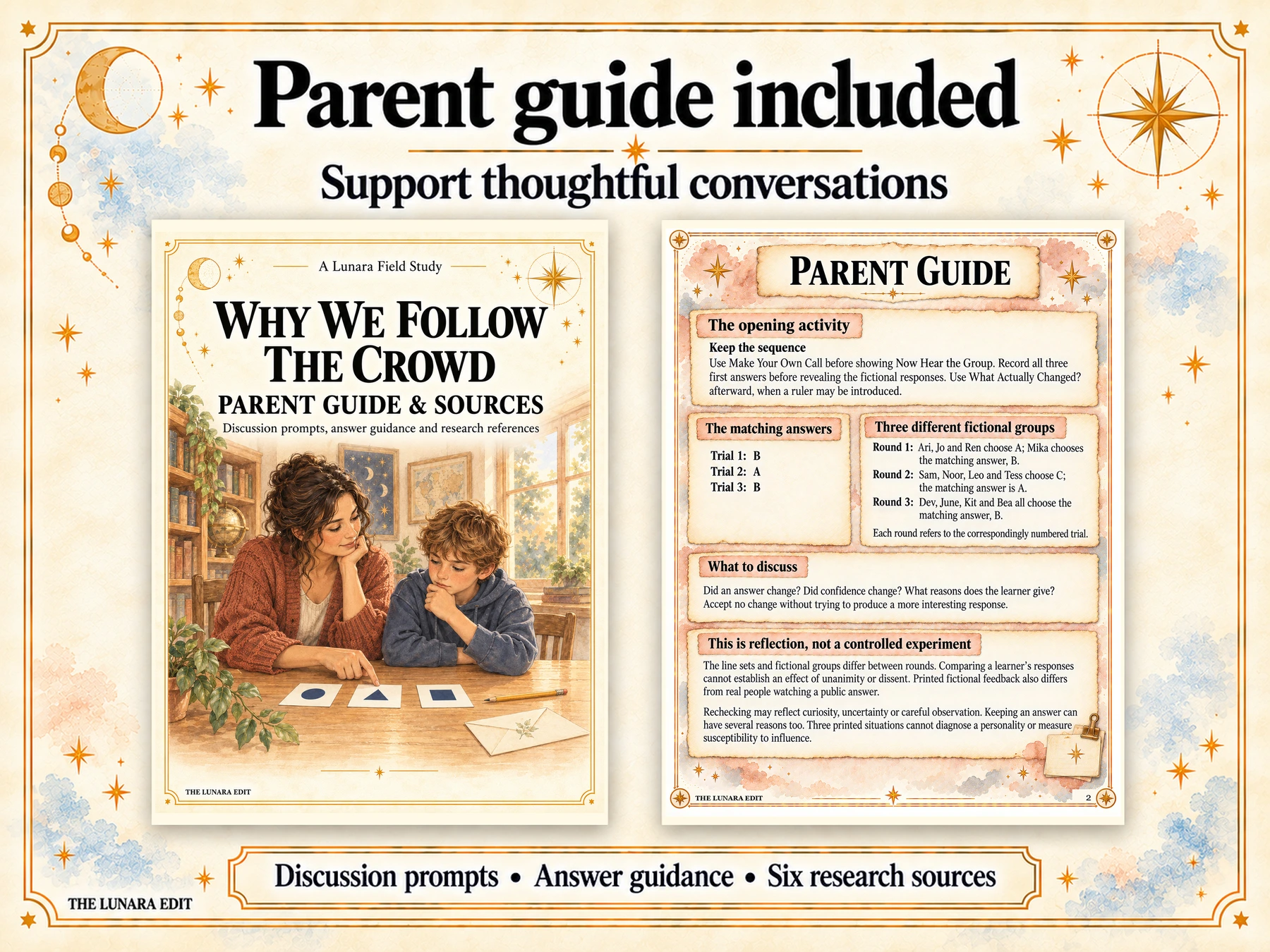
The pages are fixed-layout printables, rather than editable or fillable forms. Print at Actual Size on 8.5 × 11-inch paper. This is a digital download; no physical item is shipped.
Preview the delivered pages and full product details before choosing.
Careful judgment may lead to agreement, disagreement or a change of mind. Keeping the reasons visible gives you something concrete to talk through together.
Printing permissions
For one household or one co-op, pod, or learning group of up to 30 learners, unless the product’s own terms say otherwise. Reprint for those learners; keep complete digital files within the licensed household or group staff. The copying restrictions concern original human-authored writing and complete packets. We do not claim exclusive copyright over purely AI-generated imagery.
See the product license, safety guidance, and download support. For larger groups or a file problem, contact us.