LUNARA PROJECTS · BOOK STUDY
The Wild Robot: A Novel Study for Reading and Writing
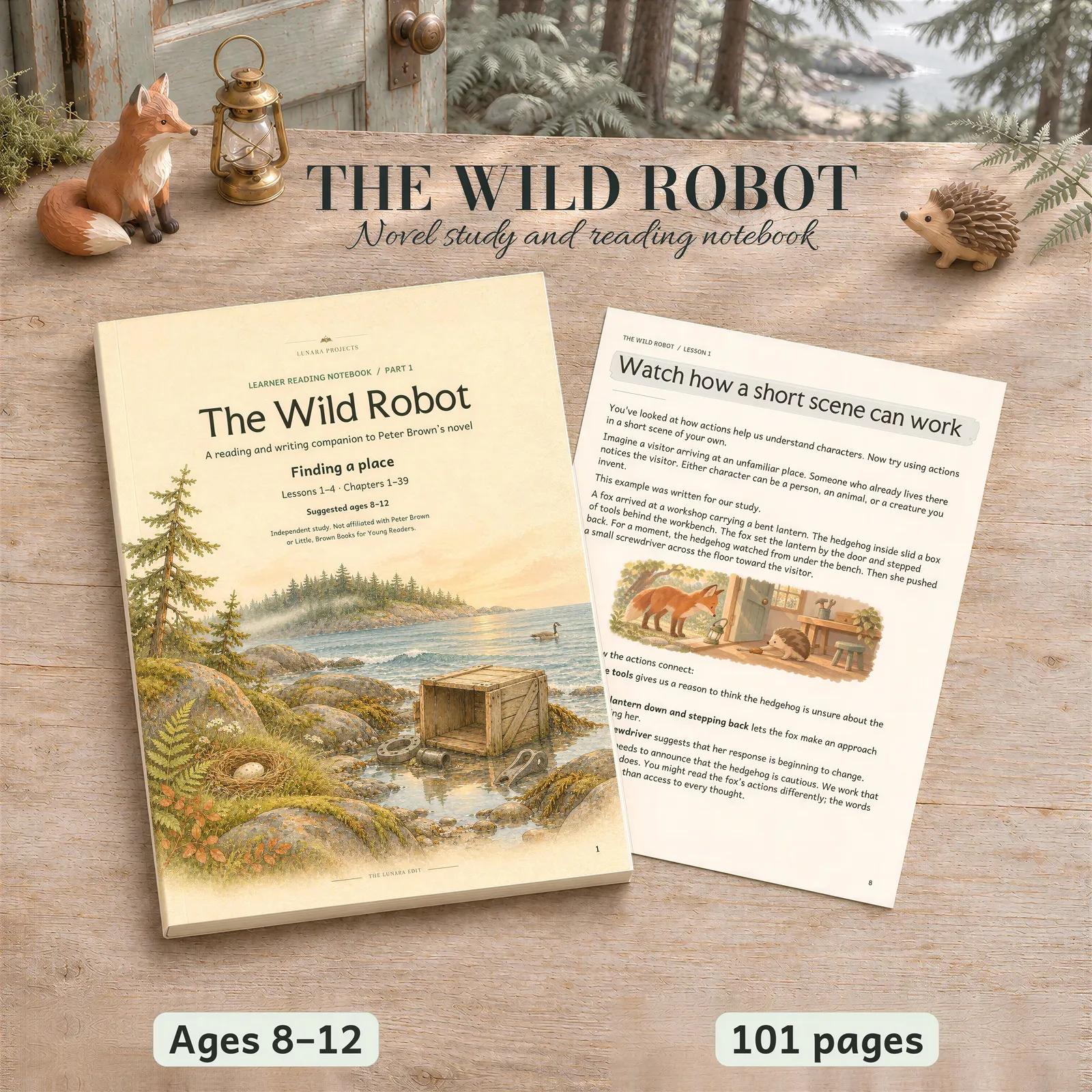
Read Peter Brown’s island story together, look at how a scene works, and help your learner turn one small first meeting into a story of their own.
START WITH THE STORY
Who gets to tell you what happened?
When Roz wakes up alone on an island, she has to learn how the place works by watching the creatures that already live there. They have their own reasons to watch her. A reader gets to move between those viewpoints, noticing things that one character sees and another overlooks.
That makes The Wild Robot a lovely book to read with a pencil nearby. You can pause at a meeting, find the action that changed it, then try that same writing choice in a completely different scene. Here’s a place to start.
AT THE READING TABLE · CHAPTER 5
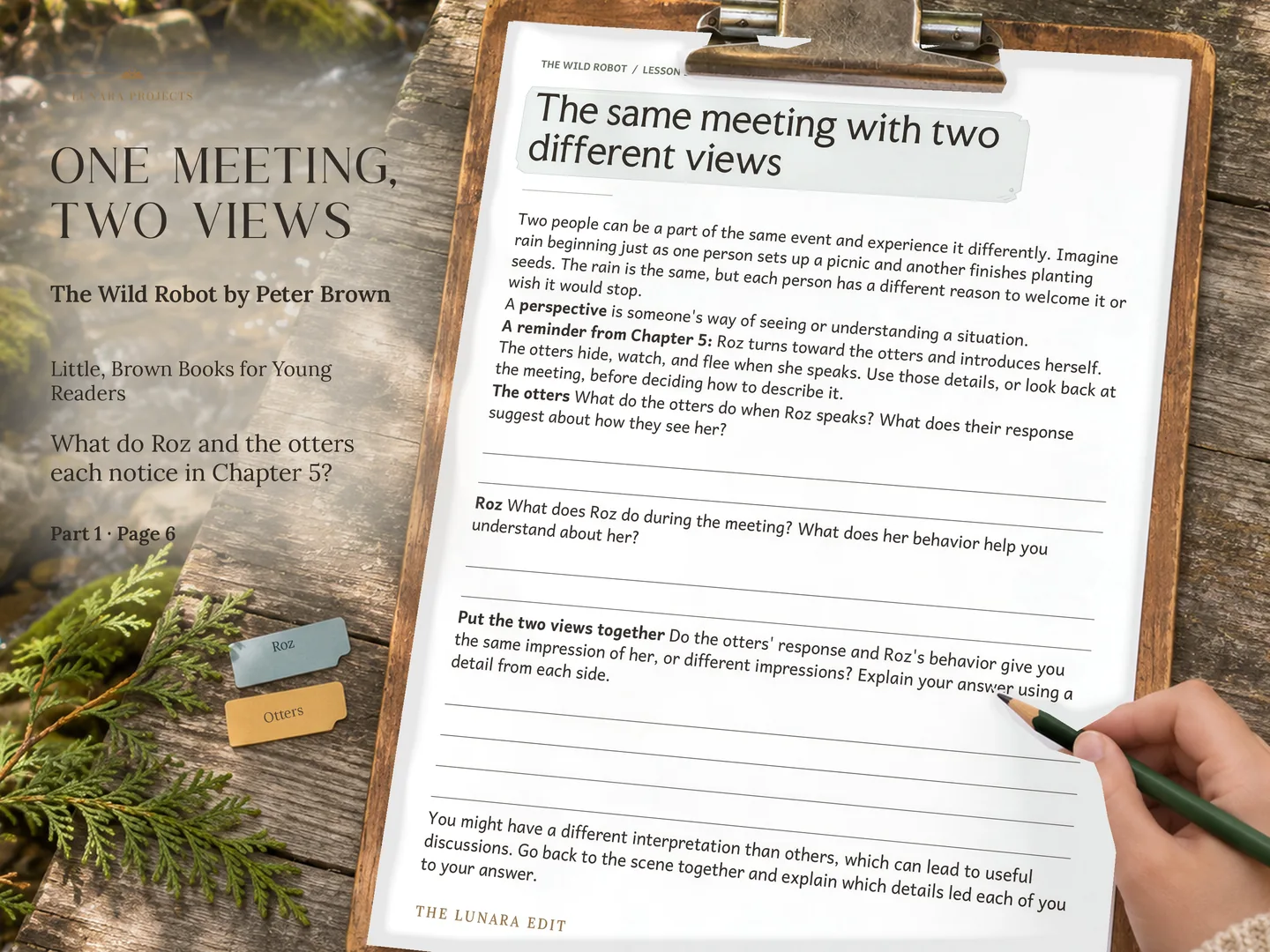
One meeting, two views
Read Chapter 5 together. Ask what the otters do when they see Roz. Then ask what Roz does in the same moment. Give your learner time to point to a word or action in the book before talking through what it might mean.
- What did the otters notice?
- Find one action from the otters’ part of the scene.
- What did Roz notice?
- Find an action of hers and think about what she knows at that moment.
If the answers sound similar, ask what each side could see from where they were. A spoken answer with one detail from the book is plenty for a first try.
 Open full-size preview ↗
AT THE WRITING TABLE
Write a first meeting of your own
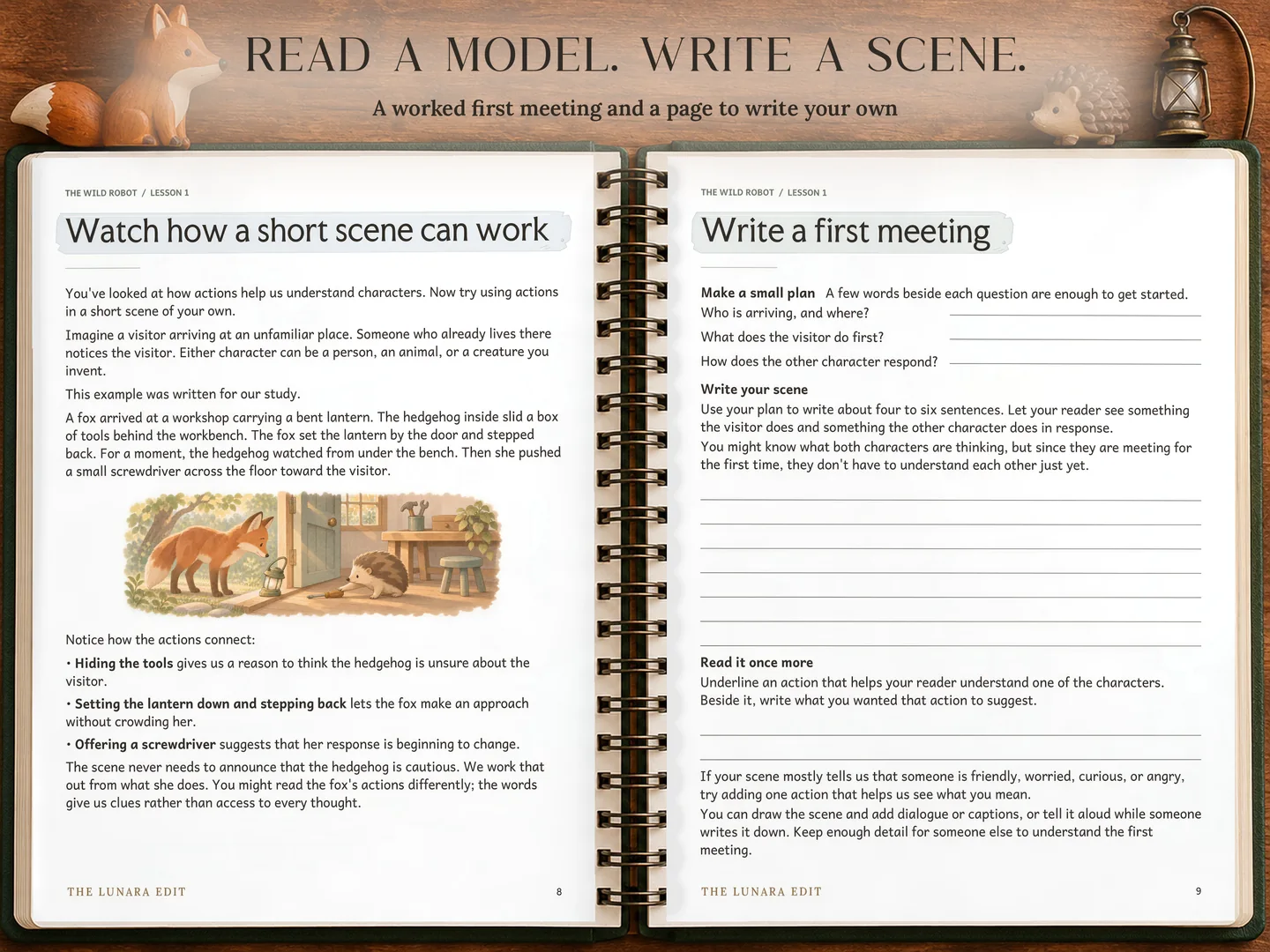
In the notebook’s worked example, a fox arrives at a workshop with a bent lantern. The hedgehog hides her tools, watches, then slides a screwdriver across the floor. A reader can see her response change through what she does.
Try that move with two characters your learner invents. One arrives carrying something. The other does something small that changes the meeting. Read the scene aloud and listen for the moment the relationship shifts.
Need a story starter?
A heron shows up at the door of a boathouse holding a tangled length of string. Someone inside puts down their work. What do they do next? Write or tell three actions and see what they suggest about the characters.
 Open full-size preview ↗
A SHORT WORD STUDY
Give a new word a little room
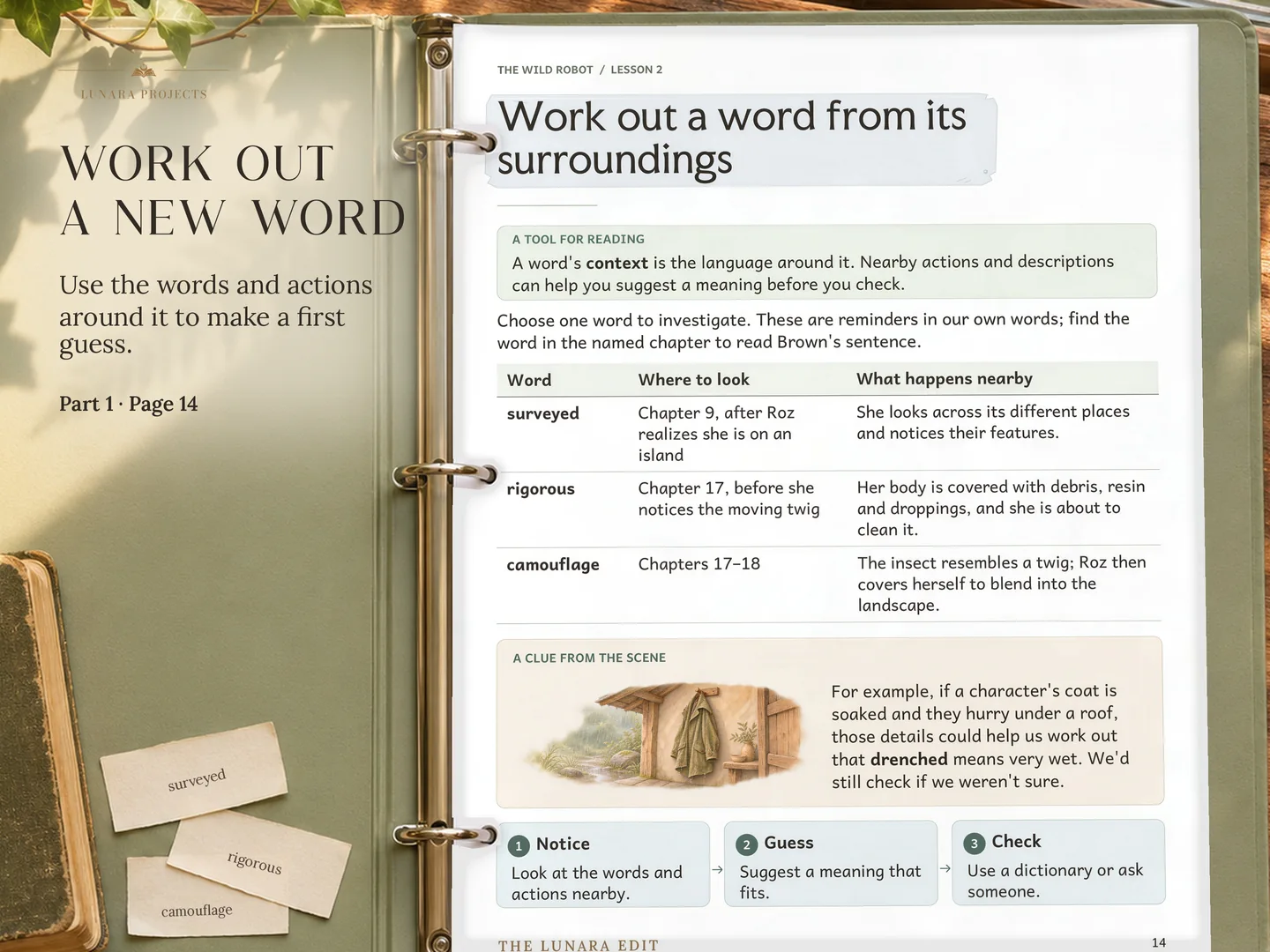
When a word slows down the reading, look at what the character was doing just before and just after it. Try a meaning that fits those actions, then check a dictionary. The notebook practices this with words from the novel, including surveyed, rigorous and camouflage.
 Open full-size preview ↗
PLAN YOUR READ-ALOUD
Inside the learner notebooks
Nine lessons take learners from reading and discussion to drafting and revising a short original story. The two learner notebooks previewed here contain 59 pages, including covers, with reading directions, discussion prompts, worked examples and space to write. The full Etsy download includes both notebooks and a Parent & Teaching Guide, for 101 pages across three US Letter PDFs.
PART 1 · 27 PAGES
Finding a place
Lessons 1–4 follow chapters 1–39. Learners look at what characters notice and practice writing a meeting.
PART 2 · 32 PAGES
A home worth protecting
Lessons 5–9 follow chapters 40–80. Learners revisit their earlier writing, revise scenes and finish their story.
- Who it fits
- Suggested ages 8–12. A learner should be able to follow a chapter book by reading or listening and explain an observation with help as needed.
- Time and pacing
- Read the assigned chapters first. A section may take several sittings, so leave a writing task for the next day if the reading fills your time.
- What the adult does
- Read aloud, help find a passage, talk through a response, or write down your learner’s words when they want to tell you an answer.
- What to gather
- Bring your own copy of Peter Brown’s novel, a pencil and the printed pages. An audiobook works for the reading. Keep a print or ebook copy for the illustration activity, plus spare paper for longer writing.
This independent study accompanies The Wild Robot by Peter Brown, published by Little, Brown Books for Young Readers.
Printing and distribution
For one household or one co-op, pod, or learning group of up to 30 learners, unless the product’s own terms say otherwise. Reprint for those learners; keep complete digital files within the licensed household or group staff. The copying restrictions concern original human-authored writing and complete packets. We do not claim exclusive copyright over purely AI-generated imagery.
See the product license, safety guidance, and download support. For larger groups or a file problem, contact us.
Created by The Lunara Edit using a mix of human and AI techniques. How I create and review these resources.