LUNARA PROJECTS · WINTER FOLKLORE
What Did You Hear in the Dark?
A winter folklore activity to try at home
In a Swedish telling of the Wild Hunt, someone hears dogs barking in the dark. The sound rushes closer and dies away before the listener sees what passed. You can try a little version of that moment at your kitchen table with a closed book or a pair of spoons.
Plan the lesson
- Who it fits
- Ages 9–14. Start with a learner who can follow a short story and retell or compare a detail. Read the stories together if that helps.
- What they’ll practice
- Compare winter traditions and versions of stories, place them on a map, and use a listening experiment to separate what they heard from what they guessed.
- Your part
- Skim the guide and preview the Yule Cat and Wild Hunt stories if your child prefers gentler material. Choose three short sittings or work through the unit in a day.
- What to gather
- Print the pages and set out a pencil. For the listening activity, grab a book, spoons, or scrap paper. Cardstock is optional for the story cards.
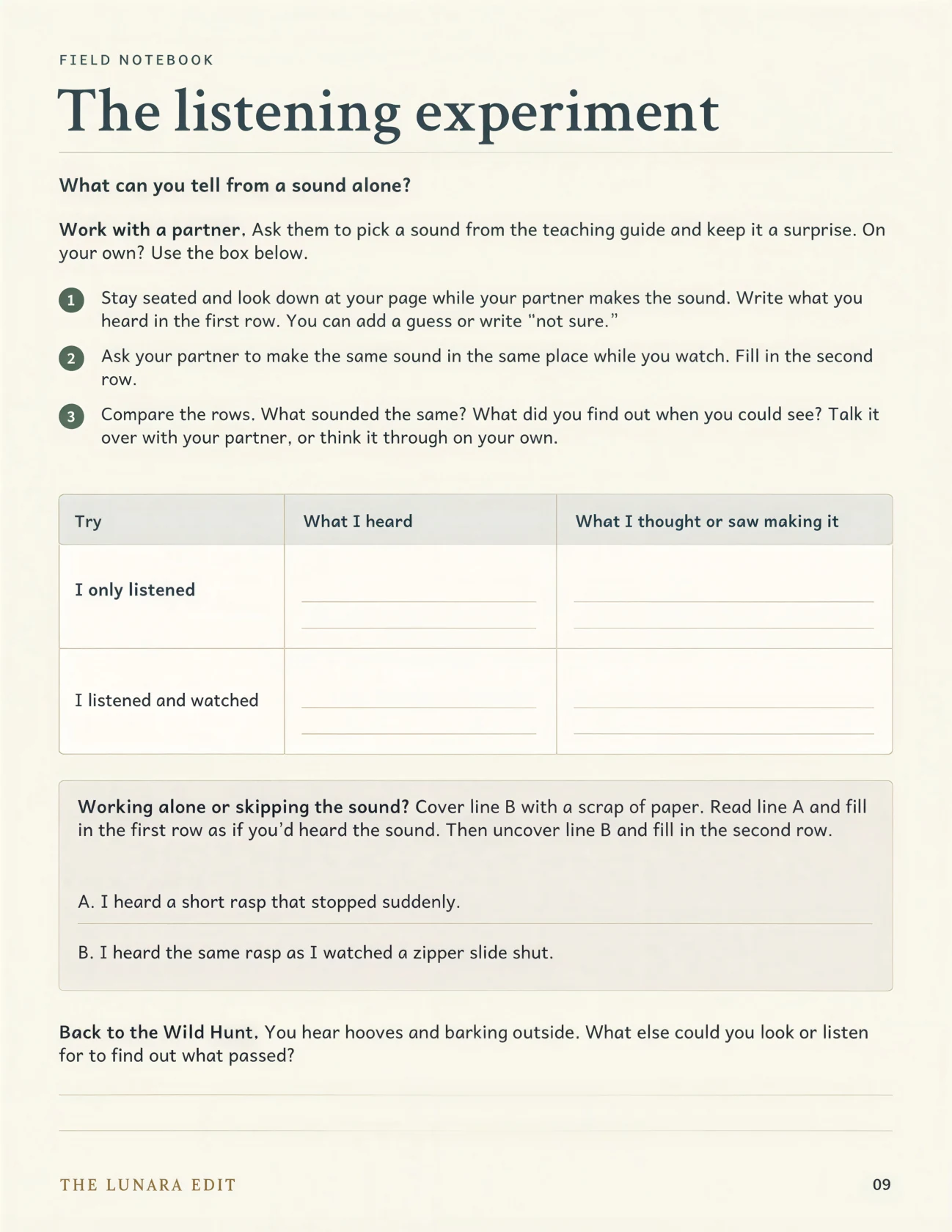
Make the same sound twice
Pick one sound while your child is looking away. Slide a closed book along the table, crumple a piece of paper, or tap two spoons together. Keep the choices to yourself until you’ve played the sound.
- Ask your child to stay seated and look down. Make the sound once and ask, “What did you hear? What do you think made it?”
- Make the same sound again in the same spot while they watch.
- Ask what sounded the same both times and what they found out once they could see.
A book sliding might get you “a long scrape” the first time and “someone dragging a chair” as the guess. Try asking what else could make a scrape like that. Your child can tell you their ideas or jot down a few words. “I’m not sure” is a fine answer, too.
Working alone? Write “I heard a short rasp” on one line and “I saw someone zip up a coat” on the next. Cover the second line with a scrap of paper and give your child a moment to picture the first one. Ask what they imagined, then have them uncover the second line.
Four stories and customs for a winter evening
Go back to the person in the woods. Ask what they could tell a neighbor about what they heard and what they’d have to guess. Try starting with the barking and waiting a beat before you tell your listener who might be out there. Read about the Swedish accounts in Werewolves, Warriors and Winter Sacrifices (pp. 137–138).
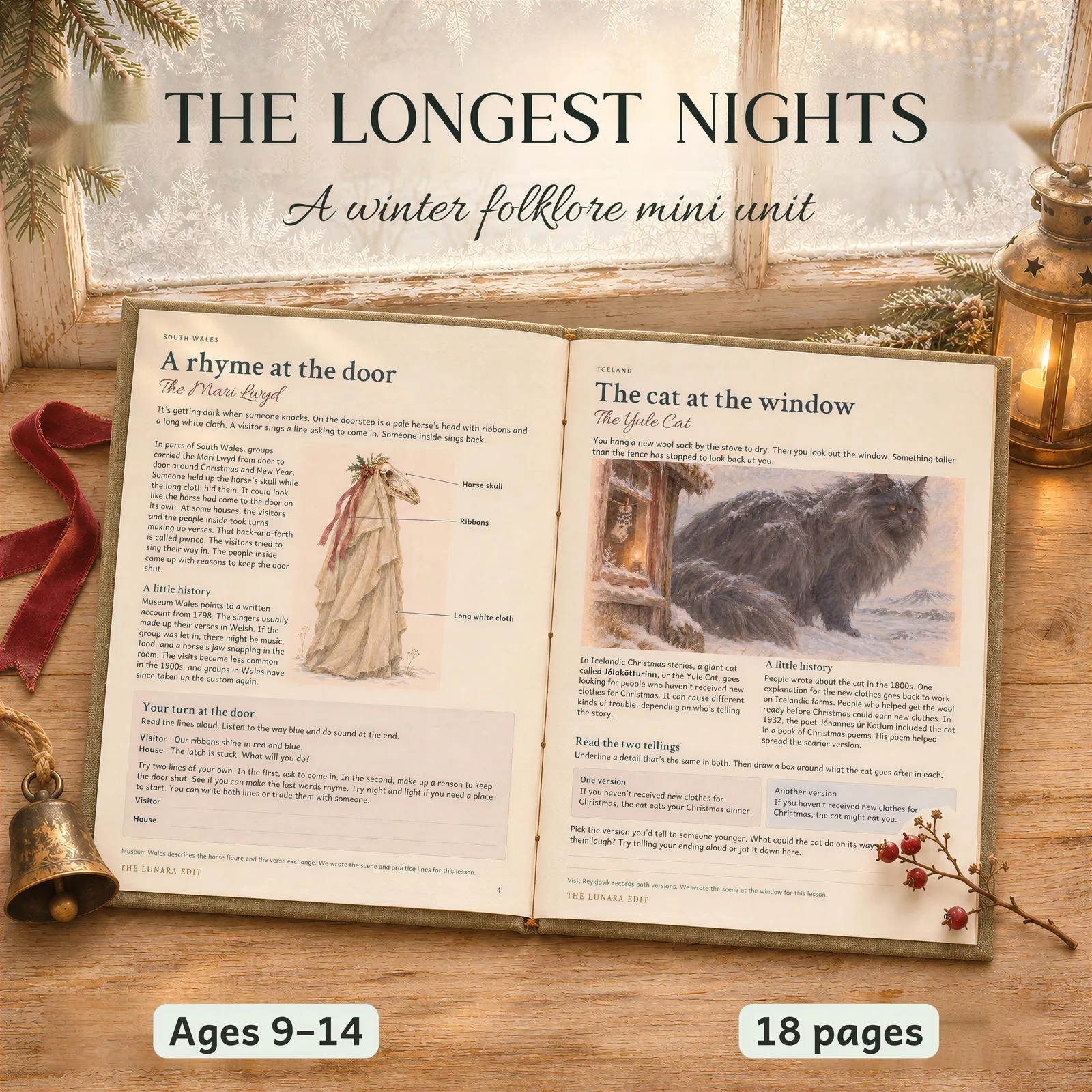
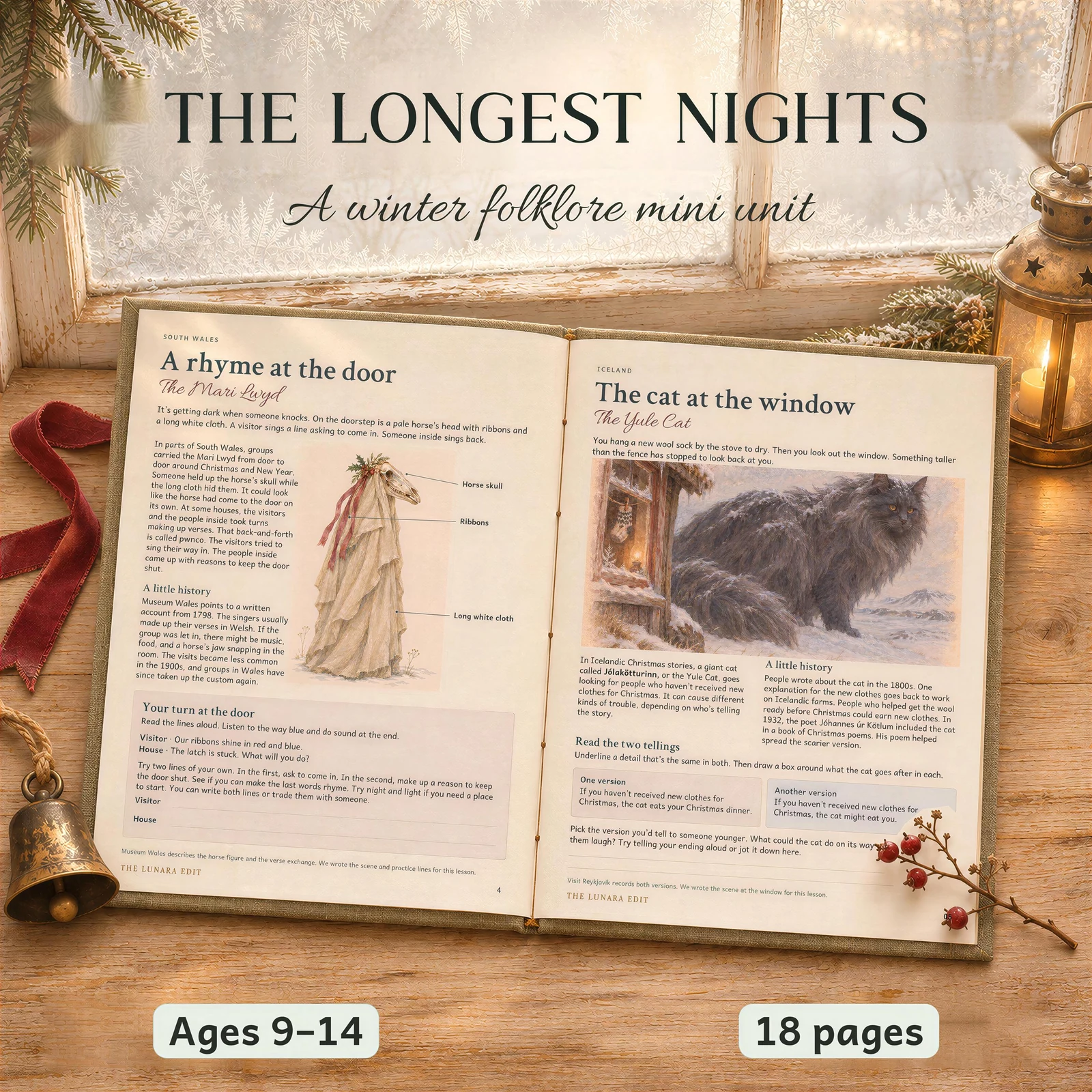
In southern Wales, a winter visitor could be easier to recognize. In the Mari Lwyd custom, a group carried a decorated horse figure from door to door. The visitors and the people inside traded improvised verses through the closed door, sometimes keeping it up until one side gave in. You can try that part with a rhyme of your own. Let one person ask to come in and give the other person the next line. Read about the Mari Lwyd at Museum Wales.
In one Icelandic Yule Cat story, a giant cat eats the Christmas dinner of someone who received no new clothes. In another, the person might be the cat’s dinner. Put those versions side by side and see which details your child keeps when they tell the story back. Read about the Yule Cat at Visit Reykjavík.
Krampus turns up in a Saint Nicholas play held each December 5 in Bad Mitterndorf, Austria. The performance moves through town, with some scenes indoors and others in procession. Looking at one town’s play gives kids a specific place to find on their map and a record to use when they check a claim about the custom. Read about the play at the Austrian Commission for UNESCO.
Inside The Longest Nights
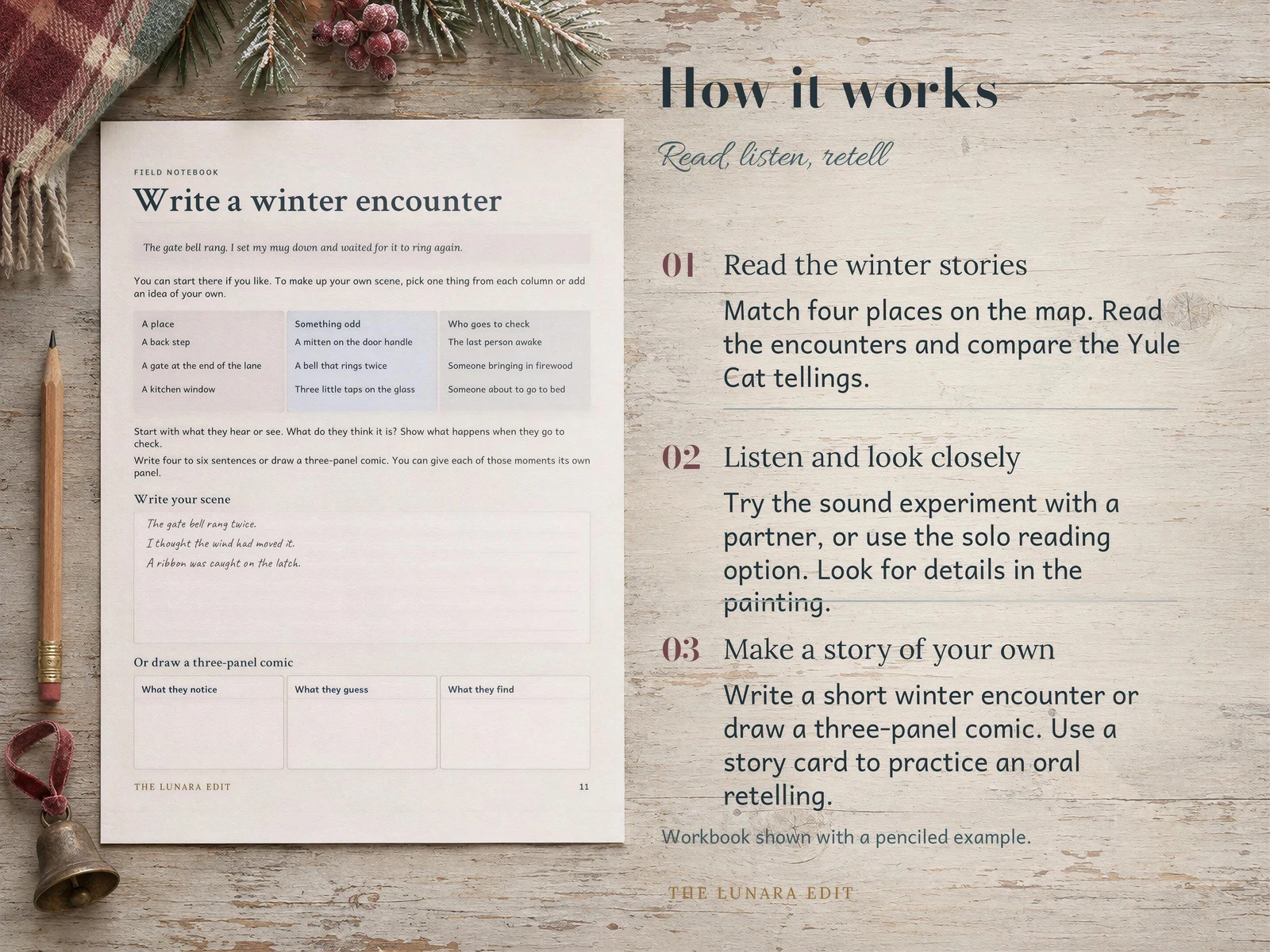
The printable mini unit gives ages 9–14 a short history reading for each tradition or legend. Kids mark the places on a map, compare details from two tellings, and look closely at Johann Wilhelm Cordes’s painted study of the Wild Hunt. They can finish by drawing or writing a winter encounter in three panels and use the illustrated story cards to retell the four stories aloud.
Planning your study
Plan for three short sittings or work through it in one day. Print the pages and skim the guide first. Your child will need a pencil, and you can read together if that helps. For the listening page, make a sound with a household object or let them try the solo version with a scrap of paper. The readings and activities can be done offline. If your child prefers gentler stories, preview the Yule Cat reading and the ghostly figures in the painting.
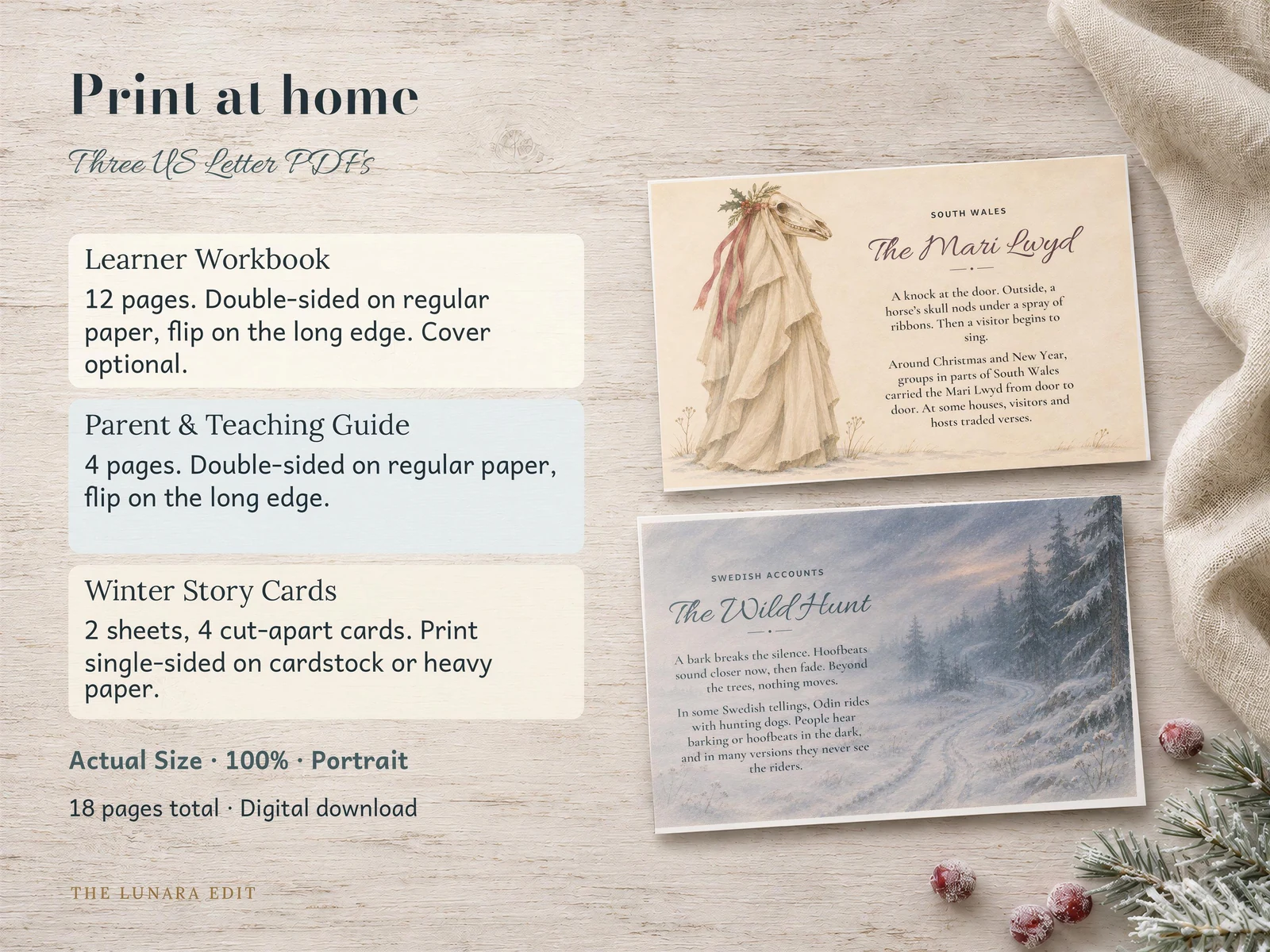
Three US Letter PDFs · 18 pages total
- A 12-page illustrated learner workbook
- A 4-page Parent & Teaching Guide with answers, sources, and printing notes
- Four illustrated Winter Story Cards on two cut-apart sheets
You can print the workbook and guide double-sided. Print the cards single-sided on cardstock or heavier paper if you’d like them to last through a few retellings.
Printing and distribution
For one household or one co-op, pod, or learning group of up to 30 learners, unless the product’s own terms say otherwise. Reprint for those learners; keep complete digital files within the licensed household or group staff. The copying restrictions concern original human-authored writing and complete packets. We do not claim exclusive copyright over purely AI-generated imagery.
See the product license, safety guidance, and download support. For larger groups or a file problem, contact us.
Created by The Lunara Edit using a mix of human and AI techniques. How I create and review these resources.