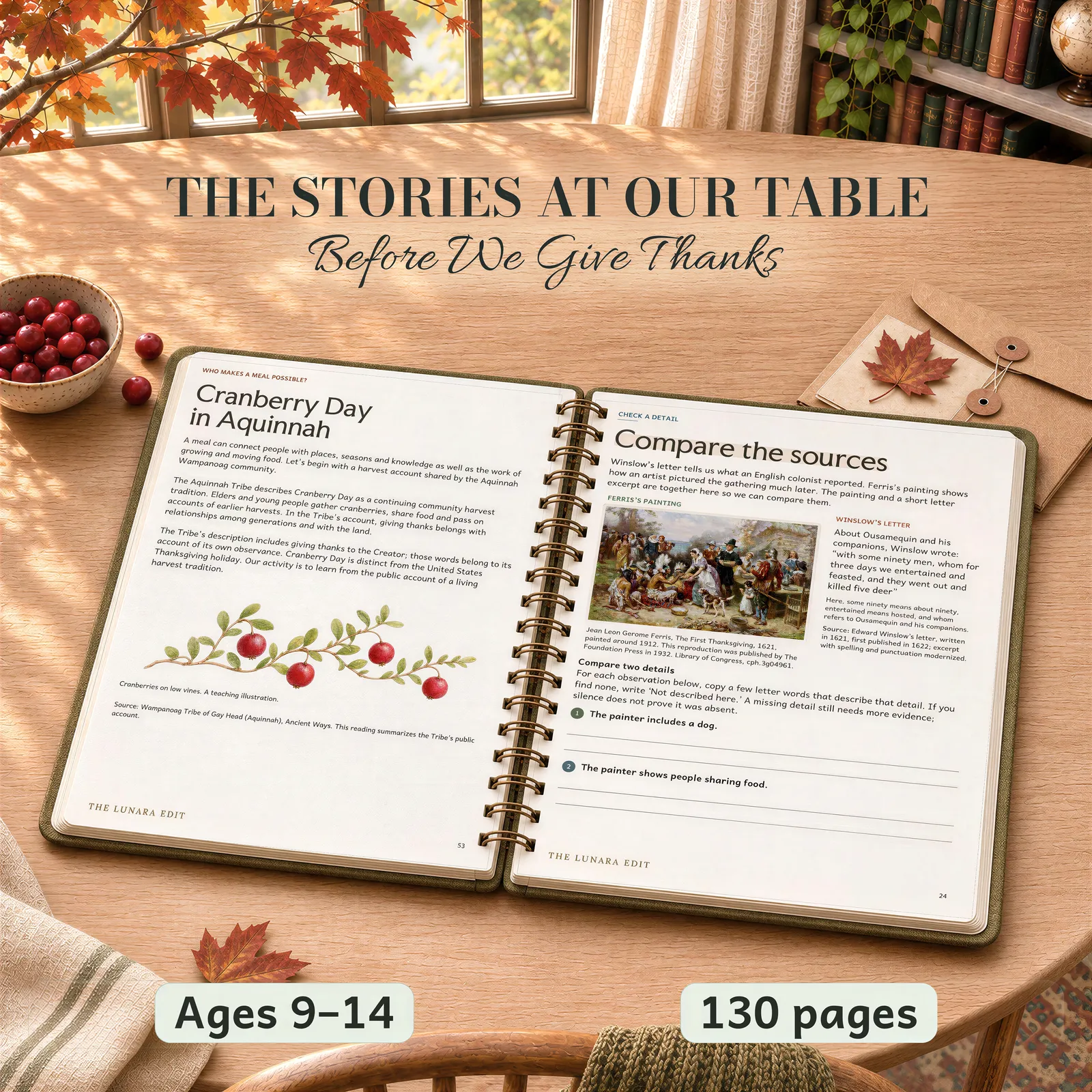
When a child asks what Thanksgiving celebrates, you might find yourself talking about three things at once. There’s a gathering in 1621, the history of the people who took part, and the national holiday that came much later. A single picture of a meal can make all three look like the same story.
I made The Stories at Our Table: Before We Give Thanks so families could spend some time with each part. Start with Wampanoag homelands, look closely at a few historical sources, and come back to the table to talk about food and care today.
Ages 9–14 with adult support · Four printable PDFs
Plan the lesson
- Who it fits
- Ages 9–14 with adult support. Start with a learner who can follow a short passage aloud and point to a detail that helped them answer.
- What they’ll practice
- Compare what a letter, painting, and map can tell us. Bring what they learn into a short family table guide.
- Your part
- Skim the teaching guide, read alongside your child as needed, and plan to discuss passages about loss, war, and enslavement together.
- What to gather
- Print the pages for the next session and set out a pencil. The readings and images are included. You can cut out the timeline cards if you’d like to move them around.
Begin with people and a place that was already home
Before introducing the English colonists, spend time learning about Wampanoag homelands, food knowledge, leadership and community responsibilities. In the first book, children look at a map and make connections between a place and the work it supports. They learn who made decisions in a village and what responsibilities people shared. When the colonists arrive in the reading, children already know something about the people making decisions about how to respond.
The study follows earlier encounters before reaching the harvest gathering. It names kidnapping, epidemic deaths and loss plainly. When we talk about the people who died, we also remember that they had families, relationships and knowledge. There was much that was lost.
The Smithsonian’s Thanksgiving inquiry includes accounts from Linda Coombs and Paula Peters. You could read one together and ask your child what they learned that they’d want to include the next time they tell this history.
Smithsonian National Museum of the American IndianRead Wampanoag perspectivesLet children see how we know what we know
Edward Winslow described the 1621 gathering in a letter later published in Mourt’s Relation. His account mentions three days of hosting and feasting and five deer brought by the Wampanoag visitors. In the study, children read an accessible version alongside a scan from a later printed edition.
They also look at a painting made centuries afterward and follow a footnote to an editor’s interpretation. Ask your child to notice who made each source and when. That gives them a way to decide which source they’d use for a question about the gathering, and which might help explain how people came to picture it later.
Plimoth Patuxet MuseumsRead Winslow’s account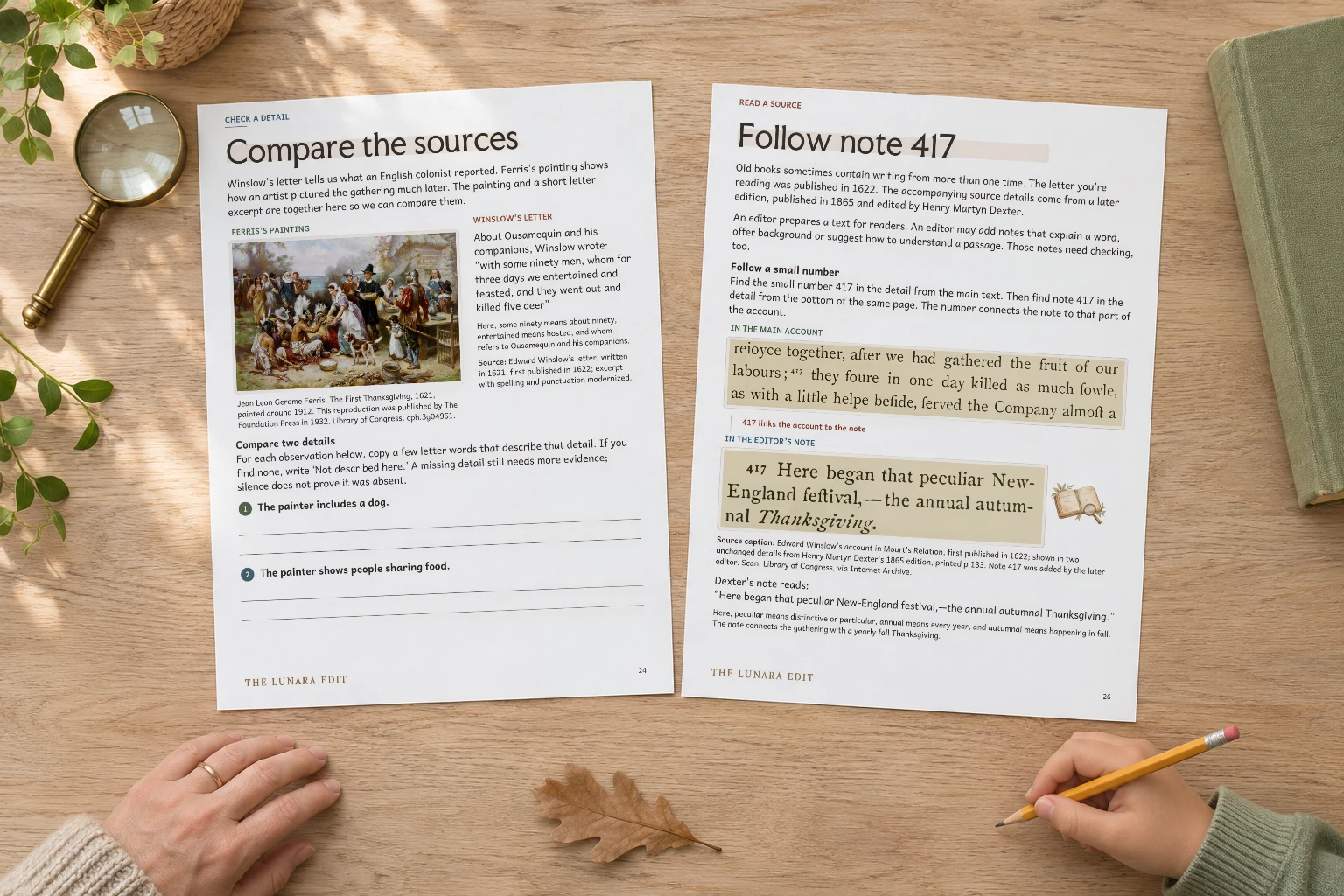
A question you can try together
Read the part about the deer aloud, then give your child a moment to look at the words.
What did Winslow say the visitors brought?
Ask your child to point to the detail they used. Winslow describes five deer.
How did the people who brought the deer feel about being there?
Ask where they would look for an answer. The passage leaves that question open. Talk about whose account could help.
You can try this aloud over a single passage. In the printed activity, children use the same process to decide whether a claim is supported, contradicted, or still open.
Follow the history beyond the gathering
After reading about the gathering, children look at the alliance, changing control over land, and later war and enslavement. The study gives families time to talk through how those changes affected particular people and communities.
There’s a separate timeline for the holiday. People gave thanks long before 1863, and the November date developed through a series of later decisions. Try asking your child which of these dates tells us when the gathering happened and which tells us how the holiday got its place on the calendar.
- 1621The harvest gathering described in Winslow’s letter takes place.
- 1863Lincoln calls for a national day of thanksgiving on the last Thursday in November.
- 1939Roosevelt moves Thanksgiving earlier. States disagree about which date to observe.
- 1941Congress sets the federal holiday on the fourth Thursday in November.
The study also introduces Wamsutta Frank James’s prepared speech and the National Day of Mourning through United American Indians of New England’s own account. Children can learn why people gather in remembrance and protest while recognizing that Native people have different views and practices.
United American Indians of New EnglandRead about the National Day of MourningKeep living communities in the conversation
The second book brings children into the present through work that Wampanoag communities choose and direct, including government, environmental care and language teaching. The Mashpee Wampanoag Tribe’s account of the Wôpanâak Language Reclamation Project explains how historical documents written in the language helped people study and teach it. A child who has been reading old records can see how those records can be used by a community today.
Mashpee Wampanoag TribeExplore Wôpanâak language reclamationLater, children learn about Cranberry Day in Aquinnah and how knowledge is shared across generations. A separate activity follows a commercial cranberry route, from growing and packing to transport and preparation. As children follow the two readings, they can notice how the work and the reasons for gathering the berries differ.
Give gratitude something concrete to notice
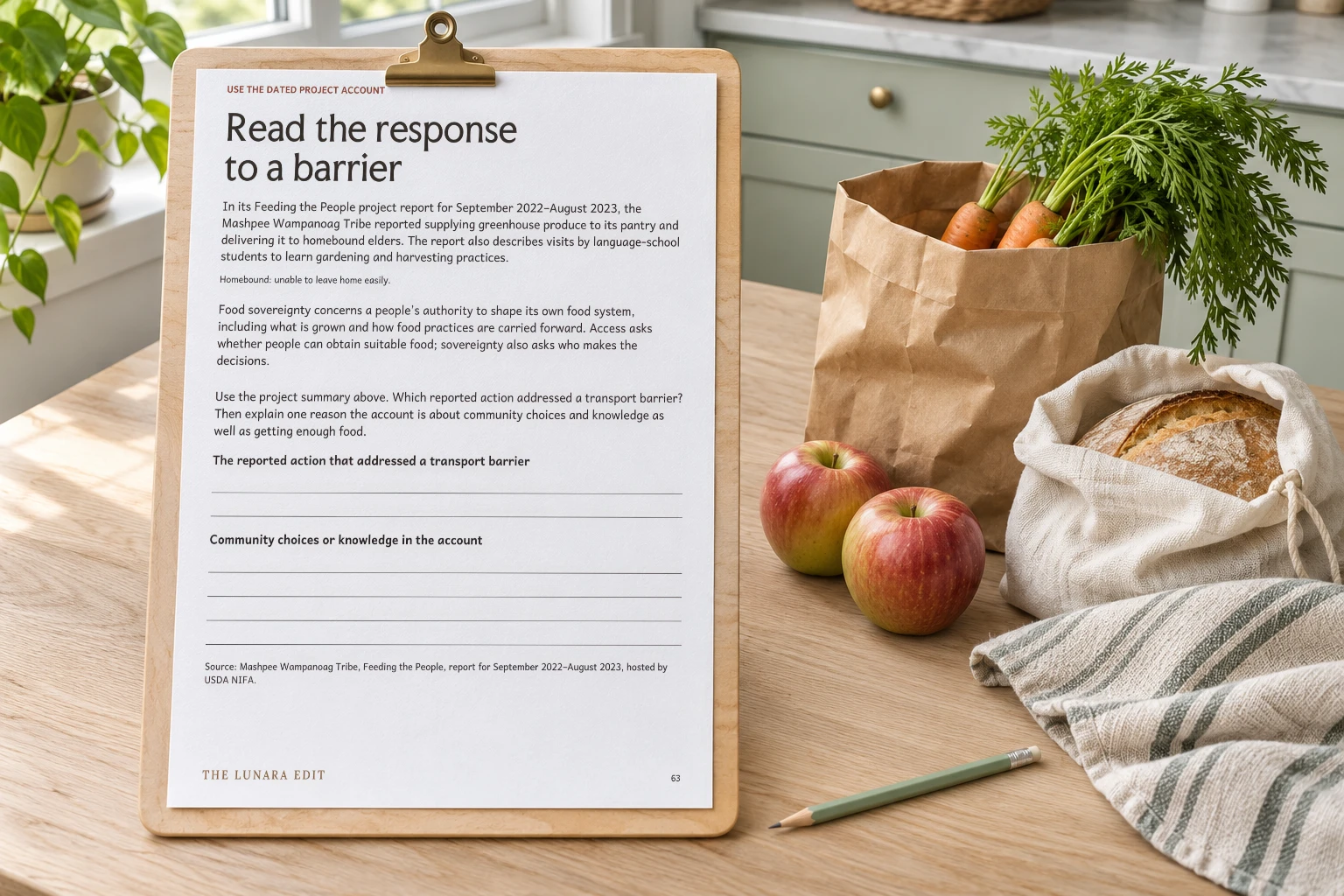
Pick one thing on the table and trace the work behind it. Who grew it, got it to the store, or made time to prepare it? Then ask what could make that food hard for someone to get or use. The third book gives children examples involving money, transport and cooking equipment, so they have something to work from if they’d rather keep their own family’s circumstances private.
For the final project, learners make a short table guide. It brings together a historical change, a named community’s work today, the work behind food, and something they appreciate alongside a concern they still have. They can write it down or talk it through with an adult.
What’s inside the printable study
The Stories at Our Table: Before We Give Thanks includes 92 learner pages and a 38-page Parent & Teaching Guide. That’s 130 pages including covers, across four US Letter PDFs.
- Part 1 32 pages
- Homelands, Encounters & Evidence
- Part 2 29 pages
- History, Memory & Living Communities
- Part 3 31 pages
- Food, Care & Giving Thanks
- Parent & Teaching Guide 38 pages
- Teaching notes, explained answers, sources and printing permissions
How it fits into your week
The guide suggests twelve sessions. You can spread them across several weeks and stop after a complete activity when a discussion takes longer. You’ll have readings, timeline cards, map and source work, sketching, and a short final project to work through.
What to set out
Skim the teaching notes first, then print the pages for your next session and set out a pencil. Read aloud or write down a spoken answer when that helps. The main activities use the included readings and images, so you can do them offline. Cutting the timeline cards is optional.
Regular price $10.00Sale price $7.50 USD25% off
USD · tax shown at checkout
Checkout with Polar
Printing and distribution
For one household or one co-op, pod, or learning group of up to 30 learners, unless the product’s own terms say otherwise. Reprint for those learners; keep complete digital files within the licensed household or group staff. The copying restrictions concern original human-authored writing and complete packets. We do not claim exclusive copyright over purely AI-generated imagery.
See the product license, safety guidance, and download support. For larger groups or a file problem, contact us.
Created by The Lunara Edit using a mix of human and AI techniques. How I create and review these resources.