HOME · WORK · DECOR & STYLING
A warmer desk without replacing everything.
A practical order for changing the light, texture, color, and visual noise around a desk — while keeping the useful pieces you already own.
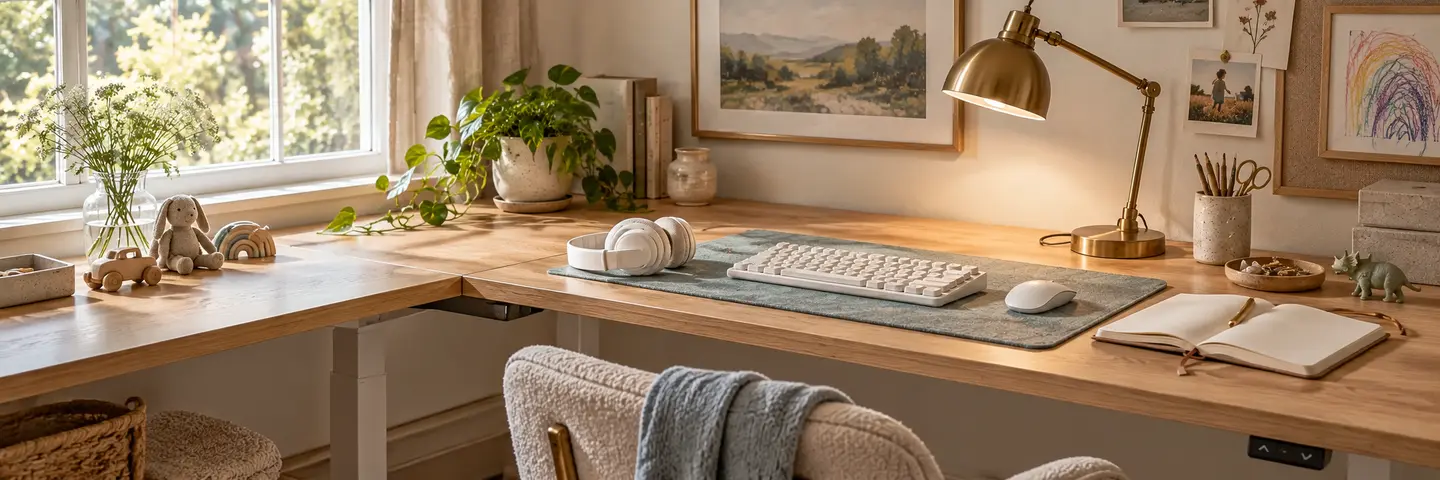
Most desks do not need a makeover haul. They need fewer competing details and one or two materials that make the hard surfaces feel less harsh.
Begin with the actual problem
“I do not like this room” is too large to shop for.
A desk can feel cold because the overhead light is sharp. It can feel chaotic because cords, school papers, and headphones all compete for attention. It can feel temporary because nothing in the space connects to the rest of the home. Those are different problems, even though they can all produce the same urge to put twelve new things in a cart.
Take one photo from the doorway before you move anything. The photo makes visual noise easier to see: bright packaging, too many small objects, a black cable cutting across a pale wall, or five finishes that never quite became friends. Write down the first three things your eye lands on. That is your starting list.
Put the maybes in a box for two weeks. If you go looking for something, return it. If you forget it exists, the desk has already answered the question.
1 · Change the light
Warmth is usually lighting before it is color.
Turn off the ceiling light and look at the desk with one lamp placed slightly behind the keyboard or to the side of your writing hand. A shade that directs light downward keeps glare off the monitor and gives the work surface a smaller, calmer pool of light. If the bulb makes white paper look blue, try a warmer bulb before changing the paint, rug, or desk.
Daylight still matters. Keep the window clear enough to use it, then let the lamp handle late afternoons and dark mornings. A brass or aged-metal lamp adds warmth because it reflects that light; it does not need a matching family of brass accessories.
2 · Soften one large surface
Choose a mat, curtain, or rug — not all three at once.
Desks collect hard materials: wood, plastic, glass, metal. One broad piece of fabric changes the balance more than several decorative objects. A felt desk mat is the easiest test because it sits where your hands already work. A woven shade or curtain helps if the whole room echoes. A rug helps most when the chair can roll on it without catching an edge every fourteen seconds.
Blue-sage, oatmeal, mushroom, faded clay, and quiet olive work well with light oak because they add color without becoming the loudest thing in the room. If every surface is beige, the desk does not automatically become peaceful. It may simply become beige.
3 · Give loose things a boundary
Contain the category, not every individual object.
One pencil cup is useful. Six tiny organizers are another collection to maintain. Group the things that travel together: current notebook and pen; headset and charging cable; school papers waiting for the printer. A shallow tray, vertical file, or drawer can hold the category without turning the desktop into a storage demonstration.
Cords deserve the same treatment. Route them toward one edge, gather the slack, and leave enough movement for the sit-stand mechanism or laptop. Perfectly invisible cables are not required. Cables that do not drag through the middle of the desk are enough.
4 · Add the part that belongs to you
A personal desk should contain evidence of a person.
Keep one or two things that have no productivity function: a child’s drawing, a small stone from a walk, a photograph, a ridiculous little dinosaur. The useful limit is not “nothing sentimental.” It is enough empty space that the sentimental thing can be seen.
Plants can do the same visual work, but they are not a moral requirement. Use a real plant if it thrives where you work, a convincing faux stem if pets or light make that unrealistic, or skip the plant and use a branch from the yard. The room will survive.
Change one large thing and live with it for a week. If the desk feels better, stop. A finished room is not one that has received every possible accessory; it is one that has stopped asking for your attention.
A simple order to follow
- Clear the surface and take a doorway photo
- Move a lamp before buying decor
- Borrow a tray, basket, or file holder from another room
- Choose one personal object to keep visible
- A warmer bulb for harsh light
- One broad textile for a hard surface
- A drawer or vertical file for recurring clutter
- A cable solution sized for the cords you actually have