HOMESCHOOL · WORK · SHARED SPACE
A real homeschool room for older kids and a working parent.
One communal table, one adult desk, two growing learners, and a room that still has to become a living room when the work is over.
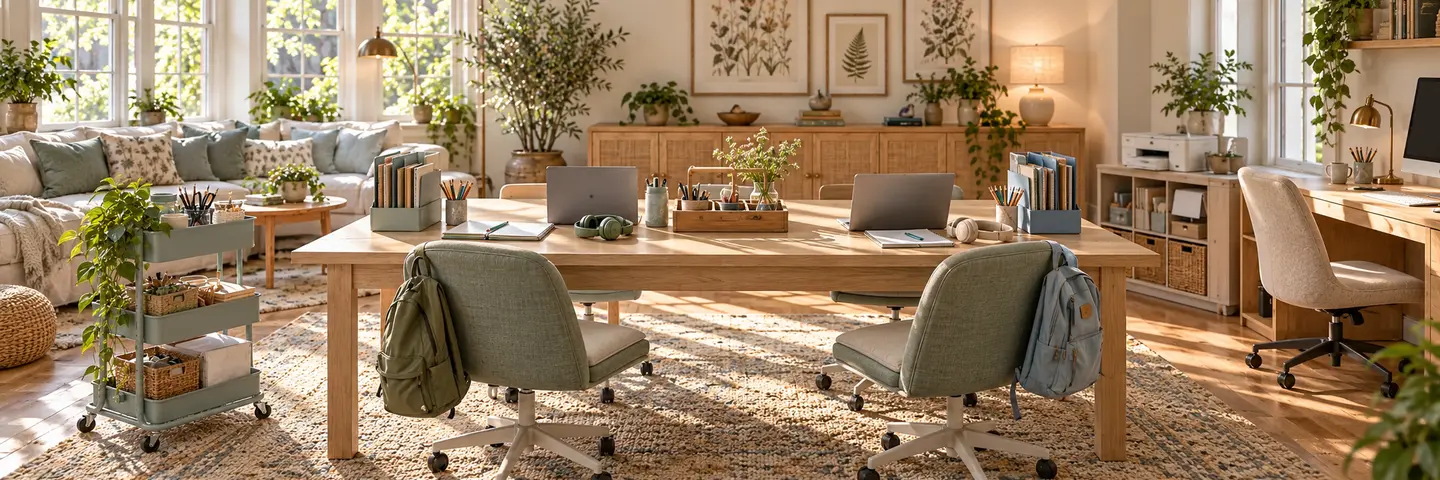
A family room does not need to look like a classroom. It needs a dependable work surface, reachable supplies, a quieter place to read, and a reset that everyone can finish.
Plan for the ages you have
Older kids need less display and more usable surface.
A room for tweens or teens has different pressure points than an early-years schoolroom. Laptops need power. Books are heavier. Projects last longer than one afternoon. Headphones, chargers, calculators, binders, and half-finished work all need somewhere to go without covering the table forever.
Start by listing what actually happens in the room during a normal week. Include the parent’s work, because pretending that desk does not count is how everyone ends up balancing a laptop beside a chemistry tray. The goal is not a dedicated station for every subject. It is a room where simultaneous work is possible and clearing it does not require a small excavation.
Computer work, handwriting and projects, reading or listening, and supplies waiting to be used.
1 · Anchor the room with one table
The table is a shared tool, not permanent storage.
A large table earns its footprint when it can hold two laptops with breathing room, open books, or one sprawling project. It does not need a matching chair set. Comfortable rolling chairs can move between the table and the adult desk, while a simple spare chair can handle reading or a visiting friend.
Give each learner one portable boundary at the table: a vertical file for current books, a handled caddy for small supplies, or a shallow tray for work in progress. When school stops, the whole boundary moves. Nobody has to sort every pencil before dinner.
2 · Put the adult desk at an edge
Nearby is useful. In the traffic path is not.
A parent desk works best against a wall or window where the chair can stay pulled out without blocking the table. Face the desk toward the room if frequent questions are part of the day; turn it slightly away if visual movement makes focused work difficult. A small angle can create more boundary than a decorative divider.
Keep the printer within reach of both zones, but not on the shared table. Paper, ink, and the inevitable mystery cord belong in the same cabinet or shelf. The printer is allowed to be visible. It is a machine the room uses, not a personal failure in the styling department.
3 · Separate daily supplies from the archive
Reachable storage should contain this week, not the entire education.
Daily books can live in the vertical files. Pens, scissors, rulers, and chargers can share a caddy or top drawer. Art materials for the current project can take one tier of a rolling cart. Completed work, reference books, backup paper, and next month’s curriculum can live farther away.
This split is what keeps a useful cart from becoming a traveling junk drawer. If every homeschool supply is “daily,” the room cannot reset. Store the archive by category and bring one category forward when it is needed.
4 · Make quiet visible
A couch can be part of the school plan.
Reading, audiobooks, oral discussion, and work that does not require a table can move to the sofa or one comfortable chair. Headphones should have a predictable hook or drawer near that spot. A soft seat gives a restless learner another posture and keeps every subject from feeling like it must happen upright at the same table.
Quiet does not have to mean silence. It means the person doing concentrated work can predict what sounds belong in the room and has somewhere to go when the table becomes too busy.
5 · End with a reset small enough to repeat
Reset the room by destination.
Put current books back in each learner’s file. Move active projects to their tray. Return loose tools to the caddy. Plug devices into the charging spot. Roll the cart home. The reset should take five minutes on an ordinary day and fifteen after a spectacularly glue-heavy one.
Leave tomorrow’s first material visible only when it genuinely makes the next morning easier. Otherwise, clear the table. An empty work surface is not wasted space. It is the room giving tomorrow somewhere to begin.
Do not reorganize every shelf. Notice where the pile forms. The pile is usually pointing to one missing home, one home that is too far away, or a category that has quietly become too large.
The useful minimum
- Two clear places to work
- One portable supply caddy
- One file or tray per learner
- A safe path for laptop cords
- An adult work edge
- A printer and paper home
- A soft reading place
- One cart or cabinet for the current week